Unknown's avatar

About Jaclyn

Reader, writer, bookaholic for life!

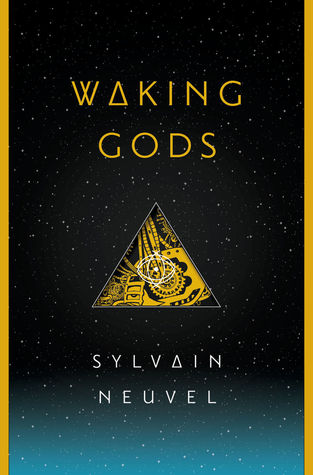
Review | Waking Gods, Sylvain Neuvel

30134847In Waking Godsgiant alien robots land in urban centres around the world. If that premise intrigues you, you should definitely give Sylvain Neuvel’s Themis Files trilogy (Waking Gods is Book 2) a try. Part of me is in total nerd heaven at the premise of this book — it’s not the military who can save us from the giant alien robots, but rather scientists. The military are all ready and eager to open fire and save the world, but it’s a task force led by a scientist who is tasked with coming up with a solution. Due to events in Book 1: Sleeping Giants, scientists have already been studying one of these giant alien robots for years, after a similar robot was discovered buried in the ground by Rose, the lead scientist on the project, when she was a little girl. Based on their study, they’ve managed to make the older robot functional, and it just needs two people in particular (a man and a woman with will-they-won’t-they romance) to operate it.

So far, so awesome. I personally would have preferred a bit more science in it. I was really excited that the solution seemed to be more an intellectual puzzle than just a straightforward action-packed battle, and in a way, this was the case as the big reveal that led to the solution had to do with science-related stuff. But most of the novel read like a Transformers movie, with stuff blowing up and teams of nameless good guys running right into the thick of danger. It’s fun and fast-paced action, and likely I wouldn’t have enjoyed too much hard-core science either, but in the beginning, I was expecting something more like Michael Crichton’s books, where there’s just enough scientific discussion to geek out over while still being accessible to non-scientists. Instead, the scientific and philosophical points here were quick throwaway lines, which makes sense given the urgency of their situation, but felt less exciting.

I’m also not a big fan of the style in which the story was told. Because there are so many characters, and lots of the chapters are told in unattributed dialogue, I found the middle of the story really confusing. I couldn’t understand what was happening, and at times, it felt like nothing significant was happening, which made the middle of the story feel really slow for me. The final third or so was the best part, where the pace finally picked up and it became an action-packed thrillfest. I compared the book earlier to a Transformers movie, and in a way, I think I would have enjoyed it more as a movie. The action scenes seem like they’d be a lot of fun to watch on-screen, and being able to put faces to the characters will be much more preferable to all the unattributed dialogue where the characters all end up sounding alike.

If you’ve read and enjoyed Sleeping Giants, you’ll likely enjoy this as well, as it significantly advances the stories of at least three of the main characters. If you enjoy giant alien robots and exciting action scenes, the final third alone makes reading the book worth it. I personally wanted more: the characters felt mostly flat, and the aliens’ motivation was fascinating but not quite as groundbreaking and impactful as I think it was meant to be. The story ended with a cliffhanger, setting up a whole new adventure for our main characters in Book 3. I’m afraid I just don’t care enough about any of the characters to be interested in what happens to them next.

+

Thank you to Penguin Random House Canada for a copy of this book in exchange for an honest review.
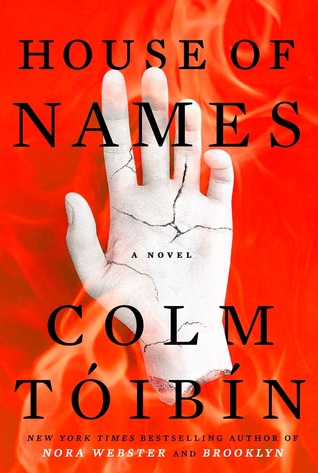
Review | House of Names, Colm Toibin

32739976Colm Toibin’s House of Names is a short but intense re-telling of the Greek myth of Agamemnon, Clytemnestra and their children. I don’t think I’ve ever read the myth, so I can’t speak about how it compares to the original. The premise of the story is compelling — a young Greek woman Iphigenia is sacrificed to the gods by her father Agamemnon in order to ensure his victory in war, and the novel follows how this event impacts her mother Clytemnestra, sister Electra and brother Orestes.

Much like a Greek myth, Toibin’s novel is emotionally charged and at times melodramatic. I was immediately sucked in by the beginning of the novel, but found the book as a whole a bit uneven in execution, and it ended up not quite living up to its promise.

The first part, told from Clytemnestra’s perspective was particularly vivid and powerful. A fierce and loving mother, she is tricked by her husband into taking Iphigenia to the battlefield to be married to Achilles, only to learn her husband’s plan to kill their daughter. Fuelled by guilt and rage, she vows revenge on her husband and solicits the support of one of the palace guards to put her scheme into motion. This section was powerful mostly because of the character of Clytemnestra, who practically pulsated on the page, she felt so real.

I particularly liked how her story highlights the unfairness of gender roles, as Clytemnestra, a powerful woman in her own right, ends up needing to use seduction to gain necessary support from another man. Worse, having already been betrayed by her husband, she finds herself betrayed by her lover as well. The actual scene of revenge is satisfying, yet her single-mindedness proves her downfall, as she is so caught up in her scheme that she fails to notice the dangers around her until it’s too late. In this, she is very much like a Greek hero with their fatal flaw, and I love what Toibin has done with this character.

In contrast, Electra and Orestes’ sections fell flat. I was particularly disappointed with Electra’s section, as she set herself up as Clytemnestra’s nemesis, and in a way, her plans were more successful than her mother’s. Given what she accomplished, I wanted her to be as vivid a figure as Clytemnestra was, a worthy opponent to such a woman. Instead, her character felt bland, almost colourless. We’re told that she was scheming and making things happen, and we see the results of her actions, but she herself seemed as much a passive observer as the reader rather than the driving force behind these events.

Orestes, who was mostly an unfortunate boy caught up in the consequences of his family’s actions, had a more interesting section than Electra’s, just because it was more action-packed. Orestes was away from the castle and had several adventures. As a character however, he was about as bland as Electra. It was his friend Leander who took centre stage in Orestes’ section, and who eventually formulated a big plan to restore order in their kingdom. Unfortunately, so much of the actual action in this section happened offstage, as Orestes is as clueless as we are, and as a result, the big climax was a surprise without any increasing tension leading up to it.

House of Names is worth a read mostly for Clytemnestra’s section, as I was actively rooting for her to win even while she was offstage. Given how Greek myths usually go, I have a feeling Toibin reversed the gender roles a bit in his interpretation of the story, so that Clytemnestra and Electra, rather than Orestes and Agamemnon, are the ones driving the story. If so, I absolutely love that change, and am curious to learn more about the character of Clytemnestra and how that may have changed over time.

+

Thank you to Penguin Random House Canada for a copy of this book in exchange for an honest review.

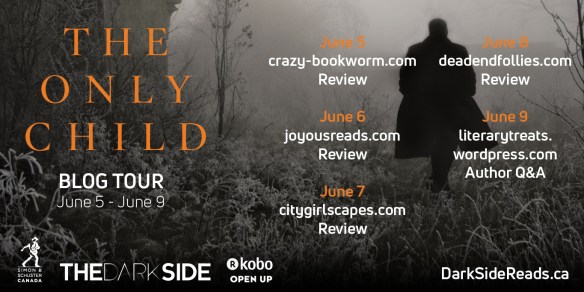
Author Q&A | Andrew Pyper on The Only Child

Only Child Blog Tour.jpg

In The Only Child, a forensic psychiatrist in New York is asked to evaluate a man who may have inspired masterpieces of classic gothic literature. Author of The Demonologist and The DamnedAndrew Pyper is one of Can Lit’s foremost horror writers today, and has built a reputation for smart and creepy reads, so I was thrilled for the chance to interview him for this blog tour.

  1. Michael inspired not just Frankenstein’s monster but a host of other characters in classic horror fiction. What do all these classic characters have in common, such that a single character could inspire them all?

For me, the three most influential novels of the gothic monster are Frankenstein, Dracula, and Jekyll & Hyde. The monsters these books featured exemplify the three main characteristics of the modern monster: the Undead, the Parasite, the Psychopath (the Devil Within). You can trace pretty much any boogeyman back to one of these three aspects. To have one real-life figure inspire these three novels, therefore, required me to devise Michael as containing version of these three monstrous qualities. He is the original monster, in the Western sense, not just because he gave Shelley, Stoker and Stevenson material to write about, but because he was a collection of this Unholy Trinity of attributes.

  1. There seems to be a sexual undertone to Lily’s fascination with Michael. Was this deliberate, and if so, what does it say about our response to evil?

Transgression has always been a motivating characteristic of the gothic. To open the forbidden door, ignore warnings, desire what is closed to you: these are the human impulses that lead us to the mansion on the moor, the dark castle, the fogbound woods. Lily’s journey in the novel is, at least on one level, a rising of the Body after a lifetime of being repressed by the Mind. Part of this is to allow herself to fantasize about Michael, at least the beginning. When she discovers he is closer to her than she initially thought possible, she doesn’t think about him in those terms anymore.

  1. In confronting the truth about her father, Lily is forced to confront some truths about herself as well. How do you think her life would have turned out if she never met Michael?

That’s an interesting question. I suspect that something would have broken Lily open at some point along the line, if for no other reason than it required too much vigilance to hold herself closed to the past, to what her body remembers.

  1. Michael is presented as a monster, but he isn’t, and has never been, fully evil. What do you think makes a monster? Would you characterize Michael as one?

For me, a monster is a being possessed of special powers (even if that power is the absence of notice of social laws and norms). But what qualifies the existential condition of the monster, regardless to how he may present himself as human or charming or emotional, is his inability to experience love.

  1. Your recent books seem to be moving away from thrillers with some horror elements to pure horror, and particularly to playing with some classical horror elements (e.g. Dante’s idea of hell, gothic monsters). What draws you to writing horror and in particular to bringing these classic pieces to the modern world?

I don’t know, I still see the playing field as psychological thrillers with the supernatural dancing around the borderlands, but it’s true that I’ve been looking at existing mythologies in the latest books. It has to do with the power of those mythologies, and their openness to augmentation and revision. To play with an existing tradition in this way is to plug into body of questions that want asking, as opposed to fixed meanings we are barred from trespassing on.

+

Thank you to Andrew Pyper for taking the time to answer my questions, and thank you to Simon and Schuster Canada for inviting me to take part in this blog tour!