

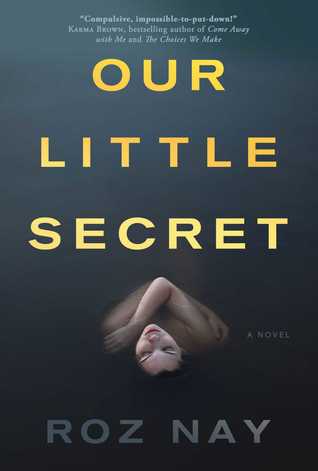
 I read so many thrillers that it’s rare for one to blow me away. Roz Nay’s Our Little Secret did. And it wasn’t so much a gripping, unputdownable page turner that sent my blood racing, but rather a slow burn build up of psychological wrong-ness. What begins as a rather innocuous break up between high school sweethearts turns into a tale of psychological manipulation and potential murder. Nay’s genius is in the subtlety of her writing and character development, such that it’s hard to pinpoint the part where things go wrong, and we have a niggling suspicion that something isn’t quite right without being able to identify what that is.
In the Author Letter that accompanied my advance reading copy, Nay writes:
Don’t we all have a time in our lives that we see as golden — that version of ourselves when we were at our best, our happiest, and our most alive? I wanted to write a novel that, whilst a page-turner, had a kind of slow yearning at its heart to which most readers could relate.
There’s something very powerful about an unwritten future; but what if the story you’d write for your life isn’t the one you end up in?
This encapsulates my experience of the novel exactly. The story takes place in a police interrogation room. The narrator Angela has been taken in for questioning about the disappearance of Saskia, the wife of Angela’s high school sweetheart HP. The story, Angela tells Detective Novak, begins not with Saskia’s disappearance, but years before, when Angela and HP first meet. Along with Detective Novak, we learn about how their friendship developed into romance, and how Angela’s choices along the way led to HP finding someone else to love.
I love how nothing dramatic happens, and how everything seems completely normal except we know that something must have gone wrong somewhere. And I love having Detective Novak as a foil to Angela’s narration — his responses give us clues to the larger story beyond Angela’s perspective.
With many thrillers, I often say it’s the ending that absolutely seals the deal for me. For Our Little Secret, while the ending is certainly strong, it’s the entire story that makes it so powerful. I love the pace of the story and its depiction of how yearning for a lost past can become a trap. Our Little Secret is such a fantastic, masterfully crafted character study, and to my mind, Angela has the potential to become one of the most compelling characters ever in the thriller genre.
Q&A with Author Roz Nay
1. How did you get the idea for Our Little Secret?
I used to teach high school and every year I’d watch the Grade 12s graduate, full of promise and excitement, so powerful. It struck me that there would always be a few kids in among them who didn’t reach their potential, and who ended up in lives they might feel weren’t theirs—or shouldn’t be. I also wanted to capture that time in a person’s life where everything is bright and vital and new. What if a character got stuck in that golden era and couldn’t quite move beyond it? I thought it might make an interesting backdrop to a crime.
2. Did you know in advance the truth behind Saskia’s disappearance, or did you have multiple possibilities in mind?
I always knew what I wanted to happen to Saskia, but I did toy with the idea of different villains. I had great conversations with my editors, Nita Pronovost and Sarah St. Pierre, but it didn’t take us long to realize there was only one real path. I couldn’t swerve away from it!
3. What, if anything, surprised you the most about the way the story or the characters turned out?
When I first wrote Our Little Secret, Olive was the victim. She was stolen—this was in the novel’s first draft, when it was first signed. As we started the edits, it became clear (because my editors have laser vision) that I’d written a novel with the wrong crime and the wrong victim. That’s pretty good, on a scale of one to very surprising.
4. There seems to me a rather delicate balance in Angela’s reliability as a narrator, which shifts subtly back and forth throughout the story. How challenging was it to create this narrative voice?
I actually found Angela’s voice came naturally, which is perhaps something I should be more worried about. You’re right, though: as fun as she was to write, she was also pretty complicated. I needed to create a shape-shifter who was also disarming and likeable. It was an enjoyable challenge.
5. How much of a role do you think Angela’s mother had in the way Angela responded to HP and Saskia’s relationship?
Oh, I think she played a huge role. Shelley is fundamental in how Angela sees the world, even though Angela would never admit it. Equally, I don’t think Shelley has a full grasp on the impact she’s having on her daughter. I like the dynamic of neither character really understanding their own relationship.
6. Do you already have your second novel in the works, or an idea for one? What will it be about?
I’ve written two more psych thrillers and I’m working on a fourth. One story I’ve written is about a baby who’s taken from his mom and her plight to get him back; the other is about a British backpacker who’s gone missing in an airport hotel. They’re both currently under consideration.
Blog Tour
Check out the rest of the blog tour reviews for Our Little Secret!
 +
+
Thank you to Simon and Schuster Canada for an advance reading copy in exchange for an honest review.
 The Hogarth Shakespeare books have been a series of hits (
 Lucy and Owen decide to spice up their marriage by experimenting with a six month open relationship arrangement. At first, all seems to be going well, with both parties noticing an increased appetite for sex yet secure in the knowledge of each other’s love. But, as has been foreshadowed practically since the beginning, things don’t quite work out as planned, and both must face the consequences of their decision.
 Set in 1972 Los Angeles, Fly Me is about a young woman, Suzy Whitman, who follows her older sister into a career as a flight attendant for Grand Pacific Airlines. Suzy skateboards and suntans on the beaches of California and falls into a drug-trafficking scheme.
 Literary Treats