
Review | The Andalucian Friend, Alexander Söderberg

coverThe Andalucian Friend by Alexander Söderberg is a fairly typical thriller. It is as “turbo-charged” and “action-packed” as the publisher blurb promises, yet it lacks the emotional punch that might’ve made it stand out.

Nurse and single mother Sophie Brinkmann unwittingly gets caught up in a world of crime and violence when her boyfriend Hector Guzman turns out to be a crime lord locked in a drugs/weapons trade war with a rival German group. Add to the mix a group of cops with shady methods and even shadier motives, and you have the makings of a real page-turner.

Unfortunately, you also have the potential to create a complete mess. To Söderberg’s credit, he does keep his multiple plot lines under tight control. Still, a lot of the story was just confusing and while the character list at the beginning of the book could’ve helped in keeping the characters straight, there just wasn’t enough differentiation between characters to care. Söderberg’s characters have obscure motives and engage in double dealing, which again could’ve been very intriguing, but instead there were just too many too soon, and with not enough at stake to make you care. Similar types of stories succeed by having at least one character who anchors the whole story, and whose fate keeps us glued to the pages, for example Smiley in John Le Carre’s novels or Lisbeth Salander in Stieg Larsson’s trilogy. Presumably, Sophie was meant to anchor this novel, but even she got lost among the large cast.

The book does get better — Söderberg just takes his time to get there, but eventually we do get to know some of the characters better, they become more distinct from each other, and the twists have a bit more of an impact. Particularly strong is the subplot about Sophie’s son, and how his life is turned upside down by his mother’s connection to Hector Guzman. The final few chapters are the best part — Söderberg ramps up the adrenaline and all the various subplots come crashing together. The climax is a bit of a typical resolution scene in a shoot ’em up TV show or movie, though the descriptions are a bit gorier than network TV.

Overall, not a bad book. The beginning is confusing and the characters weren’t well developed for most of the story. The language is also a bit clunky, which could’ve been a translation issue. It might have worked better as an action-thriller movie, where character development, particularly for minor villain characters, doesn’t matter as much, and where the high-adrenaline scenes might have had more impact. Still, the character revelations near the end of the book are interesting, the subplot regarding Sophie’s son is unexpectedly moving, and the action-packed pace did keep me reading. Andalucian Friend is an okay book, just not a memorable one.

+

Thank you to Random House Canada for a copy of this book in exchange for an honest review.
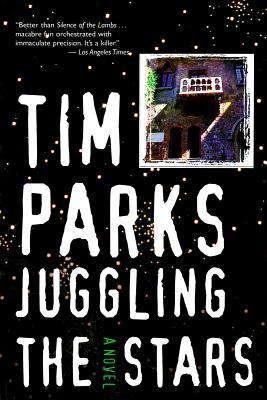
Review | Juggling the Stars, Tim Parks

16284886Juggling the Stars by Tim Parks has been compared to Patricia Highsmith’s Ripley series, and rightly so. Parks’ protagonist Morris Duckworth has neither Ripley’s skill, nor charm, but he does have Ripley’s aspiration for a better life. An English tutor in Italy, Morris views his wealthy clients with envy and disdain, believing himself more deserving of their wealth and helping himself to some of their possessions.

The story takes off when one of his students falls in love with him and her mother forbids the relationship. The student then runs away with Morris, and Morris concocts a complicated scheme where he pretends to have kidnapped her and sends her family ransom notes. Morris’ lies quickly catch up to him, and he has to keep spinning more and even more convoluted tales just to stay ahead.

Juggling the Stars is a quick, fast-paced thriller. It’s fascinating to see how much more Morris’ plan can go wrong, and to see what new plot he comes up with to extricate himself. And when his plan starts spiralling completely out of his control, the consequences are fatal.

The story isn’t chilling — for all his malice, Morris lacks the skill to be a truly malevolent villain. He’s a Ripley wannabe more than a Ripley character, and to the author’s credit, that seems to have been the author’s intent. Morris’ girlfriend (the student who runs away with him) may have made the stupid decision to go with Morris, but is surprisingly sharp in her assessment of him — he “feels inferior,” she tells her mother, and later on tells Morris he’s sucking up too much just because someone is rich. He’s a rather pathetic figure, yet sympathetic in a way because he’s just trying so hard to get rich and yet so many things are going wrong.

The result is a fun read, a quick page turner that will translate really well to the big screen. There are alternating bursts of humour and of horror, and despite all his crimes, a protagonist you root for.

+

Thank you to Thomas Allen Ltd for a copy of this book in exchange for an honest review.

Review | The Supremes at Earl’s All-You-Can-Eat, Edward Kelsey Moore

coverOn the back flap of Edward Kelsey Moore’s The Supremes at Earl’s All-You-Can-Eatthe author writes that the story is rooted in childhood memories of “eavesdropping on the women of the family as they talked at family gatherings.” Indeed, reading the book feels like being at a family gathering filled with loud, warm-hearted aunties eager to share the latest gossip. Supremes is a charming book, and a lovely reading experience.

Odette, Clarice and Barbara Jean are old friends who still meet weekly at Earl’s All-You-Can-Eat. Odette can speak to ghosts (including a hilarious Eleanor Roosevelt who likes to hover near people who are near death), Clarice’s husband is cheating on her, and Barbara Jean battles alcoholism. Moore has a gift for characterization — each woman and her personal story feels real, and you can almost imagine them across the restaurant from you. The story is set in a small town, and the diner setting as well as the way the townspeople all seem to know each other, give the story a lovely, timeless feel, even in the more contemporary sections. 

Odette in particular stands out as a friend one would love to have. She’s loud, funny and not afraid to tell you exactly what she thinks. If you’ve read The Baby Sitters Club, imagine a large, African American, more blunt, version of Kristy Thomas. So when a serious illness and the ghost of Eleanor Roosevelt (to Moore’s credit, he pulls off what could’ve been a cheesy plot device) force Odette to face her own mortality, the sudden glimpse into her vulnerability is heartbreaking. In true Odette style, however, she continues to be her sharp, wisecracking self, making the reader wish even more than ever that Odette somehow can defeat even death.

I loved reading the stories of these women. Their experiences, in many ways, are so far from my own, but the book still made me think of my own high school friends, and how we would imagine a future where we’d all still be as close as we were in school. Unlike Odette, Clarice and Barbara Jean, my high school friends and I no longer live in the same town, nor even in the same country, and so years can go by before I get to meet up with them. We’re still really close — and I feel very fortunate in that regard. Still, reading Moore’s book made me wish I had my own Earl’s All-You-Can-Eat. A place I can go to once a week, a second home I’ve had since childhood, and a tradition that my friends and I have formed years ago and still manage to keep alive. There’s an appeal in that constancy, somewhat like a real-life Pop Tate’s that has somehow never gone out of business. Moore’s book is set in contemporary times, but there is such a timeless feel to it.

It would be naive to say that Moore’s story calls to mind a simpler time. The lives of its three protagonists are certainly far from simple — they deal with racism, gender inequality, adultery, and even the strength of their friendship isn’t enough to combat these. And yet this book is a comfort. There is such a feeling of family and friendship and a sense of permanence we look to ascribe to certain places. Moore draws us into this world, and we recognize something of our own lives in it, and we just really, really want to stay.

+

Thank you to Random House Canada for a copy of this book in exchange for an honest review.