
Review | Forgive Me, Leonard Peacock, Matthew Quick

13477676

How can I even begin to describe what an emotional wallop this book is? Ever since the success of We Need to Talk About Kevin, other authors have tried their hand at school shooter stories, and stories of teenagers who don’t fit in are a dime a dozen. Matthew Quick’s Forgive Me, Leonard Peacock however stands out — not only does the author succeed in portraying a despair so deep one actually feels what drives Leonard Peacock to take a gun to school, but he also manages to keep Leonard fully, vulnerably, human.

When we think of school shooters, we imagine either complete psychopaths like Kevin, or emotional wrecks who can’t take it anymore. Instead, Quick creates a quiet, troubled young man whose motivations for committing murder-suicide are far more complex than simply his pain at being an outcast. The book works because of its subtlety and humour; its very restraint creates emotional impact.

It is Leonard Peacock’s eighteenth birthday and he will be taking his grandfather’s P-38 WWII Nazi handgun to school so he can kill his best friend and then himself. As the novel begins, the handgun lies beside Leonard’s bowl of oatmeal “like some weird steampunk utensil anachronism.” He takes a photo with his iPhone, “thinking it could be both evidence and modern art.” Then, he tells us,

I laugh my ass off looking at it on the mini screen, because modern art is such bullshit.

I mean, a bowl of oatmeal and a a P-38 set next to it like a spoon — that arrangement photographed can be modern art, right?

Bullshit.

But funny too. [p. 1]

In the space of its first few paragraphs, the book already manages to convey so much. The horror of the handgun is set beside a bowl of oatmeal, possibly one of the most innocuous objects in the world. The incongruence is troubling, and Leonard’s amusement at the image reflects his bleak outlook. His thoughts on the modern art being bullshit hint at a larger disenfranchisement with the world, and even though he laughs, one already begins to wonder at the pain beneath his words.

Before Leonard shoots his best friend, however, he plans to give gifts to four very special people in his life — his Humphrey Bogart-obsessed neighbour Walt, his classmate Baback who is a talented violin player, the Christian homeschooler Lauren whom Leonard has a crush on, and high school teacher on the Holocaust Herr Silverman. Even more than his plan to shoot, it is Leonard’s interactions with these four that form the heart of the book. Each encounter holds the potential for Leonard’s salvation — not in a religious sense, but certainly in an emotional, somewhat spiritual one. Each time Leonard gives a gift, even though he tells us it’s only so they can remember him after his death, we feel his need for connection, and we sense that he’s yearning for something from each of these friends that he may not be able to define, but if received, may make him change his mind.

These scenes therefore become more painful, because we initially see the relationships only through Leonard’s eyes, and it is only when he offers his gifts that we — along with Leonard himself — are treated to the reality of how each of these friends sees him. While some may offer some hope for actual connection, others spurn him, in a way that almost seems cruel until we realize how Leonard’s actions must seem from their point of view. Quick immerses us into Leonard’s psyche, but not so deep that we can’t see the reality of who he is to other people, and while we sympathize with him, we can’t help but sympathize as well with those who maintain their distance.

The major standout in this book is Herr Silverman. Everyone should have an Herr Silverman in their lives. Here is a teacher who goes far beyond the call of duty for his students; here is a man who genuinely cares about other people, and is willing to go out of his way to make sure you are all right. His story made me cry, and as for his scene with Leonard near the end… It moved me. I can’t even express how emotional I got reading that scene, partly I think because I have become so embedded within Leonard’s psyche, but also because I realize how much the world needs more Herr Silvermans in it, and how much everyone should be so lucky as to encounter a Herr Silverman at least once in their own lives. In a book where the protagonist has built such rigid walls of defence, to the point that he can look at a handgun and laugh, Herr Silverman’s presence is a welcome reminder that no matter how bad the world seems, it will never be all bad.

Reading this book is a profoundly moving experience. I rarely say this, but I already wish there was a movie adaptation, with Ezra Miller playing Leonard Peacock, because he’s the only actor in that age group I can think of who has the ability to portray both Leonard’s darkness and vulnerability. I tweeted my wish for a movie, and Matthew Quick himself responded that one is already in the works:

I’m keeping my fingers crossed!

+

Thank you to Hachette Book Group Canada for an advance reading copy of this book in exchange for an honest review.
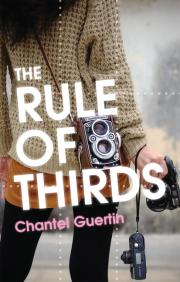
Review | The Rule of Thirds, Chantel Guertin

9781770411593Sixteen year old Pippa Greene is an aspiring photographer preparing for the competition Vantage Point, where the top two entrants will gain admission to Tisch Camp, a pre-university training course at Pippa’s dream school. She also has to volunteer at a hospital, a place that still gives Pippa panic attacks — literally — ever since her father’s unsuccessful battle against cancer. Pippa is also keeping a secret from her best friend/aspiring supermodel Dace: despite their long-ago pact to be a fashion photographer/supermodel tandem, Pippa finds herself drawn to a different type of photography, featuring objects that deal with the theme of memory. Finally, Pippa is torn between two boys: fellow aspiring photographer Ben and musician/potential slacker Dylan.

There’s a lot going on in Chantel Guertin’s The Rule of Thirds but not much reaches its potential. The love triangle is forced — it’s pretty obvious throughout whom Pippa really likes, and it’s just a matter of time before the characters figure it out too. The conflict between Pippa and Dace also seems rather forced. I do remember being a teenager, and how important such best friend pacts are. But there just wasn’t enough lead up in this book; when this situation comes to a head, I was mostly wondering where all the drama suddenly came from.

Near the end, someone does something pretty horrible, and when the person explains their motives, something tells Pippa she’s still not getting the whole story. According to the back cover, this is the first book in a series, so perhaps that unresolved plot thread will be picked up in a later book, but considering the extent of the act, I wish it could have been explored more. As well, that particular plot point leads to a really far-fetched action-adventure scene, involving a drunk individual who miraculously maintains their wits and balance. Not necessarily a bad scene, but when compared to some really strong quieter moments, a disappointment.

That being said, there are several things that Guertin does really well in this novel. I love the text conversations between Dylan and Pippa — the flirtation over gross food is adorable, and I love Dylan’s understated wit. For example, after an aborted date where Pippa has a panic attack at an ice cream parlour, he texts: “Thank you for saving me from what’s obv. v. bad ice cream. A bit dramatic but I’m impressed by ur dedication to cause. (U OK?)” [p. 120]

I also love Pippa’s reflections on dealing with her dad’s cancer. For example:

I felt special. I was the girl whose dad had cancer.

And then when I realized I was about to become the girl whose dad died of cancer, I stopped feeling anything at all. [p. 137]

Beautiful and potent.

Finally, I like the bits about photography. Another character makes a snarky comment about Pippa’s chosen theme of “Memory” and indeed it is beyond cliche. However, I do like how the act of taking pictures centres Pippa. The title of the book should be familiar to anyone with a visual arts background (the Rule of Thirds on Wikipedia), but it did set up the expectation that the protagonist would be a photographer extraordinaire. She is a good photographer, and certainly well-versed in the mechanics of composition (at one point, she observes that a fellow photographer’s work shows no sense of composition, and is just a regular photo of trees). However, I do wish she’d come up with a more unique theme than Memory. Something Claudia Kishi-level unexpected, but her talent makes it work.

Still, there’s this passage that I found very striking:

Who can remember every photo they’ve ever taken? I can. There’s an iPhoto album in my brain where very single one is collated and tagged, easy for me to call up — the composition, the thinking process, the set-up and capture. And I’d certainly remember a shot like [that]. Any real photographer would. It’s a great photo. [p. 134]

I modified the original quote somewhat to avoid anything remotely spoilerish, but the point remains. And will possibly resonate with any photographer, or any artist really, who reads this.

Overall, The Rule of Thirds has some really good moments, but still ends up trying to juggle too many elements that don’t really come together.

+

Thank you to ECW Press for an advance reading copy of this book in exchange for an honest review.

Review | Dial “M” for Morna, Evan Munday

Full disclosure: I absolutely adored the first book in this series. So much so that as early as last year, at the Toronto Comic Arts Festival, I bugged the author to tell me when Book 2 would be published. Then, in May, I happened to meet his publicist at another author’s book launch, and again I bugged her for the release date of Book 2. She agreed to send me an ARC, and yes, I’m afraid I emailed her a week later to follow up and she admitted the ARCs weren’t even ready for mailing yet. So, to author Evan Munday and to his publicist: my apologies. I’m not a creepy stalker reader fan, I promise. But really, you publish a book about a Scooby gang of dead kids and a goth tween named October who is writing a book called Two Knives, One Thousand Demons, you do expect some rabid fangirling, don’t you?

Full disclosure number two: I already want to read Book 3.

9781770410732Dial “M” for Morna picks up about a few weeks after the events in Dead Kid Detective Agency. The next full moon is coming up and October is no closer to fulfilling her promise of solving the mystery behind Morna’s death. And as if solving a 100-year-old murder mystery weren’t challenging enough, October’s friend Yumi finds herself the target of anti-Asian harassment at school.

In my review of Dead Kid, I said that the mystery was more Scooby Doo than Agatha Christie — not much of a puzzle, but still an awesome ride. Munday sharpens his mystery writing skills with this volume, which is much more atmospheric than the last one. With the help of an awesome young history teacher (a Battlestar Galactica fan who wears Buddy Holly glasses), October uses a microfilm station to research Morna’s life. Yes, a microfilm. I’ve never used one (librarians, please tell me they still exist!), but the reference did take me back to Sweet Valley and Elizabeth Wakefield. I loved the historical research — October finds an old diary, a war memento, and other items that just thrill my geeky little heart. Seriously, that’s my type of mystery. Even the contemporary mystery about racial harassment has more of a Nancy Drew feel than the last book, and what Munday gives up in terms of madcap hilarity, he more than makes up for in a deeper, more complex mystery.

Dial “M” also features a mysterious, pre-rotary dial phone in the abandoned boarding house where Morna used to live. For some reason, it only works for October, and a voice on the other end provides her with cryptic clues along the way. I’ll be honest: this supernatural Deep Throat completely freaked me out. And when you’re a thirty year old woman huddling under the covers, terrified of having nightmares from a book written for 9-12 year olds, well, it’s rather tough on the ol’ ego. According to the author, “That phone was inspired by one of the more terrifying episodes of The Twilight Zone I remember from my youth.” Munday does manage to capture that Twilight Zone feel, at least for this reader, and I was never more glad to see the jokey narrator come in and break the mood.

There were some things I didn’t quite like in this book. First: the big reveal about Stacey Whatshisname’s last name. From October’s utter inability to remember it for over a book and a half, I was expecting something like Spock’s last name, so Stacey’s last name turned out to be a letdown. I do see the point in concealing it, plot-wise, but I still didn’t think it was necessary. The other point didn’t bother me so much as puzzle me, and I know it was the same with the first book, but for some reason, I wondered more about it with this one: why split the narration between October and the unnamed narrator? I like both narrative voices, but the assigning of narrative to one or the other seems mostly arbitrary.

Ultimately though, there are two things that make the Dead Kid series so awesome: Munday’s wit and unexpected moments of tenderness. I love the bit about Morna’s crush, and the scene where she asks for a vest almost made me tear up. I love the scene where October, who doesn’t approve of her father’s current girlfriend, asks him if he’s happy. I especially love the romance I sense (or perhaps wish for) beginning to develop between Yumi and Stacey (go, Stacey, go!). Surrounded as they are by creepy telephones and throwaway wisecracks, these moments stand out, and the story is richer for them. And as for the wit, well, here’s something to take with you next winter: “the snow was fiercer than Tyra Banks’s stare.” [p. 241]

As the two mysteries begin to wrap up, a larger mystery begins to emerge, one that seems like it will span the rest of the series. In true Evan Munday style, this larger mystery promises to end up Buffy the Vampire Slayer type epic. That’s awesome enough to make me almost forgive having to wait several more books before seeing it resolved. Almost. Finally, Munday ends on a hell of a cliffhanger, which means that once again, I’m ridiculously excited to read Book 3. When I tweeted him about the ending, he responded: “I’m the worst, right?” Well yes, yes you are, Mr. Munday, and as a fan of the series, all I can say it, thank god for that.

+

Thank you to ECW Press for an advance reading copy of this book in exchange for an honest review.