
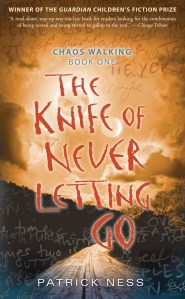
The Knife of Never Letting Go (Chaos Walking Book One), Patrick Ness #50BookPledge

Imagine a world where you can hear what everyone else is thinking, and they can hear everything you are thinking. You can’t shut it off, it’s an endless barrage of Noise, and most of what you hear are thoughts of pain and grief. That’s how it is in Prentisstown, where all the female settlers are dead and the Noise virus has left the males with the ability to hear each other’s thoughts and the thoughts of animals.

The only remaining boy in a town of men, Todd Hewitt is a month away from his thirteenth birthday and officially becoming an adult when he and his dog Manchee encounter an odd pocket of Quiet near a river. When Todd’s adoptive fathers Ben and Cillian find out about it, they pack Todd some food and his mother’s journal and order him to take Manchee and get as far from Prentisstown as possible. Turns out that a lot of what Todd believes is actually a lie, and Prentisstown has a terrible secret in its past, and the Mayor is pulling out all the stops to bring Todd back.

Knife is a powerful book, especially because we’re thrust right into Todd’s perspective. I especially love the scenes where the book describes the Noise – the overlapping lines of text in varying fonts are a veritable cacophony. I’m usually a big fan of e-reading, but the image of Noise contained within the mechanical boundaries of the e-reader screen just does not compare to the splash of words words words practically spilling over the edge of the page. Patrick Ness uses this sparingly – most of the time, he focuses on a particular character’s Noise, signified by a different font – and when he does, we are just sucked into the chaos that Todd must endure every day. Faced with the visual representation of this chaos, we can feel the desperation in Todd’s constant repetition of the mantra “I am Todd Hewitt.”

Todd speaks in a rough dialect, and Ness expresses this through his spelling. I normally don’t mind deliberate misspellings as long as the purpose is clear and consistent, and I was fine with a lot of it in Knife (e.g. “yer” instead of “your”). For some reason, “-tion” spelled “-shun” (e.g. “stayshun” instead of “station”) really bugged me, and I think it’s because I’d imagined this narrative to be primarily oral (Todd is literally telling his story) and I don’t hear enough of a difference to justify that particular misspell. That being said, about a third of the way through, I hardly even noticed it anymore, which I guess means the book really did suck me in completely. Interestingly, Todd later meets a character whose pronunciation is more conventional, and when that character tries to correct Todd’s grammar, Todd gets very defensive. I liked that; Todd’s dialect then became not just a writing gimmick, but more of a cultural stance. A friend told me he saw the unconventional spelling and grammar in Knife to mean that the old rules, what we thought of as rules in our world, just no longer applied.

Minor comment, I love how Manchee’s speech is limited mostly to “Poo” and “Squirrel.” So many books with talking animals treat them mostly as humans in animal form. I have no problem with animals able to speak intelligently (I love Snoopy, for example), but limiting Manchee’s language makes him just a creature of such boundless joy and friendship, a welcome Noise of innocence and happiness in such a confusing, dangerous world.

Ultimately, Knife works because it dares to ask the questions: how far are you willing to go to survive, and how far can you go without losing yourself? Faced with the opportunity to kill a man who wants to kill him, Todd says “But a knife ain’t just a thing, is it? It’s a choice, it’s something you do. A knife says yes or no, cut or not, die or don’t. A knife takes a decision out of your hand and puts it in the world and it never goes back again.” The decision of whether or not to kill has even more significance than Todd can begin to imagine, and he faces this decision over and over as he struggles for survival. Having a knife becomes a moral dilemma, one that haunts Todd and forces him to reflect on what makes a boy into a man.

It’s a fantastic book, first in the Chaos Walking trilogy. It felt a bit long at some points, but just when my attention drifted, something major happened that snapped me right back in. Knife ends on a cliff-hanger, with a very interesting, unexpected development that promises an exciting beginning to Book Two.

The Gathering, Kelley Armstrong #50BookPledge

I was fortunate enough to be able to attend the book signing and pre-launch sale of Kelley Armstrong’s The Gathering. I’ve been to quite a few book events, and I have to say, I’ve rarely met anyone so eager to chat with their fans. Kelley must have been exhausted – I was tired and all I did was stand in line! – but when I saw her, she was still as chatty and cheerful as she was when the event began. Love that.

Even better, she answered a ton of fan questions. As almost a brand-new Kelley Armstrong fan (so far, I’ve read Bitten and The Gathering, and still have the rest of her books on my To Be Read list), I was torn between covering my ears to avoid spoilers and realizing I would completely forget these spoilers by the time I get around to reading her other books. Still, one thing she said stayed with me. When asked about writing supernatural characters, she said she doesn’t think about it that way. It’s not about “Ooh, I’m a werewolf, let’s see what cool things I can do!” Rather, it’s about how an ordinary person who happens to be supernatural deals with living in this world. “If you or your friend happens to be a werewolf,” she asked, “how would you live?” How would you shop, eat, work… what would your day-to-day existence be like?

That’s when I realized why I love her books so much. Bitten is about a female werewolf trying to live in Toronto, and The Gathering is about Maya, a seemingly ordinary teenage girl in a tiny (population 200) town in Vancouver Island. [Spoiler alert, though this shouldn’t be a spoiler for anyone familiar with Armstrong’s work: Maya isn’t an ordinary girl. Hint: she has a paw print birthmark.] It’s the ordinariness of the situations in which Elena and Maya find themselves that make them such relatable characters.

I love The Gathering. I love how Maya is such an intelligent, savvy teenage girl. Maya doesn’t have to deal with the dystopian society Katniss faces in The Hunger Games, but Maya strikes me as a very similar character. She’s also strong and smart. I read a lot of books where heroines get caught up in really dumb situations, usually for comic effect, and I don’t usually mind. But Maya is totally not that kind of heroine – she carries pepper spray, and when she encounters a suspicious looking stranger, thinks, “He had a gun. This was the time to run, not fight.” She’s practical rather than emotional, strategic rather than hysterical. I feel old for thinking this, but if I ever have a daughter, I want her to be that capable at taking care of herself.

As with Bitten, The Gathering has its share of hot guys. Unlike Bitten though (Team Jeremy!), I honestly couldn’t choose between best friend Daniel and bad boy Rafe. Both are smart, caring, vulnerable, and equally capable of kicking ass. The story is intriguing: a “reporter” comes to Maya’s town and is interested for some reason in the teenagers, the town has a medical research lab that you just know is up to something shady… Oh, and Maya’s adopted. She’s happy with her adoptive parents, but again, you just know something interesting about her biological parents will be revealed. Unlike Bitten, The Gathering ends on a bit of a cliff hanger, which is somewhat frustrating – I want to know more! Now!

Bright side, I do have quite a few other Kelley Armstrong titles I can read while waiting for the next book.

Spells, Aprilynne Pike #50BookPledge

Spells is the second book in Aprilynne Pike’s YA series about Laurel, a sixteen year old girl who just recently discovered she is really a Fall fairy. She has a human boyfriend, David, and is very much attracted to a fellow fairy, Tamani. As a Spring fairy, Tamani is below her in the fairy social hierarchy, so there’s an interesting tension between him being her guide to the fairy world, and thus someone on whom she depends, and him having to walk behind her and having to ask her to ask him to dance. Spells has Laurel spending a summer in the fairy world and learning how to be a fairy. When she goes back to the human world, she then has to deal with trolls, and with David encouraging her to live a more fully human life.

I didn’t read Wings, the first book in the series, but it’s fairly simple enough to catch up, with Pike giving enough background to keep me in the loop without boring those who have read Wings. I did have some unanswered questions though, which I suppose must have been tackled in Wings – what’s this land that Laurel is supposed to protect, why are the trolls after it, and is there any reason (other than her being the only fairy raised as a human) that Laurel is special to the fairy world?

There are some interesting elements in the story. I like how Pike depicts Laurel’s more complicated relationship with her parents now that they know she’s a fairy; Laurel’s mom’s reaction in particular is very realistic. I also like the social hierarchy in the fairy realm, mostly because it enhances the Tamani/Laurel romance. Laurel is clearly uncomfortable with it, and there’s the hint that Laurel may some day lead a fairy revolution. I enjoyed learning about the fairy world, especially about the potions class.

That being said, Spells didn’t grab me. Possibly, there was just too much fairy school and not enough troll-fighting, but I actually liked the fairy realm parts all right. I think it’s more that with such amazing YA series in the market (Hunger Games, Harry Potter, Percy Jackson and the Olympians), this one just pales in comparison. Spells has an okay story, with okay characters and some interesting elements, but it’s nothing special. If you’re an Aprilynne Pike fan, or a fan of fairies in general, and you think you’ll be interested in this story, the paperback of Spells and the hardcover of the third book in the series, Illusions, are both coming out this April.