
Review | Son (The Giver #4), Lois Lowry

lowry23cutI can’t even begin to explain how much this book means to me. Lois Lowry’s The Giver changed my life when I was 14 (see story here), and reading Son feels like coming full circle. One of the reasons The Giver resonated so much with me is that I read it when I was fairly close to the age of its protagonist Jonas. So you can imagine the chill I got when, reading Son at 29, I realized that I must again be fairly close to the age of Jonas in this story. I’ve grown up with these books, and reaching the end of this series feels, in many ways, like ending a chapter in my own life. Son is a far more adult, far more sombre book than The Giver, or perhaps I have just grown up. [Minor warning: there will be spoilers about The Giver in this review.]

Son brought me to tears. From the very first line: “The young girl cringed when they buckled the eyeless leather mask around the upper half of her face and blinded her,” Son transported me right back into Lowry’s world, but a much darker, more frightening one than what I remember from The Giver. The “young girl” is Claire, fourteen years old, assigned to be a Birthmother. I can’t imagine being a mother at fourteen; worse, I don’t even want to imagine being twelve and being told that the only thing I have left to do in life is create a set number of babies, then retire.

Despite its title, Son is really about a mother, Claire. Her son is Gabe, the baby in The Giver who wasn’t performing at par with his age group and so had to be “released” (killed). At the end of The Giver, however, Jonas takes Gabe with him when he leaves town. Here’s the thing: as Gabe’s Birthmother, Claire isn’t supposed to see him again after birth — she wasn’t allowed to hold him, or even know his gender. Instead, she’s supposed to take pills to numb the pain of loss.

I’m not a mother, and I can’t even begin to imagine how that would feel. I have, however, lost my own mother recently, and that may be partly why Claire’s story resonated so strongly with me. I almost cried, and I also wanted to cheer, at the Claire’s resolution not to take the pills: “She would rather die, Claire realized, before she would give up the love she felt for her son” [page 116]. When Jonas takes Gabe away with him, Claire follows, and her quest, even though it’s just to a simple fishing village, felt powerful. Lowry’s way with words is nothing short of magic, making Claire’s journey feel as epic as a Tolkien narrative. Take for example the following conversation:

“It will be a long time,” he told her, “to make you ready.”

“I know.”

“Not days or weeks,” he said.

“I know.”

“Mayhap it will take years,” he told her. “For me, it was years.”

“Years?”

He nodded.

“How do I start?” Claire asked. [p. 209]

The language is that of fairy tales and legends. Lowry takes something as ordinary as the love of a mother for her son, and reveals just how extraordinary it really is.

In her speech at Book Expo America 2012 about Son, Lowry says that she wrote The Giver as a response to a question from her own son, a soldier who died in battle, who’d asked her why evil exists in the world. She had no answer. But evil does exist in Son, and while Claire faces evil, it will ultimately be up to her son Gabe to defeat it.

Evil, in Son, takes the form of the Taskmaster, who promises to fulfill a wish, but will require payment of your most valuable asset. In some people, payment will take the form of their kindness, in others, youth. And generally, whatever they receive turns out not to be worth what they gave up. The Taskmaster is a classic figure in literature, and with her simple, lovely language, Lowry makes us feel just how much is at stake here.

We do meet Jonas again; he is an adult now, and his new perspective of the world reminds me of just how much I’ve grown myself since I first began these stories. Son feels both epic and personal, and reading it is just an overwhelming experience. We want the Taskmaster to be defeated because, even though we know it’s fiction, even though we know evil will always exist in the real world, Lowry has immersed us so much in her world that whatever the outcome there is, it matters. Call it superstition, call it sentimentality, but I couldn’t help feeling that if only Gabe defeats the Taskmaster, perhaps a bit of the evil in the real world can also be defeated. Unrealistic yes, but Lowry’s words have a way of bringing out the child in her readers, the child that still believes in hope.

Son is probably one of the most powerful books I’ve read all year. The Giver changed my life as a child. Son brought me back to who I was — and in many ways, felt like the end of a chapter in my own life. Has reading Son changed me as an adult? Possibly, but unlike my experience with The Giver, I can’t even begin to tell you how.

Lois Lowry’s amazing, heartbreaking speech at Book Expo America 2012:

Evil does exist, it has always existed, and we will fight it again and again. And in every generation, it is the young who come forward and try to bring an end to it. It’s fiction, of course, the happy ending… [But] young people, young readers believe they can fix the world.

+

Thank you to Thomas Allen Ltd for an advance reading copy of this book in exchange for an honest review.

[All quotes and page numbers from Son in this review are from the Advance Reading Copy.]
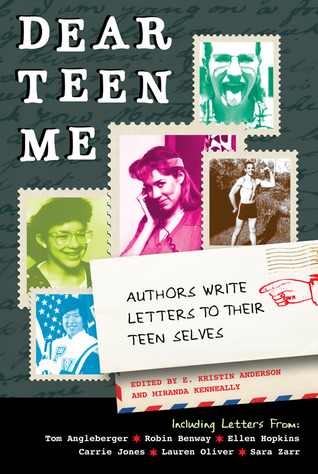
Review | Dear Teen Me, edited by E. Kristin Anderson and Miranda Kenneally

If you had the chance to write a letter to your teen self, what would you say? In Dear Teen Me, YA authors do just that. This book covers topics such as bullying, eating disorders, absentee parents, and teenage crushes. At least a couple of authors mentioned the adage that what doesn’t kill you make you stronger — in the case of Mari Mancusi, she tells her teen self, “What total BS!” Her letter is about being bullied, and her point is that life is hard enough without having to deal with the idea that being bullied can be beneficial. She’s angry at the boy who bullied her and, quite rightly, she’s angry at adults who, well-intentioned though they may be, brush away her feelings with platitudes.

Remember when you were a teen, and adults told you they knew just what you were going through because they’ve been through it themselves? Even then, you know they didn’t, really. You knew they were just trying to help, but even though they may have also gone through a breakup, a flunked test, a mean classmate, whatever, they could never understand exactly what you were feeling. However, what if that adult was you, years in the future?

Dear Teen Me is refreshingly free of the smug, platitudinal knowingness I remember seeing in adults when I was a teen. Or perhaps it’s just because in this case, knowing it all is okay. Somehow it’s easier to accept assertions like “it’ll get better” from someone who knows first hand that your life really does get better. Don’t worry about that boy turning you down; years later you really will find someone else, and you’ll be happily married to him.

Even more powerful are the letters that admit that, guess what, it does get worse. You will get a debilitating nerve disorder. The absentee father you’re jumping through hoops to impress will never notice you. That boyfriend who convinces you to have sex with him will still break up with you. These letters are mostly gentle when imparting harsh truths, because the letter writers know exactly how much it will hurt. Even better though is the message at the end of these letters — it may take years, possibly even decades, but you will survive, you will even thrive.

Reading the book, I kept hearing Kelly Clarkson’s “Stronger” running through my head, to the point that I watched it on YouTube just to get rid of the ear worm. Certainly, the authors writing to their teen selves have become stronger and wiser. Some authors observe their teen selves making mistakes and wryly comment that their teen selves aren’t fooling anyone with their attempts to be cool. Other authors observe more serious mistakes and tell their teen selves to stop — it’s not worth it. One author even told her teen self to go ahead and commit those mistakes, because they’ve shaped who she became. Through it all, however, the primary message seems not so much to be “Do this,” or even “It gets better,” but rather: I understand.

YA authors wrote the letters in this book, and I can imagine the impact this book will have in revealing that these authors grew up just as dorky and out-of-place, perhaps going through similar experiences, as their readers are. I have to admit I haven’t read most of the authors in this anthology, so I felt the impact of these letters, not as a reader discovering a human side to someone I admire, but rather as a lifelong dork reading about other lifelong dorks. There were some things in these letters I would have wanted to tell my teen self, and I’m sure other readers will also find aspects to relate to.

What would you tell your teen self? I’m not quite sure myself, but this book has certainly got me thinking. I probably will write a letter to teen me — I’ve been composing it on and off as I was reading this book. Then I’ll stick it in some journal or other, and ten years from now, write another letter to teen me. I wonder how different it’ll be.

Now to end with some Kelly Clarkson:


Review | Trevor, James Lecesne

The story that inspired the Trevor Project, a 24-hour crisis intervention and suicide prevention lifeline for LGBTQ youth, James Lecesne’ Trevor is a young adult novella whose power lies in its simplicity. Lecesne notes in his Afterword, young adult novels these days “are full of complex lesbian and gay characters.” He cites as examples authors like David Levithan, Alex Sanchez, Jacqueline Woodson, Bill Konigsberg and Mayra Lazara Dole. Unfortunately, stats still show that LGBT youth are “four times more likely to attempt suicide than their heterosexual peers.” I haven’t had a chance myself to read YA that deal with LGBT issues, but I applaud any author who is able to positively change the life of a troubled youth through fiction.

When I think of the issues facing LGBT youth, I imagine kids feeling ostracized, possibly bullied, simply for being attracted to people of the same gender. Possibly because I only really started thinking about these issues as an adult, or perhaps because my friends from school who are LGBT are fairly open about their sexuality, but I never really thought much about the confusion aspect of the experience. I suppose the Q part of LGBTQ (which I learned from this book stood for questioning) was something I was intellectually aware of, without really thinking about what it really means.

That’s why Trevor was such an eye opener for me. The protagonist, a thirteen year old boy, does not identify as LGBTQ. He’s a teen who happens to love Lady Gaga and wants to build a career in theatre. He doesn’t understand why his long-time best friend is suddenly avoiding him, or why a guy he forms an immediate connection to is not allowed to talk to him on the phone.

I found it striking that Trevor doesn’t actually say that he’s in love with Pinky — he’s “the coolest guy I had ever met,” but the whole idea of being attracted to other guys isn’t something Trevor ever really allows himself to reflect on. Rather, his classmates do that for him — calling him derogatory terms and telling him that his interest in musical theatre is “so gay.” In a rather disturbing, yet quite realistic, moment, Trevor’s best friend gives him the friendly advice to be careful.

“Careful?” I said. “Of what?”

“Of becoming a gay,” he answered. “Boys doing it with boys is gross, and you can end up a pervert. Or worse.” [p. 36]

Note that at this point, Trevor has done nothing more than form a new friendship. It’s disturbing to see a friend pigeonholing him into a label, worse still to see it as friendly advice, confidently given.

The whole pressure to be labelled is a recurring theme throughout the story. Trevor deals with it with humour and utter bafflement, which only heightens the emotion at the realization that the situation is actually bothering him much more than he lets on. In a real eye-opener (for me, at least), Trevor says that the Gay Straight Alliance members were the worst, because they kept insisting he identify as homosexual. When he asks them to leave him alone,

They suggested I consider labelling myself as “Questioning” and leave it at that. Or maybe I could declare myself an “ally.” I asked them why I needed a label at all; why did I need to declare myself as anything other than Trevor? Isn’t that enough? [p. 54]

Apparently not. He is bullied for being gay before he even realizes himself whether or not he is gay, and the inability to escape from a label his classmates affix on him is what eventually pushes him past his breaking point.

The story progresses a bit too quickly for the author to really delve deep into Trevor’s psyche — it’s more a narration of events than an in-depth look into his mind. The events are told fairly casually, and the drama lies in the events themselves rather than in Trevor’s reflections on them. The author therefore lets Trevor’s story speak for itself, without trying too hard to elicit emotion from the reader, which actually heightens the impact of the tale.

Trevor is a compelling novella, told in engaging, straightforward language that belies the complexity of emotions its protagonist undergoes. The novella also includes information on the Trevor project, as well as other resources for LGBT youth. An eye-opening book, one that will resonate not just with LGBT youth, but also with anyone who has been labelled as different, and pigeonholed into that label.

A portion of proceeds from the book will benefit the Trevor Project.

+

Thank you to Random House Canada for a finished copy of this book in exchange for an honest review.