
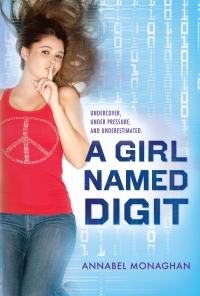
Review | A Girl Named Digit, Annabel Monaghan

9780547668529I loved the premise behind Annabel Monaghan’s A Girl Named Digit – seventeen year old Digit is a math genius whose ability to recognize numerical patterns leads her to uncover a terrorist plot and she is recruited by the FBI to track the bad guys down. Sure, the premise is far-fetched, but the story had the potential to be a fun, fast-paced thriller with lots of awesome math nerditude.

Instead, we get fluff. Digit’s ability to see mathematical patterns is certainly impressive, but we get perhaps only three instances where this helps the investigation. Most of the time, we get a Lizzie McGuire type character whose reactions to events are immature at best. It’s understandable that Digit wants to try to fit in at school by hiding her mathematical prowess and pretending to be a ditzy Party Girl, but even when on the run with the FBI and free to be 100% Digit, she seems more concerned about kissing the hot FBI agent than about escaping the bad guys. In a publishing industry with such kick ass heroines as Katniss Everdeen, or heck, even Kim Possible, Digit’s lack of common sense is just grating. I understand that not every girl is a Kim Possible, and that the book is meant to be a lighthearted beach read rather than a thought-provoking tome, but seriously: you’re on the run from bad guys known for torturing people, you know they’re planning something soon and they want to kill you before you can stop them, you’re in a cab with a tense FBI agent and a mysterious bag and all you can think of is whether or not the FBI agent will kiss you? Seriously? I don’t care how hot he is, there are somewhat more important matters at stake.

And what was the point of Digit making the stupid decision to keep her (easily trackable!) cell phone when all she did with it was read text messages from a friend about bikinis and the prom? I would understand if she wanted to keep the connection to her real life, and perhaps saw those text messages as comfort, but she just found them annoying. Digit’s ditziness is even more annoying because of her sense of superiority over her school friends — she views them as vapid and thinks she has to hide her own intelligence to fit in. This would be annoying enough if Digit actually showed her smarts, but instead, she just came off like a delusional Mean Girl.

The mystery/thriller part of the book gets woefully buried under piles of rom com, which frankly is more boring than it is witty. Digit’s math skills do come into play at the end, but for the most part, any Hillary Duff or Selena Gomez character could’ve been in Digit’s shoes and it wouldn’t have made much of a difference. The worst part is, the book started off really well. I love the description of how Digit feels compelled to hide her math smarts in order not to seem weird — she was a real, sympathetic character. Unfortunately, Monaghan falls into the Stephenie Meyer trap and sacrifices her intriguing premise to focus on the romance. The book is touted as Da Vinci Code meets Clueless but is more a Disney Channel TV show than anything.

Finally, as with Twilight, the idea that romance is far superior to anything else, including a career, bugs me. In A Girl Named Digit, the FBI agent, John, admits he wants to enter an elite program that will unfortunately prevent him from pursuing romantic relationships or having a family, but will for some reason be even more awesome than being a regular FBI agent. It’s a sacrifice John’s father refused to make so he could marry John’s mother, and good on him for being happy with that decision. My problem is that Digit expects John to give up this dream to be with her. She’s seventeen! And perhaps they really are the loves of each other’s lives, but a couple of weeks of romance is hardly enough for John to give up a lifelong dream. Digit’s heartbroken reaction to this may be understandable, but the shallowness of Monaghan’s writing just makes Digit seem bratty rather than sympathetic.

I love the premise of a young girl using her brains to stop bad guys — we need more brainy heroines, I think. Digit, despite her ability with numbers, just isn’t one of them.

+

Thank you to Thomas Allen Ltd for a copy of this book in exchange for an honest review.

Review | I Hunt Killers, Barry Lyga

7766027As the teenage son of Billy Dent, the most notorious serial killer of the 21st century, Jazz feels constantly under scrutiny. It’s only a matter of time, he imagines people thinking, before Jazz turns out just like his father. It doesn’t help that before Billy was imprisoned, he trained Jazz to join him in killing. As Jazz observes, “For Dear Old Dad, Take Your Son to Work Day was year-round.” [p.11] Jazz likes to believe that even if his father hadn’t been imprisoned, he would have been able to shake off his father’s influence anyway, but a part of him can’t help but notice how easy it would be to knock a cop unconscious. A part of him understands that a killer had removed his victim’s fingers not just for trophies, but to symbolically give the finger to the police. Despite his best efforts, Jazz had indeed absorbed his father’s lessons, and would make a great serial killer.

Barry Lyga’s I Hunt Killers has an incredibly audacious premise. As a mystery and thriller aficionado, I’ve read quite a few serial killer stories, and the Dexter Morgan character is utterly compelling. But to explore the potential of a teenage boy to be a serial killer — and more importantly, to have that boy not be a psychopath, but rather someone who is fighting desperately to avoid what he fears is his destiny.

In his quest not to be his father, Jazz is determined to use his father’s training to hunt down a serial killer currently terrorizing his neighbourhood. In doing so, he is faced with how much he really has learned about being a successful serial killer. This is dark and twisty territory, the kind that in an Ian Rankin, Stuart MacBride or Val McDermid novel would probably have the hero drinking or doping heavily. Lyga keeps it PG-13, with Jazz being more like a tortured superhero than a truly broken man, but kudos to the author for not shrinking back from the darkness in Jazz’s psyche. The mystery itself is puzzling enough, but Jazz’s relationship with his father is just as complex and frightening as you might imagine it would be in real life. At times, Jazz seems much more mature than a teenager, but then with a childhood like his, it’s certainly understandable.

I Hunt Killers is a daring, complex, disturbing novel. Lyga pulls it off with well-paced plotting, fascinating characterization and pure guts. The ending felt a bit too superhero serial, dialling back a notch on the disturbing possibilities with a fairly standard promise of a new adventure. Still, after the rest of the story, I have no doubt Lyga will pull it off again with the next books in the series.

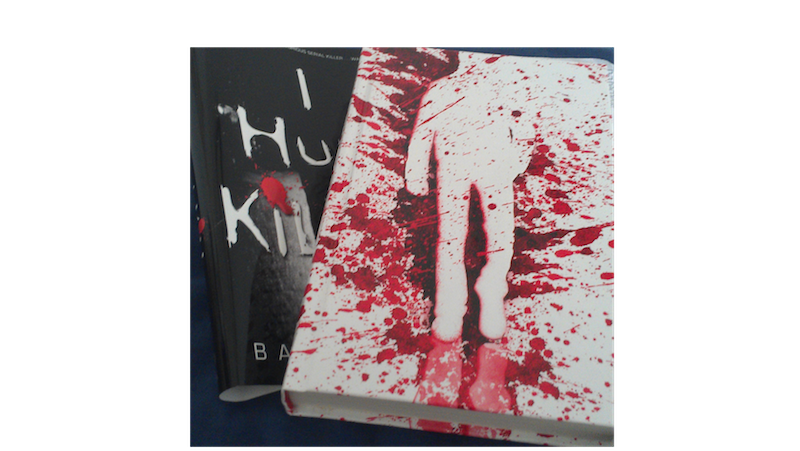
Finally, the hardcover edition has probably one of my favourite book designs from last year. Kudos to jacket and book designer Alison Impey. The experience of opening the dust jacket to realize what lay beneath is an apt introduction to the impact of the novel itself. Striking, horrific and memorable, with the rather audacious, almost defiant title I Hunt Killers, this book draws you in even before you turn the page, and it simply refuses to let go.

+

Thank you to Hachette Book Group Canada for a copy of this book in exchange for an honest review.
Review | Endgame, Nancy Garden

9780152063771By utter coincidence, I started reading Nancy Garden’s Endgame on the same day I heard about the Newtown shooting. Endgame happens to be about a high school shooter, and returning to the book felt a bit like a betrayal to the Newtown victims. I steeled myself against any attempt by Garden to elicit sympathy for the shooter, and to be fair, this did colour my approach to the book.

The back cover blurb is what I would expect for a teen book told from the perspective of the shooter — fourteen year old Gray Wilton is bullied at school, can find no support, and his “only joys are taken away… first his beloved drums, then his dog, and finally his only friend.” To the author’s credit, despite all Gray goes through, she very clearly establishes his disturbed nature. Rather than a total innocent who suddenly snaps, Garden portrays Gray as full of anger, fantasizing about torturing and killing his bullies. She contrasts the violence of Gray’s anger with that of his best friend Ross, who is also bullied, and who also fantasizes about getting back at the bullies, and yet laughs nervously at the extent of Gray’s fantasies, suggesting perhaps milder forms of revenge. With this contrast, we see how, despite what Gray is going through, he is still a psychologically disturbed individual who will clearly make the wrong decision.

Again, to be fair, I’ve been biased against Gray from the beginning, because I know from the back cover that he kills his classmates with his father’s semiautomatic. Granted, I feel sorry for him for being bullied, because the school bullies in the book really are major jerks. Still, when Gray complains about his father limiting his drum practice time at home and requiring Gray to use padded sticks, all I could think was, of course, otherwise you’d disturb the neighbours. Perhaps I’m just becoming old and cranky, but really, Gray, it’s not the most unreasonable request.

Gray’s parents are interesting characters. His mother is a sympathetic figure, too weak-willed to stand up to her overbearing husband, which is too bad because she seems smarter than the father and might’ve kept him from pushing Gray over the edge. Gray’s father, while understandable in some respects, such as his concern about Gray potentially taking weapons to school, is inept at best (Gray easily sneaks a knife past his father’s daily body checks), and must share in much of the blame for Gray’s shooting spree. Despite Gray’s anger issues, it is his father who pushes him to take up shooting in order to “man up” and face the bullies. There’s an uncomfortable parallel here with the Newtown shooter, and in Gray’s case at least, you can’t help but want to yell at the father to see all the warning signs. Much easier to do in a book where you know how it’ll turn out, rather than in real life, of course.

I love the character of Lindsay, the girlfriend of Gray’s brother. She is the only one who really reaches out to Gray and tries to help him face his problems in a non-violent manner. She is a hero, and her ultimate failure in preventing Gray from his shooting spree is utterly tragic.

Garden does take us into Gray’s head — we learn about the events leading up to the shooting from Gray talking to his lawyer. Tellingly, he claims to not remember the details of the actual shooting. Garden does make us feel his guilt, and his grief, in his unwillingness to think about the students he’s killed.  You may be reminded that he’s only fourteen, and himself a victim of bullying. As well, Garden does show how Gray tries to get teachers to help him with the bullies, but they generally turn a blind eye. So she does present both sides of the story, and we can view Gray in a sympathetic light. Personally, I had little sympathy.

Endgame isn’t quite as brilliant as We Need to Talk About Kevin, but in some ways, it feels much grittier. We actually see the progression of a school shooter’s thoughts, and given how much anger Gray had since the beginning of the story, his crime seemed inevitable. This is an emotional book, however it ends up making you feel about Gray and his experiences. I don’t know if Nancy Garden set out to present Gray as a sympathetic character, a victim of bullying, or if she wanted to present him as I ended up seeing him — a disturbed person who had little to no justification for his actions. I admit it may be my personal bias, but again, kudos to Nancy Garden for the ambiguity created by her straightforward narration.

+

Thank you to Thomas Allen Ltd for a copy of this book in exchange for an honest review.