
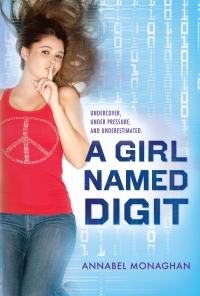
Review | A Girl Named Digit, Annabel Monaghan

9780547668529I loved the premise behind Annabel Monaghan’s A Girl Named Digit – seventeen year old Digit is a math genius whose ability to recognize numerical patterns leads her to uncover a terrorist plot and she is recruited by the FBI to track the bad guys down. Sure, the premise is far-fetched, but the story had the potential to be a fun, fast-paced thriller with lots of awesome math nerditude.

Instead, we get fluff. Digit’s ability to see mathematical patterns is certainly impressive, but we get perhaps only three instances where this helps the investigation. Most of the time, we get a Lizzie McGuire type character whose reactions to events are immature at best. It’s understandable that Digit wants to try to fit in at school by hiding her mathematical prowess and pretending to be a ditzy Party Girl, but even when on the run with the FBI and free to be 100% Digit, she seems more concerned about kissing the hot FBI agent than about escaping the bad guys. In a publishing industry with such kick ass heroines as Katniss Everdeen, or heck, even Kim Possible, Digit’s lack of common sense is just grating. I understand that not every girl is a Kim Possible, and that the book is meant to be a lighthearted beach read rather than a thought-provoking tome, but seriously: you’re on the run from bad guys known for torturing people, you know they’re planning something soon and they want to kill you before you can stop them, you’re in a cab with a tense FBI agent and a mysterious bag and all you can think of is whether or not the FBI agent will kiss you? Seriously? I don’t care how hot he is, there are somewhat more important matters at stake.

And what was the point of Digit making the stupid decision to keep her (easily trackable!) cell phone when all she did with it was read text messages from a friend about bikinis and the prom? I would understand if she wanted to keep the connection to her real life, and perhaps saw those text messages as comfort, but she just found them annoying. Digit’s ditziness is even more annoying because of her sense of superiority over her school friends — she views them as vapid and thinks she has to hide her own intelligence to fit in. This would be annoying enough if Digit actually showed her smarts, but instead, she just came off like a delusional Mean Girl.

The mystery/thriller part of the book gets woefully buried under piles of rom com, which frankly is more boring than it is witty. Digit’s math skills do come into play at the end, but for the most part, any Hillary Duff or Selena Gomez character could’ve been in Digit’s shoes and it wouldn’t have made much of a difference. The worst part is, the book started off really well. I love the description of how Digit feels compelled to hide her math smarts in order not to seem weird — she was a real, sympathetic character. Unfortunately, Monaghan falls into the Stephenie Meyer trap and sacrifices her intriguing premise to focus on the romance. The book is touted as Da Vinci Code meets Clueless but is more a Disney Channel TV show than anything.

Finally, as with Twilight, the idea that romance is far superior to anything else, including a career, bugs me. In A Girl Named Digit, the FBI agent, John, admits he wants to enter an elite program that will unfortunately prevent him from pursuing romantic relationships or having a family, but will for some reason be even more awesome than being a regular FBI agent. It’s a sacrifice John’s father refused to make so he could marry John’s mother, and good on him for being happy with that decision. My problem is that Digit expects John to give up this dream to be with her. She’s seventeen! And perhaps they really are the loves of each other’s lives, but a couple of weeks of romance is hardly enough for John to give up a lifelong dream. Digit’s heartbroken reaction to this may be understandable, but the shallowness of Monaghan’s writing just makes Digit seem bratty rather than sympathetic.

I love the premise of a young girl using her brains to stop bad guys — we need more brainy heroines, I think. Digit, despite her ability with numbers, just isn’t one of them.

+

Thank you to Thomas Allen Ltd for a copy of this book in exchange for an honest review.

Review | Calling Dr. Laura, Nicole Georges

When Nicole Georges visits a psychic for her twenty-third birthday, she finds out that the father she’s always believed to be dead is actually alive. Now, having grown up in a family of secrets and lies, Nicole considers the need to confront her mother about two things: the identity of her father, and the fact that Nicole is gay. The back blurb compares Nicole Georges’ Calling Dr. Laura to Alison Bechdel’s Fun Home, and while Georges lacks Bechdel’s sly humour, she also doesn’t get bogged down by Bechdel’s philosophizing. The result is a straightforward, rather earnest, heartfelt narrative.

Georges highlights the difference between her adult life and her childhood memories through her drawings — her life in her twenties is sketched with realistic detail, while her flashbacks to her childhood are sketched in simple, stylized shapes such as a child might draw. This shift in style highlights the child Nicole’s innocence, and thereby emphasizes the pain such a figure must undergo, watching her mother being abused by various husbands. I especially love Georges’ use of this technique in a scene where the adult Nicole has a particularly devastating piece of information confirmed, and the character shifts back to the child version for two panels, before shifting back to adult mode.

The Dr. Laura in the title actually plays less of a role in the narrative than I expected. Pressured by her girlfriend to confront her mother, Nicole finally calls Dr. Laura Schlessinger for advice. The author has included bits from the actual transcript of their conversation in the memoir, and while the radio personality seemed harsh, it seemed to be the tough love Nicole needed.

Georges does a good job illustrating the atmosphere of stress and deceit in which she grew up. She relates incidents such as stress-related bowel irregularities that lead to an embarrassing situation with a friend, conspiring with her mother to skip school as long as her stepfather never found out, and having to call 911 when her stepfather tried to strangle her mother. As she later points out, even whens he discovered her biological father was still alive, her experience with fathers hasn’t given her much incentive to find him. She struggles not just with the fear of confronting her mother, which comes hand in hand with her coming out to her mother as well, but also with the fear of meeting her biological father. The simplicity of Georges’ narrative enhances the emotional impact of her decisions; she is thoughtful without becoming too introspective. While her tone felt at times too flippant, it’s an understandable way to cope with her fear, and adds realism to her narrative.

Calling Dr. Laura is a touching tale of growing up, of coming out and of trying to make sense of one’s family. The biggest emotional wallop is reserved for the end of the book. Like the rest of the book, it is heartfelt but rendered with understated precision. It’s telling that Nicole feels most free to talk about her concerns over the phone with a radio personality or over email with loved ones. The medium provides a comfortable layer of protection, yet what comes through most strongly is Nicole’s vulnerability. Calling Dr. Laura is a sweet, simple story, surprising in how much it can reveal through so little. Well done.

+

Thank you to Thomas Allen Ltd for an ARC of this book in exchange for an honest review.
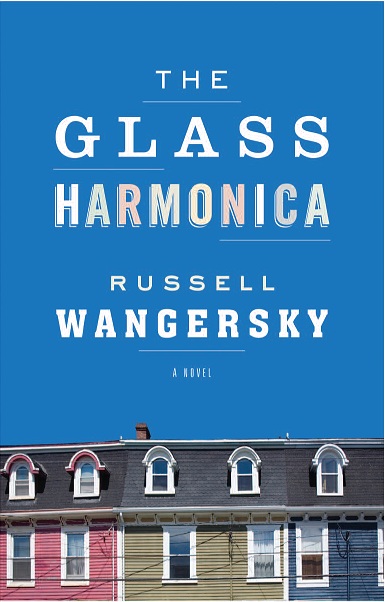
Review | The Glass Harmonica, Russell Wangersky

The-Glass-Harmonica-by-Russell-WangerskyI was eager to read Russell Wangersky’s The Glass Harmonica because I’d heard a lot of praise for his short story collection Whirl Away (in particular this glowing review from blogger Bella’s Bookshelves whose taste in books I totally trust). So when I saw this novel in the publisher catalogue, I knew I wanted to check this writer out.

The Glass Harmonica begins with a man witnessing a man being killed, but it’s really the chronicle of a neighbourhood rather than a story about a crime. Just after the dedication page of the book is a sketch of McKay Street, marking the homes of various characters. The narrative moves between characters and back and forth in time. We come to realize not just the circumstances around and behind the killing but also the way in which the lives of the people in the neighbourhood intertwine.

As a mystery fan, and in particular an Agatha Christie fan, when I think of exploring the circumstances around a crime, I expect to find a complex motive, one that reveals hidden tensions between the killer and the victim and that explains why the killer went to such lengths to commit his crime. The killer’s motive in this novel is much simpler than that, and yet in other ways much more multi-layered. Because while the actual motive is simple, the story reveals all the seemingly minor events and plot threads that connect the characters, all of which have a touch of influence that somehow led to the killing.

The narrative moves back and forth in time, as well, shifts between characters. We see multiple perspectives on the same set of events, not so much a straightforward Rashomon-like retelling, but rather tendrils of stories that somehow come together to form a web. One chapter may mention an event, only for it not to be brought up again till a few chapters later on, either from someone else’s perspective, or with our own perspective coloured by other events that happened in between. Then somehow, Wangersky pulls it all together.

There were parts of this book that I really liked, however I found the format confusing and at times frustrating. In one instance, for example, a teenage girl is running away from a group of boys who are threatening her. They corner her in an alley, she faces them defiantly — and the chapter ends. I loved that chapter — it was gripping, emotional, and I really, really wanted to find out what happened next.

Unfortunately, Wangersky then follows it up with a chapter about a completely different character, and a completely different set of events. I was still so caught up in that teenage girl’s predicament that I skipped ahead several chapters until I found the next mention of her. To my dismay, that chapter was several years in the future, and the resolution to the incident in the alley was mentioned only as a memory, and therefore now lacking the sense of urgency that had compelled me to skip ahead in the first place.

The number of narrative perspectives was confusing as well. It was difficult to keep track of all the characters, and in particular of the relationships between the characters. Then, once I did get to tell the characters apart and focus on a couple who I really cared about and wanted to find out more (such as the teenage girl, for example), the narrative would switch to another perspective that I’d find less interesting. Granted, this is a risk faced by any author telling a story from multiple perspectives, or with a large cast of characters, but in Glass Harmonica, I sometimes thought there was just too much going on.

Still, Wangersky has a beautiful way with words, and when he does pull all the threads together, and the story begins winding down, the reader’s emotions begin to run high. The final two chapters are just powerful, emotional, even heartbreaking.

+

Thank you to Thomas Allen Ltd for a copy of this book in exchange for an honest review.