Happy birthday, Jess! ~ Review roundup in honour of my sister

My sister Jessica is celebrating her birthday today. She’s introduced me to some of my favourite books and writers ever, including:

  • The Harry Potter series by J.K. Rowling
  • The Rebus series by Ian Rankin
  • The Spenser series by Robert B. Parker
  • The Guido Brunetti series by Donna Leon

… and lots, lots more. So, I figured, what better way to celebrate her birthday on my blog than by writing about some books and genres she loves?

The Hunger Games trilogy, by Suzanne Collins

I don’t have to tell you how awesome this series is, do I? It’s one of the most brilliant YA series I’ve read, possibly second in my mind only to Harry Potter. It took me months to convince Jess to read it, and she’s now an even bigger fan than I am. It just has everything: an inspiring heroine, self-sacrifice, politics, reality TV, family, kick ass action scenes, and yes, a love story.

If you’re one of a handful who hasn’t read the book yet, check out the website here to find out more about it. Better yet, read the books already. Trust me on this one.

Even better, there’s a movie out in 2012.

Love The Hunger Games and looking for your next read? May I suggest Moira Young’s Blood Red Road or Veronica Roth’s Divergent.

And, if you’re a nerd like me, check out The Girl Who Was on Fire, full of essays about the books.

View my review of The Girl Who Was on Fire 

To Kill a Mockingbird, by Harper Lee

One of Jess’ favourite books ever, and I’m sure a lot of you already agree about how awesome this book is.

Harper Lee’s To Kill a Mockingbird still feels as relevant today as it did when it was first published. Despite all the tense race relations Lee depicts in her story, Lee also offers us some of the most inspiring characters in literature. How often do we watch the news and wish we had lawyers or politicians with as much integrity and passion for justice as Atticus Finch? How much do we wish we had the same staunch beliefs in right and wrong that Scout has? In Lee’s tale of a white lawyer defending a black man in a racist town, we simply fall in love with her characters, and cheer them on, whole-heartedly, in their battle, which is a battle for justice, but more importantly, a battle against hate.

The Sigma Force series, by James Rollins

Actually, any book by James Rollins is guaranteed to have two things: insane thrills and science that seems too weird to be true, but is actually based on extensive research. The Sigma Force series, which Jess introduced me to and we both love, has the added bonus of starring a team of kick-ass nerds. Seriously, imagine Sheldon Cooper with a black belt in karate and Iron Man type gadgets.

Reading Rollins is always like watching a good movie: you’re riveted by the action, and freaked out by the knowledge that there’s a kernel of truth in the story. His latest, Devil Colony, isn’t my favourite of his books, but it’s still pretty damn good.

View my review of Devil Colony

For Rollins fans: he’s a very active tweeter, and chats often with fans.

Follow James Rollins on Twitter

Spycatcher by Matthew Dunn
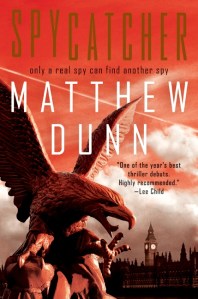
Jess is a huge fan of spy novels, especially those that feel “close to the ground.” John Le Carre, Alan Furst and Len Deighton, rather than Ian Fleming. Matthew Dunn’s Spycatcher caught my eye as something she’d enjoy. To my delight, I absolutely fell in love with this book myself, and I’m not even much of a spy fiction fan.

Dunn is a former MI6 agent, and like Le Carre, his field experience is almost palpable in his writing. (Unlike Le Carre, Dunn doesn’t use a pseudonym, which I find interesting.) Spycatcher follows Will Cochrane as he tries to stop an Iranian terrorist. It’s a thrilling story, and while Cochrane and his team appear almost superhuman at times in their strategies, Spycatcher works so well because we see Cochrane’s vulnerability, his humanity. We feel his pain at not having seen his sister in eight years, and we long as much as he does for him to be able to settle down with the woman he loves. Incredible book, and I can only hope Dunn writes even more.

View my review of Spycatcher

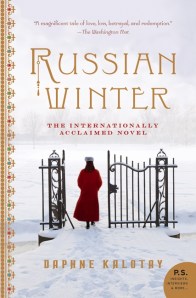
Russian Winter by Daphne Kalotay

Jess loves books about Russia, especially books written bySolzhenitsyn, Dostoevsky and Chekhov. I haven’t blogged about any of their books (I’ve also never read Solzhenitsyn, though Jess assures me he’s really good), so here’s the next best thing: Kalotay’s Russian Winter is about Nina Revskaya, a former ballet dancer now living in Boston and auctioning off her jewelry. A mysterious link between her and a man who appears to own a necklace that belongs to one of her sets leads Nina to remember her past in Russia under Stalin. The present-day scenes were okay, but I just love the scenes in Russia. The descriptions of ballet are just beautiful, and Kalotay makes us feel both the fear of Stalin and the characters’ desire to escape this fear through art.
View my review of Russian Winter

Review: Sing You Home, Jodi Picoult

In Sing YoHome, Jodi Picoult explores the issue of gay parenting. Music therapist Zoe and her partner Vanessa want to have a baby, using frozen embryos from the time Zoe and her ex-husband Max tried to have their own baby. Unfortunately, since the divorce, Max has become a member of a conservative Christian church. He believes homosexuality is a sin, and would rather his and Zoe’s embryos be implanted in his sister-in-law’s womb, for her and Max’s brother to raise in a Christian household.

Picoult handles the issue well, presenting both sides fairly. Even Max, the “bad guy,” is a sympathetic character, a recovering alcoholic who has found solace and a community in church, and is genuinely trying to reconcile his newfound beliefs about morality with his knowledge that Zoe is really a good person and would become a good mother. While I can’t personally understand Max’s pastor’s position, I think Picoult shows well how thoroughly he believes what he says, and so his motivation, however misguided I think it, is primarily to provide for the spiritual welfare of the people at his church. Picoult clearly shows her belief that gay couples should be allowed as much right to parent as straight couples, and while I completely agree with her, I’m also glad she made Zoe’s lawyer as arrogant and focused on political agenda as Max’s lawyer is. Zoe and Vanessa are wonderfully developed, flawed characters, and I’m glad that Picoult chose to show characters rather than just present her take on the issue.

It was near the beginning of the book, however, where Zoe and Max were dealing with their most devastating failed pregnancy yet, that really hit home for me. Zoe recalls being called into a dying pediatric patient’s room to provide some music therapy. She starts playing a melancholy melody, to fit in with the mood of the family, but they ask her to play instead the dying child’s favourite songs, mostly upbeat nursery rhymes. She does, and the family sings along, until the child passes. Zoe remembers that, and realizes that she is incapable of playing anything for her own child, that all she can do is hold his body and while she wants to give him some music, she can’t.

My mom passed away a couple of months ago, and at her wake the night before the funeral, we had a band play her favourite songs. I remember a cousin looking at me, brows furrowed, a few moments after the band began: “Is that Barry Manilow?” Not exactly in line with the solemn, sombre mood, but it was the most we could do for Mom. The worst part is knowing how inadequate it is, and how no matter what we did, there was no way we could give Mom any more. So, reading that scene in Sing You Home took me back to that evening. Since my mom’s passing, I’ve found it difficult to read scenes of characters dealing with the death of loved ones (mostly their children, at least in the last couple of books I’ve read). That scene, in Sing You Home, was just absolutely raw, and real, and I ached with Zoe at her inability to sing to her own child.

Possibly because the beginning, with Zoe and Max dealing with death together, affected me so much, I found the transition to Max’s conversion to Christianity and Zoe’s finding a new soul mate in Vanessa abrupt, and much too convenient. It was just too obviously orchestrated; when Max, after chapters of hating it when his brother tried to convert him, suddenly has a big experience and decides to join a church earlier shown picketing against homosexuality, I just knew that Zoe, who throughout showed no inkling of ever being attracted to women, would suddenly realize she was gay. In fairness to Picoult, she builds up the Zoe/Vanessa romance gradually, but after the emotional impact of the beginning, I felt cheated when I realized the book wasn’t about the relationship (Zoe/Max, who really did seem an intriguing couple) and the issue (Zoe’s desire to be a mother) that I’ve already become so invested in. In a way, it still is about Zoe’s desire to be a mother, but that felt like a minor thread in the main plot about gay rights. While the Zoe/Vanessa romance was certainly believable, there were portions where I felt like I was reading a primer on homosexuality. Vanessa and Zoe reflect a lot on what makes homosexual relationships different from heterosexual ones, which is fine, but I felt more like Picoult was educating us rather than showing the romance develop.

The ending is disappointing, with convenient plot twists that tie everything up neatly, but I’ve come to expect this from Picoult’s books (ever since I was horribly disappointed by the neat, convenient ending of My Sister’s Keeper). So the only thing that really disappointed me here was that I thought Lucy’s story (a troubled teen undergoing music therapy with Zoe) was just left hanging. I definitely wanted to find out more about what happened to her.

Still, overall a pretty good book. Worth checking out.

Wither, Lauren DeStefano

First, kudos to Lizzy Bromley, who designed such a captivating cover. The softness of Rhine’s dress contrasted with the edginess of the geometric shapes wonderfully captures the story’s blend of romance and science fiction.

Wither takes place in the mid- to late 21st century. Humans have discovered a cure for cancer and have created a generation of children (called “first generation” in the book) who are completely free from viruses and other illnesses and who are “practically immortal.” Unfortunately, succeeding generations are genetically cursed with an illness that kills males at age twenty-five and females at age twenty. To keep the human race going, girls are kidnapped and forced into polygamous marriages. Sixteen year old Rhine, the protagonist, is one of them, kidnapped by a scientist, Housemaster Vaughn, to become a wife to his son Linden.

The story reminded me of a mix of Suzanne Collins’ Hunger Games trilogy, Margaret Atwood’s The Handmaid’s Tale and Kazuo Ishiguro’s Never Let Me Go. Focusing mostly on Rhine’s emotions and her relationships to her “sister wives,” the servant Gabriel, and Rhine’s twin brother back home, Wither is nowhere near as political as Hunger Games or Handmaid’s Tale. It does touch on interesting issues – society is divided between those who want to keep looking for a cure and the “pro-naturalists” who believe the human race should just be allowed to die out. The interesting thing about that is that it is those who are searching for a cure – seemingly the more sympathetic cause – who kidnap girls like Rhine and perform experiments on children.

I love Lauren DeStefano’s characters. They are all incredibly complex and, I believe, are the major reason Wither is such a good book. Rhine is a complicated heroine. She vehemently wants to escape her marriage and return home to her brother. However, even as she falls in love with Gabriel, she also develops sympathy, and even affection, for Linden, who she realizes is also as trapped in his lifestyle as she is. Housemaster Vaughn, the primary antagonist, commits horrible acts for a noble purpose — to discover an cure for the illness and therefore save his son. Linden, who has forced three women to marry him, appears mostly a pawn in his father’s plans, and has a tragic love story of his own. Gabriel, who becomes Rhine’s primary ally, also appears resigned to his life with the Vaughn family, and therefore not as motivated to escape as Rhine is. None of the characters are completely sympathetic or completely unlikable, and this makes them all more engaging.

Wither is a teen book, but it definitely has adult appeal as well. Because of their shortened life spans, Rhine and the other teenage characters are remarkably mature. However, because humanity hasn’t adapted to these shortened life spans, in many ways, the teenagers in this book are still very much teenagers, vulnerable, emotional, and lacking the jadedness and experience of adults. The world in Wither forces teenagers to become adults, and DeStefano beautifully depicts the struggle that comes with this.

The ending is a bit anticlimactic, especially compared to the rest of the book, but it does set up the promise for an interesting sequel. I definitely recommend Wither, and I’m definitely keeping an eye out for the rest of the trilogy.