Review | Luckiest Girl Alive, Jessica Knoll

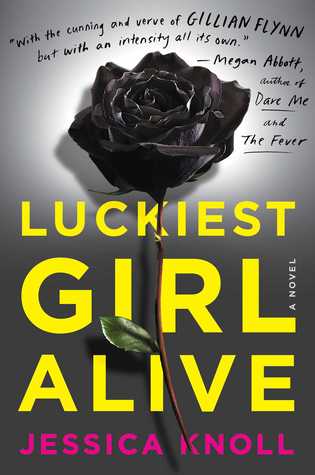
22609317Ani FaNelli appears to have the perfect life – a glamourous job at a glossy magazine, a gorgeous figure, and a handsome blue blood fiance. But beneath the facade are scars that she has worked for years to keep hidden, and a team of documentary filmmakers may very well bring the truth to light.

When I began Luckiest Girl Alive, I thought it was going to be just like Gone Girl. Ani reminded me of Gone Girl’s Amy in many ways — beautiful, cold and calculating. And right on the very first page, Ani is contemplating slipping a knife blade into her fiance’s stomach. So I figured, it was like Gone Girl, but  we know the woman is a psychopath from the beginning.

Fortunately I was wrong. Luckiest Girl Alive wasn’t the straightforward psychological thriller I was expecting, and it was a much better book because of that. Knoll takes great pains to make Ani seem like a coldhearted bitch, but slowly peels back the layers of her past to reveal a very vulnerable young woman. There are a couple of big reveals about her past, and we realize why doing the documentary is so important to her. I found the flashback scenes powerful, and I was impressed with the contrast between Ani at fourteen and the much more guarded, faux confident Ani in the present day.

As a whole, the novel doesn’t quite come together completely. Perhaps it’s partly because her supposedly “perfect” adult life never really feels perfect. As well, Ani the adult just doesn’t quite add up — she seems more a wannabe rich bitch than an actual one, yet doesn’t quite show the vulnerability that could make the wannabe aspect work. Ani as a teenager felt more real, and I’m wondering if the personality shift could have been better integrated.

I also wish we knew more about Ani’s fiance. As it was, I didn’t quite understand why doing the documentary was such a big deal. And later on, I was mostly confused about his responses to various situations. At times, it felt like he was there more as a prop for the plot than an actual character.

The ending as well seemed really sudden. Elements of it made sense, but the shift to get to that point seemed to happen really quickly, and there was a minor tidbit that was left hanging for some reason. Perhaps the author felt she didn’t have to explain how that tidbit turned out, but it felt like such an important part of the story that I wish it had been closed off more neatly.

Overall though, the segments about Ani’s past really made the book for me. These raised some powerful, timely and highly relevant issues, and I thought the author did a great job in presenting teenage Ani as a complex, multi-layered character. At one point, remembering a particularly traumatic moment, Ani confesses to some really dark thoughts, and to me, that bit of darkness is far more interesting than the bitchy facade the author uses to make her character seem evil and unlikeable. These are the most powerful moments of the book, and the ones that make the slow start very much worth it.

+

Thank you to Simon and Schuster Canada for an advanced reading copy of this book in exchange for an honest review.

+

RESPONSE TO QUESTIONS ABOUT THE ENDING
EDIT NOVEMBER 21, 2015 

Since posting this review, I’ve received quite a number of questions about the ending, and I now really wish I hadn’t given my copy away because I’m now wondering if I’d missed things in my original reading.

Short response: I’m afraid I don’t remember anymore. I’d read it so long ago, and I no longer have a copy to refresh my memory.

So for anyone asking about the ending, here’s the reply I sent to one of the earlier emails I received, and please note that my interpretation of the seashell is by no means at all confirmed as accurate:

I agree on the big reveal (that Ani’s conversation with Dean was miked up to catch his confession), mostly because I didn’t think it was as much of a surprise as the build up led us to believe. That being said, I like that Ani finally got the confession she deserved all those years ago, and having it recorded puts the power back in her hands.

I thought the story as a whole could’ve held together better. What I like the most is that I thought it was one kind of story at the beginning (Gone Girl), but it was really about a young girl’s trauma. So in that sense, the conversation being miked and going public is a fitting happy ending. Personally, I thought the whole Gone Girl angle/fiancé subplot felt unnecessary – it would have been more powerful (and IMHO less confusing) if the author had stuck to the high school trauma story. Even the shooting part wasn’t really necessary – like the author tried to put so many reveals into one story.
Re seashell: It’s been a while since I’ve read it, but I don’t remember the seashell playing a significant role necessarily, other than as a souvenir of the day with Arthur. I thought it was mostly part and parcel with the photo, and so both kinda meant a lot to her and her memory of Arthur, so her fiancé (can’t remember his name) being so casual about it just shows how little he really knows her.

Hope this helps, and if anyone has alternative explanations of the seashell or the ending, feel free to write in the comments!


Review | Black Dog Summer, Miranda Sherry

23574104When Sally is brutally murdered on her farming commune in South Africa, her spirit remains tethered to this world and the people she left behind. Similar to The Lovely Bones, Miranda Sherry’s debut novel Black Dog Summer is about a family dealing with grief and, more significantly, with all the issues left unresolved before death. Sally watches as her teenage daughter Gigi falls into a deep depression alleviated only by drugs. Her estranged sister Adele, her brother-in-law and unrequited love Liam, and their daughter Bryony are all struggling to come to terms with Sally’s death, and with the addition of a silent, troubled teen into their home.

Sherry’s writing is beautiful, and I love how she describes her characters’ lives as threads of stories that Sally must follow before she can move on. Sherry also weaves in a bit of a supernatural feel — the darkness Bryony senses in the aftermath of her aunt’s murder takes the form of a black dog out to harm her and her cousin. Bryony’s next door neighbour Lesedi is a reluctant sangoma, someone in touch with the spiritual realm and can communicate with the dead, and anchors the story’s shifting between both worlds.

My favourite passage in the novel comes early on, almost immediately after Sally is killed. She hears a noise, a “whispering, humming, singing, screaming awfulness.” She soon realizes that

The noise comes from Africa’s stories being told. Millions upon millions of them, some told in descending liquid notes like the call of the Burchells’ coucal before the rain, and some like the dull roar of Johannesburg traffic. Some of these stories are ancient and wear fossilized coats of red dust, and others are so fresh that they gleam with umbilical wetness…

[My family’s story is] just one story amongst millions, and yet it has become so loud now that it drowns out the others. It is howling at me, raging, demanding my attention. I look closer to find that this small, bright thread of story weaves out from the moment of my passing and seems to tether me to this place. Perhaps this is why I have not left yet. Perhaps I have no choice but to follow the story to its end.

Isn’t that beautiful? From that passage on, like Sally, I too felt compelled to follow this story to its end.

I also really like how Sherry connects the spirit world with the elemental one. Sally feels her being a spirit most keenly when Lesedi looks at her, and ironically, she is both most disconnected from the physical world and intimately connected to its elements. She has become an Ancestor, one with the millions upon millions of stories of the past and connected as well somehow to the potential of the future. What a beautiful way to think of the afterlife!

Black Dog Summer is a very emotional book. Much of the story within the physical world is told through Bryony’s point of view, and as a tween, she is barely able to cope with what has happened to her aunt. She looks up the term “massacre” in the dictionary, and repeats this definition several times. And indeed, when faced with something as incomprehensible as murder (not just murder, but mass murder), when having to deal with the overwhelming grief of a cousin you barely know who is now your roommate, when unable to comprehend the rising tensions between your parents, how can anyone cope?

This is a beautiful, heartbreaking, page turner of a book. Like Sally, we as readers are invested in the story while necessarily being detached from it. And like Sally, all we can do is hope it all works out for this family.

+

Thank you to Simon and Schuster Canada for an advance reading copy of this book in exchange for an honest review.

Please note that the passage quoted above is from the ARC, and may be edited prior to publication.

Review | The Damned, Andrew Pyper

damned-9781476755144_lgAndrew Pyper does it again with The Damned. Creepy, atmospheric and with more than a touch of existential tragedy, the book is signature Pyper. I raced through the book in a couple of days, and ended up not quite knowing how to feel at the end.

“I have a talent for dying,” protagonist Danny Orchard admits. “It’s the one thing it seems I can do, not just once like everyone but over again.” Danny is a middle aged man who had narrowly escaped death at 16, in a fire that ended up killing his beautiful, psychotic twin sister Ashleigh. Now a bestselling author who’d penned an account of his experience in the “After” (Danny’s term for the afterlife), Danny has lived his entire life haunted by Ashleigh’s spirit, who appears determined to take Danny back into the After with her.

Just like my favourite Pyper novel The GuardiansThe Damned focuses on the intensely personal, small scale, individual type of horror. Danny’s attempts at a normal life, foiled by his sister’s spectre appearing at inopportune moments illustrate a very personal kind of hell on earth. Pyper includes other characters who are undergoing similar experiences with their own departed unloved, and these incidents are both chilling and tragic. On one hand, The Damned is a freaky horror story (a scene with a washing machine almost gave me nightmares); on the other hand, it’s also a potent metaphor for how we can never really escape the people who have touched our lives. An abusive father may die, but his daughters will never completely escape the effects of his abuse. Ghosts, whether corporeal or psychological, are real. Even Pyper’s version of the After is based on reality — a bit of earthly life stretched out to eternity. This grounds the unknown of death in something tangible, and makes the idea of hell even more within our grasp.

What elevates this straightforward horror story into something much more troubling is that Pyper resists comfortable, easy characterizations. For example, it would be easy to paint Ashleigh as purely evil. Just like the abusive father who haunted another character, Ashleigh’s cruelty lives on and impacts upon Danny’s life for decades afterwards. However, Ashleigh’s explanation of her nature, rooted in a near death experience the twins had in their mother’s womb, raises questions about good and evil, and the justice of her damnation. Questions that go far beyond a novel, and possibly into our own concept of heaven and hell, right and wrong.

The Damned is a fairly quick read, mostly because you just keep wanting to find out what happens next. But much like Pyper’s ghosts, the disquieting questions his novel raises linger on long after you turn the last page.

+

Thank you to Simon and Schuster Canada for an advance reading copy of this book in exchange for an honest review.