
Review | The Kill Order, James Dashner

To be fair, I haven’t read The Maze Runner. So while the prologue with Teresa and Thomas may have resonated with Maze Runner fans, I was just mildly curious. Also to be fair, this series is written for a younger audience, though with the narrative sophistication of contemporary YA, that probably shouldn’t say much. If you like Maze Runner, I hear this book is very similar, and so you’ll probably like it as well. If you haven’t read Maze Runner, this book is still fairly easy to follow, though personally I’m wondering if Maze Runner has a more interesting storyline. The prologue, at least, was intriguing enough to make me curious about the original trilogy.

The Kill Order is the prequel to the best-selling Maze Runner trilogy. Sun flares have destroyed a huge chunk of civilization and now a mysterious virus, originally spread by poisoned darts, is turning survivors into raging lunatics. The story follows Mark, Trina and their friends as they struggle to survive. I originally assumed Mark and Trina were teenagers, both because this is YA and because of the way they act. But a passage describes Trina as a woman, so I’m not completely sure about their ages.

The Kill Order is mostly an action-packed apocalyptic zombie story. I liked that Dashner showed how Mark and his friends had to sometimes make the difficult decision to leave behind infected friends. I also really like the Mark and Trina romance and wish Dashner had explored that a bit more. The fight scenes are fast-paced and suitably gory, and descriptions of infected individuals are definitely shudder-worthy.

Kill Order reminded me somewhat of a simplified, YA version of Justin Cronin’s The Passage. The main difference is that Kill Order focused a lot more on the action at the expense of character development. Dashner has created some interesting characters, in particular the heroic elderly soldier Alec, whose sense of duty and emotional connection to fellow soldier Lana compels him to keep going. I only wish there was more character development. I usually like action-packed books, but Kill Order was mostly just confusing, and I ended up caring a bit about characters’ relationships (e.g. the Mark and Trina romance), but not much about the characters overall.

The best part of the novel is when we find out the real reason behind the virus. From an action-packed but mostly aimless zombie story, The Kill Order reveals the beginnings of political commentary. I wish Dashner had explored that angle a bit more — I would’ve loved to find out more about the story behind the people who committed such an act, and how they would’ve reacted to seeing the unintended consequences. I’m unsure if this is explored in Maze Runner, but there are definitely interesting implications from the revelation.

+

Thank you to Random House Canada for a finished copy of this book in exchange for an honest review.
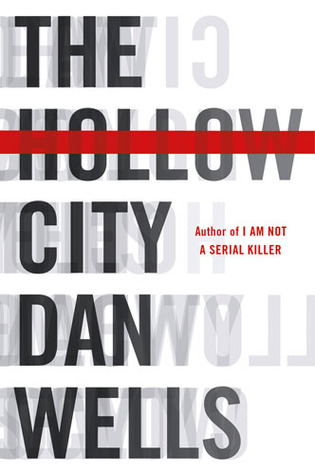
Review | The Hollow City, Dan Wells

Michael Shipman is crazy. A diagnosed paranoid schizophrenic, Michael sees Faceless Men and gets splitting migraines whenever a cellphone rings. So when we see the world through Michael’s eyes in Dan Wells’ The Hollow City, we know not to take it at face value.

It takes great talent for an author to get into the mind of someone who’s had a psychotic break from reality. Wells takes this to a whole different level by having readers mistrust his narrator from the beginning, yet slowly begin to question this mistrust. Some authors are able to make psychologically disturbed characters sympathetic and their views understandable, usually through eloquence (Lolita, A Clockwork Orange) or through comparison with a villainous “sane” world (One Flew Over the Cuckoo’s Nest). Wells however  offers actual clues and details that make us wonder if Michael is, in reality, seeing Faceless Men, and if there is some rational, physiological reason for his adverse reaction to electronic devices.

Hollow City begins as a tragic depiction of an unbalanced mind. Michael’s hallucinations are as real to him as reality is to us, and the intensity of his fear at things we view as ordinary (cellphones, TVs, hot water faucets) inspires sympathy. His condition, particularly his obsession with Faceless Men, makes him a prime suspect in the investigation of serial murderer The Red Line Killer, whose trademark is slicing his victims’ faces off. Worse, Michael has lost two weeks’ worth of memory and is himself unsure if he is the Red Line Killer. I can’t even begin to imagine how difficult it must be not to be able to trust yourself, and when Michael begins to doubt the reality of people around him, some of whom he loves and depends on, he becomes even more isolated.

Then the story takes a completely different turn when Michael’s hallucinations start making more sense. We’re never quite sure if Michael’s perceptions are turning out to be real or if we too have been sucked into his mind. But this does open up a science fiction/horror story angle to the plot. It’s a thrilling ride to the end, and I was as desperate as Michael to find out what, exactly, is going on. Wells never gets as complex as China Mieville or as seductive as Vladimir Nabokov, which he could have done given his premise, and this is perhaps the reason Hollow City didn’t blow me away. The murder mystery that drove the plot started out compelling, but wasn’t really developed, and the big reveal regarding the murderer was fairly obvious and anti-climactic. That being said, I was definitely taken by surprise by the other big reveal, the reason behind Michael’s hallucinations. I love that Wells took a big, unexpected leap with that, and while the ending seemed a bit rushed, given the build up, it made sense. After all the uncertainty, and all the wondering about where Wells could possibly be taking this story, the ending satisfies. A good, solid, fast-paced read.

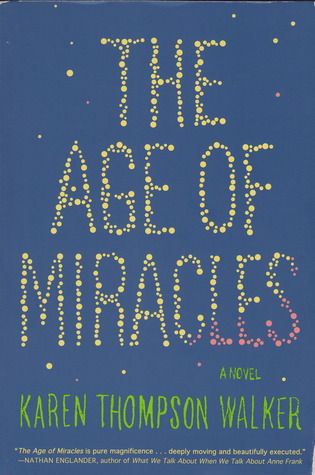
Review | The Age of Miracles, Karen Thompson Walker

What a lovely, lovely book! Karen Thompson Walker’s The Age of Miracles takes a terrifying science fiction idea and turns it into a touching coming of age story. When the Earth’s rotation begins to slow, eleven year old Julia barely even notices. Some people were terrified about the end of the world, but when the entire world is affected, where can you run? The effects are slow but inexorable, and even as a reader, panic turns to horror and, eventually, to resignation. Julia’s world is ending, and Bruce Willis isn’t about to launch a spaceship to save it.

This then is where the power of Walker’s story lies: when you can’t prevent the end of the world, what else is left but to live your life as best you can? Walker creates a complex world, and offers social commentary. Society, for example, is divided into those using clock time (following the 24-hour clock despite the schedule of daylight) and those using real time. “I’ve never liked her lifestyle,” Julia’s mother sniffs, speaking of real time user Sylvia. “It’s not our business how she chooses to live her life,” Julia’s father responds. This type of conversation sounds familiar, eh? The world stops spinning, people will go on being judgmental. Another real time user tells Julia’s family:

You probably think we’re a bunch of pipe dreamers out here […] but it’s just the opposite. We’re not the ones in denial. […] We’re the realists. You’re the dreamers. [p. 214]

Indeed, the clock time users are dreamers, desperately clinging on to a world that no longer exists. Ostensibly about something as quotidian as telling time, Walker creates a powerful metaphor here, a searing portrait of our own society.

Even more potent perhaps is the deeply personal thread to this story. In an especially poignant scene, Julia decides to buy herself a training bra. This insistence on a ritual of growing up, even in the face of the world ending, is a lovely fist pump against circumstances. It also stands out as one of the few times Julia, an all-around good girl who hesitates to cut class even with the world going topsy turvy, deliberately defies her mother. It’s that important to her. And that’s why it’s utterly heartbreaking when she gets home and realizes the bra is much uglier than it seemed at the store:

One of the seams was already coming loose. Even worse was the way the cups rippled unsexily across my chest, like two empty water balloons waiting to be filled. [p. 155]

It’s a young girl’s heartache, and a deeply moving reminder that she may never have the chance to fill those cups. Julia’s concerns about family, friendship and friendship are all rendered even more poignant by the urgency, and inevitable futility, of her situation.

The ending, the final chapter in particular, is absolutely beautiful.

+

Thank you to Random House Canada for a finished copy of this book as a prize in the Random Reader Challenge: John Irving. I read this book as part of Random House’s Random Reader Challenge: Debut Novels.