
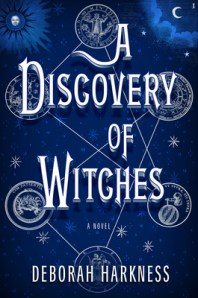
Review: A Discovery of Witches, Deborah Harkness

Deborah Harkness’ A Discovery of Witches begins with an interesting premise: reluctant witch Diana Bishop discovers an ancient book of great power in a library and sends it back. It turns out witches, vampires and daemons have been after that book for centuries, each with their own ideas about what the book contains. Together with tall, handsome vampire Matthew Clairmont, Diana tries to escape all the baddies after her (and the book) and find out more about this book. They fall in love, which unfortunately violates a centuries old treaty that vampires, witches and daemons must not mingle. Forbidden love, a mysterious ancient text and a reluctant witch who, it turns out, has the potential to be the most powerful witch in history — sounds exciting, eh? The beginning certainly was.

Unfortunately, the rest the book felt like the first six hundred pages of a three thousand page novel — full of minor threads that either get resolved or not yet, with no major story arc for the book itself. As a result, a lot of the major dramatic scenes didn’t have the impact it could have. Once, Diana is tortured by a baddie wanting to force her to reveal her powers. She survives and is praised for her bravery. Unfortunately, it comes too early in the novel to feel climactic, and as Diana herself didn’t know what her powers were at this point, her resistance seemed more unavoidable than heroic.

Several major baddies show up, all of whom are given only a few chapters before disappearing, ostensibly to reappear in a later book. The major baddie, who provided what I assumed was the climax, came almost literally out of nowhere. This could’ve been a wonderful surprise twist, if only this particular baddie had been present, even as a shadowy, unknown behind the scenes puppeteer, throughout, but that wasn’t the case. I can only assume Harkness is saving the actual climax for a later book.

Discovery is bogged down by minutiae. Harkness may have been so fascinated about vampire eating habits (they eat nuts!) that she wanted to devote practically an entire chapter to Diana serving Matthew a meal. Halfway through, when I realized the conversation was never going to move beyond Matthew praising Diana’s attention to detail and Diana’s fascination that Matthew can eat solid food, I stopped caring completely. So imagine my horror when only a few pages after this meal, Matthew decides it’s his turn to feed Diana, and to educate her about all the wines he serves. While it must be amazing to taste centuries old wine, by what felt like the tenth bottle described in loving detail, I wanted to swear off wine forever.

Minor quibble, but while I love having a heroine with a great appetite (finally!), Diana eats more toast in one book than Miss Marple drinks tea in all of Christie. That’s how it seemed anyway, from Matthew serving her tea and toast to Diana wondering if they had any more butter. I love foodie lit (Goldy Schulz! Guido Brunetti! Hannah Gruen!), but there’s a reason none of those authors spent this many pages on toast.

Diana spends a huge chunk of the novel in Matthew’s mother’s castle, where she waits around for Matthew and finds out lots about the vampires’ back stories. Way too many pages of nothing exciting happening, and way too much boring information, to the point when, after a few chapters of action, when a vampire I actually liked said “This is my tale to tell,” I had to turn off my Kindle (much less satisfying than slamming a book shut).

This book does have one of the most unintentionally hilarious scenes I’ve read in a while. When Matthew leaves Diana in the castle to go pursue baddies, Diana cries so hard she starts leaking water everywhere and creates a literal flood. Maybe it’s just because it’s such a lame reason to be that devastated, but that made me laugh. It was only afterward, when Matthew’s mother said Diana was the first witch in centuries powerful enough to command witchwater that way (Diana actually became water) and Diana admitted her fear that she’d disappear completely (think Wicked Witch of the West) that I realized the scene was meant to be solemn.

So why did I finish the book? Like I said, the premise was promising, and the parts where the characters talk about the book are interesting. There is also the possibility of a revolution and a war among the witches, vampires and daemons, which sounds exciting. So I do want to find out how this whole story ends.

The next book promises to be about Diana training to use her powers properly. Personally, I’d like to find out how many books Harkness plans to have in this series, so I can wait for the final one and read the last few chapters to see how the war turns out and what the ancient book actually contains. Till then, I leave the toast eating and vampire reminiscing to other readers.
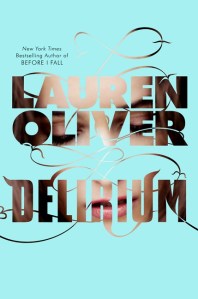
Delirium, Lauren Oliver #50BookPledge

In Lauren Oliver’s Delirium, love has been diagnosed as a disease, and everyone is required to undergo the cure when they turn eighteen. When I first heard the premise, my cynical brain immediately thought it was brilliant. No more Eponine-style romances for me! Thing is, the procedure doesn’t just kill off romantic love. My sister, who also read this book, called it practically a lobotomy, and that’s what it is: the doctors surgically remove every last bit of passion. You will never been heartbroken, but you will also view your friends and children with cold logic (you’ll give your baby milk because he’s hungry and needs food to live, not because you can’t stand to see him cry). You will no longer feel depressed, but you will also never enjoy your hobbies with as much fervour as before. Hana, the best friend of protagonist Lena, tells her early on, “You know you can’t be happy unless you’re unhappy sometimes, right?” And it’s true. Cliches aside, if you remove all violent emotion, you’ll have to remove the good with the bad.

Unlike Hana, however, Lena can’t wait for the procedure. When she was very young, her mother committed suicide because she was too infected by amor deliria nervosa to be cured. All Lena can remember is her mother laughing and dancing with her (then immediately checking to see if anyone had noticed; too much laughter after all is a symptom of delirium) and her mother fiercely telling her, “I love you. Remember. They cannot take it.” Lena is heartbroken by her mother’s death, and looks forward to being cured and freed from all that pain. I love that the heroine begins the novel looking forward to the procedure, and horrified whenever Hana makes negative comments about it. My natural reaction, once I found out the procedure destroyed all passion and not just romantic love, was to wonder how anyone could think that was a good idea. Lena’s desire to forget a completely different kind of pain made sense to me, and showed me how this procedure could be seen as a good thing, even by intelligent, non-brainwashed-drone individuals like Lena.

But Lena falls in love. Only three months before her procedure, she meets a boy named Alex, who has the scars of the cured, but whom Lena saw laughing when something messes up an evaluation interview. I love how she falls in love with him not just because of his good looks (though he is hot), but because of the tremor of laughter in his voice, and the constant look of amusement in his eyes. In a world where serenity is prized and passion is feared, happiness is enticing. Alex too, it turns out, first develops a crush on Lena when he sees her acting silly during a run — as Lena discovers during class picture day, even her ordinary looks are transformed into great beauty when she’s really happy. It’s wonderful seeing this tale from Lena’s perspective — I worry with her when Hana sneaks off to attend an underground party (with real music! Not the government regulated chipper tunes!), I feel for her whenever she remembers her mom, and I get just as giddy as she does whenever she meets up with Alex. She still worries about ending up like her mother, and I love what Alex tells her about the downside of the cure: “That’s when you really lose people, you know. When the pain passes.” I think of when my grandfather died, how my biggest fear is forgetting how he looks, or how he sounds. Pain sucks, but Alex is right; pain also keeps the past alive.

As you can probably tell, I love this book. It’s an emotional ride, which reminds me of how repressing emotions actually ends up making them burst out even more violently. I love how it goes beyond just a romance, and deals with the value of passion in so many things — friendship, family, music, hobbies, and yes, love.

I remember how violently I felt about things when I was younger, and how much more practical I am today. I remember how, when I was young, an older cousin told me never to fall in love, because it hurt too much, and I remember how I, fuelled by Disney movies mostly, vowed never ever to turn away from love, because I’d rather be hurt than block myself from feeling. I remember changing my mind later on, and chalking it up to maturity. Delirium is about a surgical procedure that removes strong emotions, but I wonder, though not as extreme, do we all subject ourselves to a similar procedure in the name of growing up?

This book will make you believe in love again. At the very least, it will make you realize why numbing yourself against pain, while tempting, can never work in the long term. Delirium ends with a bang, which actually reminded me of a Le Carre novel (I can’t say which, as that would totally be a spoiler). It’s a wonderful, exciting book that I hope will touch you like it has touched me.

By the way, if you plan on getting this book (as you should!), just to let you know, I found out on the Harper Collins Canada website that Delirium: The Special Edition will be published July 20, 2011. It’ll have new cover art, a Q&A with author Lauren Oliver and an exclusive excerpt from her next book! Pretty cool, eh? (Thanks to Harper Collins Canada’s Savvy Reader for letting me know details about Delirium: The Special Edition!)

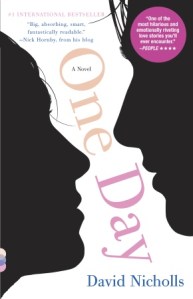
One Day, David Nicholls #50BookPledge

I read One Day on the recommendation of a fellow bookworm who thought it was a good book but hated the ending. My boss at the bookstore loves this book, has recommended it a lot of times, and is looking forward to the movie with Anne Hathaway and Jim Sturgess. So it’s been on my TBR list for a while, and when my bookworm friend lent me her copy, I was excited to read it.

One Day follows the relationship between Emma Morley and Dexter Mayhew over the course of twenty years, depicting snapshots of their lives on the same day (July 15th) each year. They meet in 1988, have sex, and set off to pursue different lives after graduation — Emma as an aspiring writer and Dexter as someone who wants to travel the world and become famous somehow. Their relationship shifts from romance to best friendship, and their lives turn out very different from how they’d imagined it in university. Taking a yearly snapshot is an interesting concept, allowing Nicholls to show gradual character development and long-lasting effects of decisions that characters make. Nicholls is a talented writer, and his characters are complex, interesting people you can imagine being friends with.

That being said, it took me a long time to get into One Day. I found myself bored for the first half of the book. Nothing to do with Nicholls’ writing, and I have to admit, the behaviour of characters and development of Emma and Dexter’s relationship felt realistic. It actually took me a while to figure out why I wasn’t enjoying the book, and I realized that while the yearly snapshot approach is an interesting idea, it made me find the story meandering. I just wanted something to happen already. While I acknowledged the Emma-Dexter chemistry, I found the single day narrative too abrupt — I’d just be getting invested in a plot thread when the day ends, I flip the page and I have to hear about the results through flashback. It didn’t help that I found the young, politically active Emma annoying. Dexter accuses her of being condescending and a know-it-all, and I had to agree. That made me a bit wary about the upcoming movie — I can imagine finding it more annoying on screen.

As Emma and Dexter grow older, however, and become a bit more settled in their respective lives, I found myself becoming more interested in the story. Secondary characters started to become more significant, and Emma and Dexter’s desire to be with each other (not just romantically, but also to connect more deeply as friends) becomes more urgent. That’s what I love most about Emma and Dexter’s relationship: it’s based on a deep friendship; they’re soul mates in a similar (though much less melodramatic) way as Cathy and Heathcliff. It’s a wonderful, touching love story, and Nicholls depicts their connection well.

Like my friend, I hated the ending. Without giving away any spoilers, I just have to say I found it unnecessary. Fortunately, Nicholls is a gifted writer and he handles it much better than I imagine others would have. I also think the one day snapshot format helped him pull off this ending well.

Would I recommend this book? Sure. I can see why so many readers like this book. Despite the movie poster image, One Day is more than just a romance. It’s a well-written look at how two individuals grow up, and, more importantly, grow up together.