Review | Under the Hawthorn Tree, Ai Mi (trans. Anna Holmwood)

Ai Mi’s Under the Hawthorn Tree was a wonderful book to kick off the weekend before Valentine’s Day. Set in China during the Cultural Revolution (early 1970s), Hawthorn Tree tells the love story of high school student Jingqiu and geology student Jianxin, nicknamed “Old Three.” They come from very different social, economic and political backgrounds, yet they fall in love. But, the publisher’s book description tells us, “their budding romance is cut short by fate…” This book has been made into a movie by House of Flying Daggers director Zhang Yimou, and the film’s promotional tagline was “the cleanest romance in history.” So I began the book expecting a sweet, innocent romance, possibly tinged by tragedy. Best part is that it’s set in an exciting time in Chinese history — I admit I know little about this part of history, and, being half-Chinese, I was eager to find out more about it.

In a lot of ways, Hawthorn Tree was what I expected — the romance between Jingqiu and Old Third is sweet and innocent, and the romance really picks up once Jingqiu finally acknowledges are feelings for Old Third. The last few pages of the book are especially touching, and the last line in particular made me feel like I just read the kind of epic romance that spans generations.

Being half-Chinese and having grown up in the Philippines, I did not expect the level of culture shock I had reading this book. The world Ai Mi has created of China during the Cultural Revolution is so different from the world I know. It certainly feels different from the China of The Good Earth and from other books I’ve read set it in the 1970s. Even though the book is narrated in the third person, we remain firmly within the extremely naive, sheltered perspective of Jingqiu. Translator Anna Holmwood warns us in her introduction that the degree of Jingqiu’s innocence may seem incredible to a Western reader, but that this just reveals “the startlingly intimate reach of politics in that period.” As a 21st century reader, I found myself in the odd position of seeing only Jingqiu’s limited view of events while understanding so much more than she did. At times, this was frustrating, and I had to keep reminding myself that what I may view as overly defensive is completely natural behaviour given the character’s circumstances.

I was fascinated to learn about this period. I love that Jingqiu completely believed Chairman Mao’s teachings, because it offers such a different perspective from what I’m used to reading. Her father is a political prisoner and her mother, branded a capitalist, has been forced into menial work, so I can definitely understand why Jingqiu is extremely hesitant to even think anything vaguely revolutionary. More than that, however, Jingqiu takes pride in doing heavy manual labour and finds it difficult to understand why the “noble peasants” aren’t more excited about living the communist ideal.

Jingqiu’s mother warns her about boys, but, like Jingqiu’s friends and the books she’s read, is very vague about specifics. Jingqiu knows that going for a walk with a boy can lead you to trouble, but all she knows is that there are girls in her class who suddenly turn up pregnant and either kill themselves or are disgraced. At one point, her brother is arrested because he and his girlfriend were caught in bed together — hard enough to believe from our point of view, but even harder to believe is that both were fully clothed and, according to the girlfriend, doing nothing but sitting at the edge of the bed with a blanket over their legs because it was cold. Even if the girlfriend was lying (just sitting? sure…), Jingqiu believes her, yet thinks, but they were sharing a bedroom, which is what husbands and wives do, so what does the girlfriend mean they were doing nothing? It’s not so much that Jingqiu finds the idea of being in a bedroom together scandalous, but that she honestly doesn’t know what exactly husbands and wives do in the bedroom other than share it.

At times, Jingqiu’s naivety can be funny. For example, when she and Old Third go swimming, Old Third asks her to go out of the water first, and she notices he looks uncomfortable. She asks him why he’s so shy about her seeing his legs and if he has a cramp, then offers to rub it out for him. Her unintentional innuendo and Old Third’s utter embarrassment are just really sweet. Other times, however, her innocence and concern over protocol can be frustrating — Old Third seems like such a nice guy that I want them to get together already. Then I remind myself that Jingqiu grew up in a different culture, and when questionable details come up about Old Third’s past, she really feels unable to confront him.

Old Third is a likeable hero. He is clearly concerned about Jingqiu — he begs her not to do the heavy manual labour as it’s too dangerous for a woman. My inner feminist reacted to that, but then again, her work sometimes required her to carry hundreds of pounds of material up and down hills. He helps her out by giving her money, but always through someone else, because he knows Jingqiu is too proud to accept money from him. I of course wanted to tell her to stop being so stubborn and just take the money already — at times, their exchanges of money, with Old Third sneaking it to her and Jingqiu sneakily returning it and so on, go from funny to a bit ridiculous. He’s a sweet guy, and his bewilderment whenever Jingqiu scolds him for doing something improper (usually nothing more serious than give her an extra piece of meat at dinner) is endearing.

Hawthorn Tree is a delicate love story. Ai Mi does a fantastic job making us feel the fragility, even brittleness, of Jingqiu and Old Third’s relationship within their society. The slightest slip, and Jingqiu’s future can be compromised forever. I do wish Jingqiu had been less defensive and Old Third less gun shy, but I did cheer for them as a couple. Theirs certainly is a “clean” romance, and at times almost endearing in its innocence.
Review | The Decision, Penny Vincenzi

What a treat it is to read a Penny Vincenzi novel! The blurb from Daily Express likens The Decision to a “glass of Champagne: bubbly, moreish and you don’t want it to end.” I’ve never read Vincenzi before, but I was in the mood for a Champagne-type novel. True enough, The Decision was like a bubble bath of a book — luxurious, frothy and oh so indulgent.

To be clear, the book tackled a lot of very serious issues as well, particularly women’s rights and the role of a mother. It had its emotional moments, and at times, I was literally outraged at how Matt (the hero) treated Eliza (the protagonist). However, all these were framed within the story of a delightful Mad Men world of fashion, travel and romance. Escapist fiction with big ideas — love it!

To tell you more about The Decision, here’s a video I found on Vincenzi’s website, where Vincenzi herself tells us about the book and reads some excerpts:

Penny Vincenzi – The Decision from BeyondTheBlurb on Vimeo.

(source: http://www.pennyvincenzi.com/thedecision.html)

From the prologue and the back cover, we already know what’s going to happen to Matt and Eliza’s relationship — it won’t work out, and they’ll have a messy custody battle over their daughter Emmie. To my surprise, Matt and Eliza get married almost halfway through my 758-page ARC. Forget any concern about spoilers — the custody battle alluded to in the prologue only about 3/4 through the book, so you’re reading hundreds of pages about Matt and Eliza’s romance, with the full knowledge that it won’t last.

To my even greater surprise, it didn’t matter at all that I knew how it was going to turn out — I still had a great time watching it unfold. A lot of that is because of the world Vincenzi created, filled with fascinating characters you can’t help but root for. Take Eliza, for example. Raised in a wealthy family that just wants her to marry rich and have babies, Eliza prefers to be a successful career woman in the fashion industry. She has a natural instinct for fashion, and I loved watching her organize fashion shoots and come up with ideas for magazine features. It’s a glamourous world, and Vincenzi’s writing just wraps us up in it.

I especially love that despite her ambition, Eliza agrees to give up her career to raise a family with Matt. I didn’t agree with her decision, and in fact Eliza’s reluctance to do so was very evident. However, I love the complexity it added to her character. She wasn’t even a starry-eyed Bella Swan type; rather, she was a mature yet vulnerable young woman, like Julia Stiles’ character in Mona Lisa Smile, who wanted to make her marriage work. I didn’t agree with her decision, and given how unhappy it made her, I couldn’t really respect it, but I did sympathize with it, and with her. I especially, especially love that, even after having made the decision to give up her career, Eliza clearly struggles with it every day. I can imagine how many women in the 60s did face that dilemma, and I love how textured and complex Eliza’s character was.

Then there’s Matt. Ambitious, handsome, with a huge chip on his shoulder about his working class background, he was appealing as he fought to make his way in real estate, and he got annoying when he married Eliza. Team Eliza all the way! That, of course, is me reacting as a woman. Matt’s old-fashioned attitudes about gender roles were very apt for the time period, and I cheered every time Eliza or another woman (usually his sister Scarlett or his business partner Louise) stood up to him.

Beyond the romance, however, the female characters really shone in this book. Louise is an even stronger, more ambitious, woman than Eliza, and her tough negotiation tactics with Matt and other male colleagues made me cheer. You go, girl! Reading about Scarlett’s love life felt like watching a soap opera, and I love the man she eventually ended up with.

The pace slowed down somewhat once we got to the custody case. From a fun, lighthearted read, the book switches over to a more sombre, emotional tone. I was still definitely Team Eliza in the case, and I felt her horror as she looked back at various incidents in her past that seemed innocuous then but that could now lead to her losing her child. I also realized, as she did, the financial impact giving up her career had on her ability to fight her husband in a legal battle. It was horrible seeing the confident, successful woman at the beginning of the novel turn so vulnerable, even broken, in court, and I wished, absolutely wished, that she would be granted custody. I love how Vincenzi pulled together so many minor plot threads from the rest of the book, and made them all relevant to the climactic court case.

The Decision is an absolute treat of a book. It’s a long novel, but the 700 pages zip by really quickly. Vincenzi whisks you away to another world — more exciting and glamourous, and yet more difficult for women — and it’s so much fun just to sit back and let yourself be entertained. I love how engaged I was in the lives of these characters, and how much I either cheered for them or wanted them to go down. The book also made me very, very grateful for all the feminists of the era, who fought hard so that I, and other women, can enjoy all these little freedoms we take for granted.


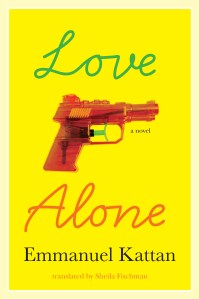
Review | Love Alone, Emmanuel Kattan (Sheila Fischman, trans.)

In Emmanuel Kattan’s Love Alone,  Judith and Antoine were lovers for a brief time. Nine years later, they reunite and revive their former passion. However, they cannot forget the events of the past, and after a violent incident, their relationship spirals down into a nightmarish tale about the effects of sexual jealousy.

The story starts off a bit slow, but becomes much more interesting about halfway through, after the violent incident I mentioned. From the blurb, I was expecting a quirky, darkly comedic book along the lines of War of the Roses. Love Alone does get a bit dark and violent, but was neither horrific enough nor wildly gleeful enough to keep me riveted. It’s a sad, earnest story, yet it didn’t pull me in.

Part of the problem for me is the language, and it’s very possible that this is simply a translation issue. The writing felt stilted to me, stiff and formal at points and overly flowery at others. Take for example:

When I first came here nine years ago, New York was merely a refuge, a cold and unattractive place. I felt lost and I was relieved  not to find anything here that could help me to find myself.

Or, in a news article about a woman whose corpse had been discovered,

According to her sister she had received several anonymous letters, but was determined not to give in to intimidation. The reaction of her colleagues was dismay. “We’re shocked. […] She was irreplaceable,” declared editor-in-chief Ronald Auger.

The language just didn’t flow for me, especially the overly formal construction of “The reaction of her colleagues was dismay.”

There are lines with ideas I find beautiful, taken alone:

Who knows to what degree his eyes have been shaped by temptations he doesn’t even remember, who knows what his caresses to my  body owe to the pleasure that he learned to give to others?

But combined with more awkward phrasing later on, these lines just get lost. I sense this is a translation issue more than anything; it’s possible that, in the original French, the language flowed more naturally.

Kattan also uses to use alternating perspectives, the first person journal entries of Judith interspersed with third person view of Antoine’s experiences. Again, because the language, to my ear, lacked fluidity, these episodes of varying perspectives felt disjointed. The small jumps in time and the number of other women in Antoine’s life also added to my confusion.

Overall, an interesting concept, with some interesting scenes and beautifully written lines, and Kattan certainly doesn’t shy away from showing the brutal nature of sexual jealousy. However, I found the writing a too stiff to be effective in drawing me in to the nuances of Judith and Antoine’s relationship.