
Revolution, Jennifer Donnelly #50BookPledge

Troubled Brooklyn teen Andi has to spend winter break in Paris with her estranged father. Andi’s dealing with a lot: her younger brother is dead, and she blames herself. She finds solace only in her music, but at times, even that isn’t enough to help her deal with her pain.

Over two centuries ago, Paris teen Alexandrine wants to become an actress and ends up becoming a companion to Marie Antoinette’s young son, Louis-Charles. The French Revolution breaks out and Louis-Charles is locked in a tower and starved, leaving Alexandrine feeling helpless about her inability to save him. Alexandrine keeps a diary, which Andi finds. The parallels between both girls are obvious, and Andi finds comfort in reading Alexandrine’s diary.

Andi is a very dark character, and kudos to Donnelly for not shying away from such a potentially controversial protagonist in a YA book. Andi takes recreational drugs, couldn’t care less about her classes (with the notable exception of music) and getting expelled from school, and contemplates committing suicide through most of the book. She is also on psychiatric medication, which causes her to hallucinate about her brother’s death, and sometimes turns to physical pain to escape from her emotions. I expected to get tired of Andi pretty quickly. She often thinks she’s being witty and rebellious, when really she’s just being emo. I generally have very little patience with self-indulgent characters, often wishing they would just get over themselves and do something constructive. That wasn’t my reaction to Andi, however, and I think while it’s mostly because what Andi has been through is so horrible, I don’t even want to imagine how messed up I’d be in her shoes.

Andi’s relationship to Alexandrine is interesting. Andi finds comfort in the hope that Alexandrine’s story with Louis-Charles has a happy ending, despite history stating that Louis-Charles died in the tower. The emotions in Revolution are very raw, and are, I believe, the major strength of the book. I found Andi’s story interesting, with memorable scenes featuring her family, a love interest, and a comically uptight reference librarian. The parallel storyline however isn’t quite as strong. Alexandrine’s story develops into a somewhat watered down version of V for Vendetta. While Alexandrine’s inner struggle – her desire to help Louis-Charles battling with her helplessness against the socio-political forces that work towards his death – remains interesting, her adventures don’t quite have the same level of realism and attention to detail that Andi’s experiences do.

Near the end of the book, the past and the present collide for Andi. Whether it is a hallucination or real is something that Donnelly doesn’t fully resolve, though she does strongly hint that it’s real, and this ambiguity hurts the story, in my opinion. With Revolution’s major strength being the rawness and realness of Andi’s emotions, the need to suspend disbelief to such an extent as the pseudo-mystical events near the end demand I do distances me from the emotions and turns the story into an adventure tale. Granted, Donnelly sets us up for these scenes by establishing Andi’s hallucinations early on. Also granted, this section turns out to be very important for plot development, and helps Andi resolve her emotional issues. I just found it mostly convenient, tying up way too many loose ends, including the mystery behind the musician Andi’s researching for her thesis, and I just wish Donnelly had chosen to complete Andi’s story wholly within the present-day reality. Overall, Revolution is a pretty good book. I can’t call it completely enjoyable, because it deals with such heart-breaking subject matter, but it’s definitely a compelling read.
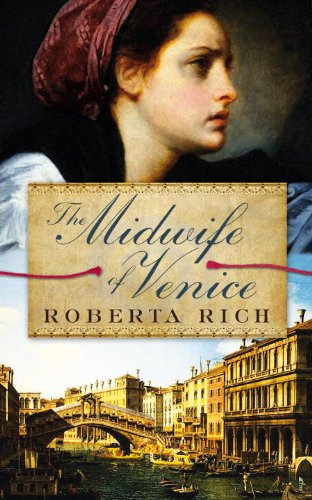
The Midwife of Venice, Roberta Rich

I’d been eyeing Midwife of Venice for a while, and eventually picked it up only because I’d heard about it on Twitter and I wanted something new to read. I’m glad I did – it’s an interesting story, a good blend of romance and cultural conflict.

Hannah, a Jewish midwife, is hired by a Christian nobleman to help his wife who is going through a very difficult childbirth. Despite it being illegal for a Jew to help a Christian woman give birth, Hannah takes the job in order to make enough money to ransom her husband Isaac from slave traders. The novel alternates between Hannah’s story and Isaac’s life as a slave in Malta. Both are motivated by their love for each other, and Roberta Rich communicates the strength of this love without being mushy.

Rich creates some interesting secondary characters. Hannah’s sister, in particular, is very well fleshed out. She’d converted to Christianity, and had been disowned by her family and the Jewish community in Venice, so that when she was having a difficult childbirth and was in danger of losing the baby, Hannah was forbidden to help her. Other minor characters – the nobleman’s greedy brother, the slave trader, the nun – aren’t given the same level of complexity in their own stories, but still add colour and conflict to Hannah and Isaac’s love story.

Minor irritants – I found the ending too neat. On one hand, I cared for Hannah and Isaac, and I found the ending satisfying for that reason. On the other hand, the timing and events all seemed too convenient, so that the ending felt staged.

Also, despite both Hannah’s and Isaac’s stories being compelling, I thought Hannah’s story was developed so much more richly than Isaac’s. We are told, for example, that Isaac’s an amazing writer, and it is by playing Cyrano de Bergerac to the slave trader that he can earn his freedom. But we aren’t shown his writing. Isaac promises that his letter will be so well-written that the recipient would fall in love with even the utterly vile slave trader. Isaac then says at one point that all he needs to complete his letter is the recipient’s eye colour, and is horrified that the slave trader couldn’t remember. With such characterization of romance and poetry in Isaac’s character, I wanted to see for myself just how beautiful this letter is. Another minor point in Isaac’s story is that a woman in Malta falls in love with Isaac, and somehow wants to free him from slavery while still keeping him from Hannah. I wanted to find out more about this woman, and how she reacts to Isaac’s devotion to Hannah. Subtlety is one of the reasons I enjoyed this book so much, but, in Isaac’s story at least, I wish there had been less of it.

Overall, definitely a good read. At its heart, it’s a beautiful love story. It’s refreshing to see a romance where the couple is so secure in their love for each other, with no contrived conflict to make them doubt each other, and where much bigger issues like culture and economics are what keep them apart.

The Unconsoled, Kazuo Ishiguro

The Unconsoled is a challenging read. It’s over 500 pages long, and even though I can usually go through a book or two a week, it took me several weeks to read this, because I found myself having to stop once in a while to absorb what I’ve just read. And it is just so worth it. I’ve read a lot of good books (Ishiguro’s Never Let Me Go among them) last year, but this is the one that I think really blew me away.

The story begins with Ryder, a world-famous pianist, checking in at a hotel in a city he doesn’t know for a concert he cannot remember having agreed to give. Lost and extremely confused, he decides to just go along with it, hoping to learn more as he goes. The story has a very surreal, dream-like quality to it. You know how in dreams, things that wouldn’t make sense in real life seem realistic because they fit in with some weird internal logic within the dream? So many things that Ryder undergoes shouldn’t make sense, and yet we somehow accept that they do, because Ishiguro maintains an undercurrent of internal logic throughout. In this way, we as readers undergo the experiences with Ryder, and Ishiguro keeps us as off-balance as Ryder must be feeling. Ryder is sucked into a whirlwind of publicity stunts, interviews and parties to promote his upcoming concert. Not knowing anything about the concert or his agenda, Ryder sometimes stands back and watches in a daze as things unfold, and other times, he interacts with people, and performs his public relations duties perfectly, though with a sense that he does it all by rote without really understanding why.

It would be easy to dismiss the entire story as just a dream, a completely nonsensical Alice in Wonderland type tale. But as the story progresses, it becomes clear that all these seemingly nonsensical threads are propelling the reader, and Ryder, forward in a very logical, purposeful pattern. Even more important, despite all the seeming superficiality of events, deep, complex emotions are slowly revealed in characters. Even though Ryder walks around in a daze, the other characters are very clear about what’s happening, and are genuinely confused at Ryder’s befuddlement.

Reading The Unconsoled, I went from trying to figure out what was going on to deciding that was impossible and simply sitting back and enjoying the ride. The story’s emotional core crept up on me, as I imagine it must have crept up on Ryder. I started understanding more of what was going on, as I saw Ryder was doing as well. The blurb at the back of my book describes Ryder’s world as possibly ”the day-to-day reality of a man whose public self has taken on a life of its own,” which explains it perfectly, I think. Eventually, all the public relations-type events Ryder attends blur together, with little distinction between them. In contrast, Ryder’s relationship with his family develops in deep, complex ways. We begin to learn less about his public life and more about his private life, and it is only when we do that the story becomes less dream-like, and more real.

I am a major Ishiguro fan, and I especially love the beauty and cadence of his language. He uses it extremely well in Unconsoled, taking readers into a world of dreams and reality and the reality of dreams. Funny, complex and haunting, this is an amazing novel.