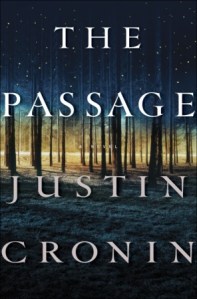
The Passage, Justin Cronin #50BookPledge

For the past couple of weeks, I’ve been lugging around an 800 page hardcover wherever I went, sneaking pages on the subway, in the food court, and practically everywhere else I could find the time. I once attempted to read this 800 page hardcover with one hand, simply because the subway was too jerky for me to keep my balance without holding on to something. My point: Justin Cronin’s The Passage is just very, very difficult to put down.

My one sentence (and completely inadequate) summary of the 800 pages: a military experiment goes wrong and humans must now survive in a world populated by vampires. Vampirism is a virus, and heads up, Twilight fans – these vampires don’t just sparkle; they glow like radioactive glow sticks. Seriously, these vampires are far from Meyer’s vamps, or even Anne Rice’s seductive creatures of the night. Cronin’s vampires are very much like Richard Matheson’s vampires in I Am Legend – savage, blood sucking zombies.

The Passage reads like a movie – action-packed and full of twists. It’s an exciting science fiction/horror thriller and like all good books in those genres, gets you emotionally invested in the characters. I was surprised by that, considering the format of the book. Passage begins in the year 5 B.V. (Before Virus, I presume), chronicling the failure of the military experiment up to Year Zero. Then about a third of the way through, the book makes a leap into the year 92 A.V. Having come to care for in the characters of the first part of the book, it was jarring to be introduced to a completely new cast. The only character who plays a major role in both parts of the book is Amy, a six year old orphan who is seen as a possible solution for the vampire virus. We do find out what happens to some of the other major characters from the B.V. era, and quite honestly, a few chapters into the A.V. era portion, I’d already become so involved in the relationships among new cast of characters that I no longer as interested in what happened to the people from B.V.

The world had completely transformed in almost a century, and the characters in the A.V. era can’t even imagine how the world must have existed before being overrun with the vampire virus. In one of my favourite scenes, two of the characters are talking about Where the Wild Things Are, and finding it hard to understand how such an unrealistic tale could have be so appealing in the Time Before. Peter and his friends cannot afford to indulge in fantasies. Yet they still fall in love, start families, and the little things become even more precious because of the threat that any day, they can all be eaten or infected by vampires. In one of my favourite passages from the book, Maus, who is pregnant, says, “A baby wasn’t an idea, as love was an idea. A baby was a fact…Just by existing, it demanded that you believe in a future…A baby was the oldest deal there was, to go on living.” There’s also a great love triangle between Peter, Alicia and Sara, and I was cheering for Sara (the Eponine figure) all the way.

Cronin intersperses his narrative with passages from journals, ostensibly discussed in conferences 1000+ A.V., which adds a sense of detachment to very emotional material. The way he uses such a segment to end the book left me just thinking: Wow. It’s a wallop of an ending, heightened by the sense of detachment. These segments also raise questions, as Cronin mentions conferences for studying human behaviour. In the long term then, do vampires win? Or, as I prefer to think, humans win and it’s humans in the future studying humans of the past?

Fair warning: Passage ends on a cliff hanger. It’s the first in a trilogy, with the next instalment coming out in 2012, and a possible movie later on. If you find the 800 page hardcover too cumbersome to carry around, Passage is also out in ebook and will be out in paperback this May.
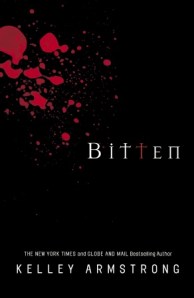
Bitten, Kelley Armstrong #50BookPledge

I read this book after about half a dozen people recommended it to me on Twitter. I also learned that she was doing a book signing in Indigo Yorkdale on April 3rd, so I wanted to find out if I liked her books in time to still have the opportunity to get my book signed. Final verdict: count me in on the Kelley Armstrong bandwagon.

Bitten is the story of Elena Forbes, the only female werewolf in existence, who tries to live a normal human life in Toronto (love that detail, actually, especially since Armstrong really uses Toronto landmarks and streets in her book). Her human boyfriend, Philip, is remarkably understanding of Elena’s late-night walks, where, unbeknownst to him, she turns into a werewolf and runs around the city (where was your partner last night, eh?). Pack Alpha Jeremy (my newest literary crush) summons her back to deal with a mutt crisis. Mutts are Pack-less werewolves, and in Bitten, unknown mutts are killing humans in Pack territory, putting the Pack in danger of discovery. Unfortunately, or perhaps fortunately, for Elena, reuniting with the Pack means living with Clay again, the hot werewolf who was once engaged to Elena, and who clearly still has sparks with her. While reading the book, I called the experience “good wolfy fun,” but in all seriousness, even putting hormones aside, Bitten is such an enjoyable read.

Armstrong has created some fascinating characters, and put them in difficult situations. Elena is a strong, independent woman. In a twist from the ordinary, love interest Clay uses her as bait to draw out the bad guys. While quite understandably pissed off, she admits she would’ve been more pissed off if he’d thought her too weak to take care of herself. Smaller and physically weaker than the other, all-male werewolves, Elena nevertheless gives as good as she gets, and makes for some action-packed fight scenes. Clay is also a compelling character – physically attractive, hot-tempered, total bad boy type who obviously loves Elena. He is overall a bit too aggressive to be my literary crush in this book, but towards the end, he shows a very appealing vulnerability. Jeremy as the Pack is a strong leader who commands respect, but also gets overwhelmed by the mutt attack. Even the bad guys are interesting – each has his own motivations and long-term schemes behind their actions, and just watching them interact is like watching politicians try to negotiate for the best deal.

Bitten has compelling characters and an exciting story with emotional pull. It’s the first of Armstrong’s Women of the Otherworld series, and I’m definitely looking forward to reading the rest of it.

A Red Herring without Mustard, Alan Bradley #50BookPledge

I am a major Flavia de Luce fan. She’s an 11 year old Nancy Drew meets Sherlock Holmes with a Sheldon Cooper-esque IQ, solving mysteries in an Agatha Christie/Caroline Graham world. She boils tea in a Bunsen burner, uses science to play pranks on her older sisters, and misses her mother, who died when Flavia was too young to remember anything about her. Charming, precocious, and vulnerable, Flavia is probably the most endearing heroine I’ve encountered in contemporary fiction.

So I come into Red Herring without Mustard as a fan, and am thrilled to see at the end of the book that there is a Flavia de Luce fan club! The book begins with Flavia accidentally setting fire to a Gypsy’s tent and inviting the Gypsy to park her caravan on Flavia’s family’s land. As any mystery fan knows, it’s never a good idea to accept an invitation from an amateur detective, and (SPOILER ALERT!) sure enough, the Gypsy is murdered.

The mystery itself is a good, solid, convoluted tale. I didn’t find it as interesting as Sweetness at the Bottom of the Pie (The Weed that Strings a Hangman’s Bag is still on my To-Read list), but it’s still a good mystery that kept me guessing. Still, you don’t necessarily read a Flavia de Luce tale for the myriad twists and turns of the plot. A Flavia de Luce tale is a lark, a fun, charming read where you fall in love with Bishop’s Lacey and the characters who live in it. And what a lark this tale is! Without giving too much away, I just have to say, I love Flavia’s mirror trick. Pure genius.

Flavia also comes up with some gems of wisdom that I, as a lifelong mystery buff, just want to highlight and quote to others over and over again. One insight in particular just blew me away: “I’ve recently come to the conclusion that the nursery rhyme riddle is the most basic form of the detective story. It’s a mystery stripped of all but the essential facts.”  Wow. Yes, absolutely yes. The Flavia de Luce stories are an homage to this notion (Bradley’s titles are very nursery rhyme-like), and an homage as well to Agatha Christie, with so many of her mysteries referring to nursery rhymes (One, Two, Buckle My Shoe, Hickory Dickory Dock, A Pocket Full of Rye, “Four and Twenty Blackbirds”). I’m a lifelong mystery buff, and a major Agatha Christie fan, and so this just made me fall even more in love with the Flavia de Luce series.

Bradley also gives us a beautiful look at Flavia’s vulnerability in Red Herring. Flavia finds out a bit more about her mother, and we see how much Flavia wishes she had known her mother, and how much Flavia wishes she could be confident in her mother’s love for her. Flavia is so intelligent that it’s sometimes easy to forget she’s still a child, and Red Herring reminds us of this in subtle, heartbreaking, beautifully written scenes.

Loveable character, wonderful book, amazing series. Someone told me recently that the only negative thing she can say about the Flavia de Luce series is that there aren’t enough books in it. So to that customer and any other fellow Flavia fans, here’s some good news: according to his author biography, Alan Bradley’s already working on the next Flavia de Luce mystery. Any chance of a book tour with a Toronto stop, Mr. Bradley?