
A Visit from the Goon Squad, Jennifer Egan #50BookPledge

Jennifer Egan’s A Visit from the Goon Squad has got to be one of the most hyped books in the past few months. My co-worker had been recommending it since it first came out, but it wasn’t really on my list of books I have to read. I’m not too big a music fan, and to be honest, the idea of a chapter in powerpoint, while intriguing, also turned me off: I’m not too big on gimmicks. What eventually convinced me to read Goon Squad is the phrase “Time’s a goon.” I’d heard of it as a quote from the book, and the significance of that with the title touched me. So I read it.

True enough, when a character utters that line in the middle of the book, I got… well, not chills, but that ineffable pull you feel whenever something touches you deeply and makes you want to reach for something just beyond your grasp. “Time’s a goon” ties together all the seemingly disparate stories within Goon Squad, and makes you realize the breadth of Egan’s tale. Goon Squad begins with Sasha, who suffers from kleptomania, and her boss Bennie, an aging music executive and former rocker. The story then traipses through time, picking up one element in a character’s story and skipping with it into the past, often with a completely new set of characters and an altogether different perspective.

I’d say the story feels like a web, with threads stretching out in different directions and spinning everywhere till it returns to the centre, but it feels more like a hyperlinked cyberweb. You click on random elements, get taken to some other story that’s still somehow connected, and, in the end, return home. I may have been wary of the Powerpoint chapter, but Egan has changed my mind. The Powerpoint, with all its bullets and arrows and random phrases in bubbles, depicts the overall structure of Goon Squad perfectly. Because this chapter is narrated by a younger character, the next generation, so to speak, its form also wonderfully illustrates the drastic changes that come with the inevitable passage of time. And, quite frankly, the powerpoint form turns what could’ve been a maudlin, albeit emotionally significant, chapter into something zippier and more interesting.

So did I like Goon Squad? I liked portions of it, ended up feeling deeply about some of the characters, and I admire what Egan has accomplished. I didn’t completely love it, and that may just be because I couldn’t fit it all into a linear narrative. I found myself caring about a character and wanting to find out more about him/her, only in the next chapter to be taken to a completely new set of characters, or an event in the character’s past. There are a lot of characters, some of whom only appear for a chapter, and after a while, I just got confused about how a certain character knew another (which I knew was explained in an earlier chapter, but which I’d forgotten already).

I liked the Powerpoint chapter, but a couple of the other gimmicks just made me go “meh.” Egan uses footnotes in one chapter, which reminded me of David Foster Wallace, but overall, I found the actual events in the chapter much more compelling. The footnotes were okay, but just that: okay. The thing about text messaging at the end, where a young character gets tongue-tied when she speaks and needs to “T” her responses to someone right in front of her, is funny, kinda sad, and actually reminds me a lot of what’s happening in real life. That being said, Egan then needed to continue with the conceit, and, especially with a little kid texting along, it just started to feel precious. Especially with a lot of phones now having QWERTY keyboards, text language phrases like “4 rEl??” and “no more Ar/lyt” just feels like it’s trying too hard to be hip.

Would I recommend it? Sure. It’s a Pulitzer winner, and there are points when the realization about time and aging, and seeing these characters age in ways they didn’t expect or particularly wish for, is poignant, and heart-tugging. At times, especially in the first chapter, it reminded me of Eleanor Henderson’s Ten Thousand Saints, probably because of the description of music, and the insights on time and aging. Egan does use some clever gimmicks, and for the most part, uses them well, or at least has a good reason for using them (not just gimmicks for gimmicks’ sake). I would’ve preferred a bit more focus, perhaps a more linear narrative or at least less characters. But that would’ve been a different book and not as ground-breaking.
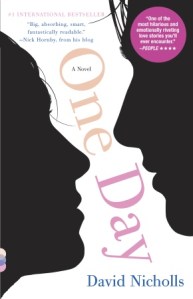
One Day, David Nicholls #50BookPledge

I read One Day on the recommendation of a fellow bookworm who thought it was a good book but hated the ending. My boss at the bookstore loves this book, has recommended it a lot of times, and is looking forward to the movie with Anne Hathaway and Jim Sturgess. So it’s been on my TBR list for a while, and when my bookworm friend lent me her copy, I was excited to read it.

One Day follows the relationship between Emma Morley and Dexter Mayhew over the course of twenty years, depicting snapshots of their lives on the same day (July 15th) each year. They meet in 1988, have sex, and set off to pursue different lives after graduation — Emma as an aspiring writer and Dexter as someone who wants to travel the world and become famous somehow. Their relationship shifts from romance to best friendship, and their lives turn out very different from how they’d imagined it in university. Taking a yearly snapshot is an interesting concept, allowing Nicholls to show gradual character development and long-lasting effects of decisions that characters make. Nicholls is a talented writer, and his characters are complex, interesting people you can imagine being friends with.

That being said, it took me a long time to get into One Day. I found myself bored for the first half of the book. Nothing to do with Nicholls’ writing, and I have to admit, the behaviour of characters and development of Emma and Dexter’s relationship felt realistic. It actually took me a while to figure out why I wasn’t enjoying the book, and I realized that while the yearly snapshot approach is an interesting idea, it made me find the story meandering. I just wanted something to happen already. While I acknowledged the Emma-Dexter chemistry, I found the single day narrative too abrupt — I’d just be getting invested in a plot thread when the day ends, I flip the page and I have to hear about the results through flashback. It didn’t help that I found the young, politically active Emma annoying. Dexter accuses her of being condescending and a know-it-all, and I had to agree. That made me a bit wary about the upcoming movie — I can imagine finding it more annoying on screen.

As Emma and Dexter grow older, however, and become a bit more settled in their respective lives, I found myself becoming more interested in the story. Secondary characters started to become more significant, and Emma and Dexter’s desire to be with each other (not just romantically, but also to connect more deeply as friends) becomes more urgent. That’s what I love most about Emma and Dexter’s relationship: it’s based on a deep friendship; they’re soul mates in a similar (though much less melodramatic) way as Cathy and Heathcliff. It’s a wonderful, touching love story, and Nicholls depicts their connection well.

Like my friend, I hated the ending. Without giving away any spoilers, I just have to say I found it unnecessary. Fortunately, Nicholls is a gifted writer and he handles it much better than I imagine others would have. I also think the one day snapshot format helped him pull off this ending well.

Would I recommend this book? Sure. I can see why so many readers like this book. Despite the movie poster image, One Day is more than just a romance. It’s a well-written look at how two individuals grow up, and, more importantly, grow up together.

The Gathering, Kelley Armstrong #50BookPledge

I was fortunate enough to be able to attend the book signing and pre-launch sale of Kelley Armstrong’s The Gathering. I’ve been to quite a few book events, and I have to say, I’ve rarely met anyone so eager to chat with their fans. Kelley must have been exhausted – I was tired and all I did was stand in line! – but when I saw her, she was still as chatty and cheerful as she was when the event began. Love that.

Even better, she answered a ton of fan questions. As almost a brand-new Kelley Armstrong fan (so far, I’ve read Bitten and The Gathering, and still have the rest of her books on my To Be Read list), I was torn between covering my ears to avoid spoilers and realizing I would completely forget these spoilers by the time I get around to reading her other books. Still, one thing she said stayed with me. When asked about writing supernatural characters, she said she doesn’t think about it that way. It’s not about “Ooh, I’m a werewolf, let’s see what cool things I can do!” Rather, it’s about how an ordinary person who happens to be supernatural deals with living in this world. “If you or your friend happens to be a werewolf,” she asked, “how would you live?” How would you shop, eat, work… what would your day-to-day existence be like?

That’s when I realized why I love her books so much. Bitten is about a female werewolf trying to live in Toronto, and The Gathering is about Maya, a seemingly ordinary teenage girl in a tiny (population 200) town in Vancouver Island. [Spoiler alert, though this shouldn’t be a spoiler for anyone familiar with Armstrong’s work: Maya isn’t an ordinary girl. Hint: she has a paw print birthmark.] It’s the ordinariness of the situations in which Elena and Maya find themselves that make them such relatable characters.

I love The Gathering. I love how Maya is such an intelligent, savvy teenage girl. Maya doesn’t have to deal with the dystopian society Katniss faces in The Hunger Games, but Maya strikes me as a very similar character. She’s also strong and smart. I read a lot of books where heroines get caught up in really dumb situations, usually for comic effect, and I don’t usually mind. But Maya is totally not that kind of heroine – she carries pepper spray, and when she encounters a suspicious looking stranger, thinks, “He had a gun. This was the time to run, not fight.” She’s practical rather than emotional, strategic rather than hysterical. I feel old for thinking this, but if I ever have a daughter, I want her to be that capable at taking care of herself.

As with Bitten, The Gathering has its share of hot guys. Unlike Bitten though (Team Jeremy!), I honestly couldn’t choose between best friend Daniel and bad boy Rafe. Both are smart, caring, vulnerable, and equally capable of kicking ass. The story is intriguing: a “reporter” comes to Maya’s town and is interested for some reason in the teenagers, the town has a medical research lab that you just know is up to something shady… Oh, and Maya’s adopted. She’s happy with her adoptive parents, but again, you just know something interesting about her biological parents will be revealed. Unlike Bitten, The Gathering ends on a bit of a cliff hanger, which is somewhat frustrating – I want to know more! Now!

Bright side, I do have quite a few other Kelley Armstrong titles I can read while waiting for the next book.