
My sister sometimes makes fun of me and how much stock I put in book covers. Browsing through a bookshop or flipping through the IFOA booklet, she’d ask me what I thought of one book or the other, and my response usually is, “Ooh, I love that cover!” or “Meh, the cover doesn’t grab me.” My sister would then ask, “No, what do you think of the story?” and I’d go, “Story?”

Now, I don’t usually buy a book simply because of the cover art. Usually, it takes at least an eye-catching cover and a gripping first page to make me buy a book. That being said, in this age of e-books, it’s even more important for print books to be works of art in their printed form, and I appreciate it when publishers make the extra effort to provide that. One book I boughtprimarily for the book design is Chip Kidd’s The Cheese Monkeys. The story, about an art student and his class, is pretty good, but what really makes this book pop is the book design. Beyond the eye catching cover art, the text on the title page, copyright page and table of contents scroll right off the edges of the pages. Harper Collins offers a view of the first few pages here, but it’s an effect you can appreciate only from the physical book. I love it, and I think it’s a great example of the extra wow factor book design can give a print book.
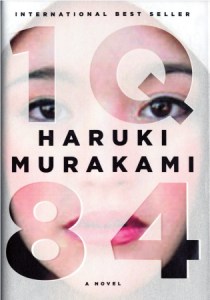 Cheese Monkeys actually made me a Chip Kidd fan, and I am absolutely in love with his latest work — the cover of the single volume edition of Haruki Murakami’s 1Q84. Now this image is beautiful enough, but what the picture doesn’t show is that the book jacket is actually in two layers. An onion skin layer covers the image of the woman, and, my personal favourite part, the portions of the woman’s face within the book title are printed on the onion skin layer and left white on the layer beneath. I can’t remember where I read it, but someone wrote about how the onion skin layer on this cover is defiantly fragile. This seems antithetical to the sturdiness people look for in hardcovers, but it’s also a beautiful testament to the ephemerality of Aomame and Tengo’s love story. I also love that, even with colour e-readers now out, the physical 1Q84 will still have the advantage of design; the e-book version will necessarily merge both cover layers into one image, and it will still be beautiful, just not as beautiful.
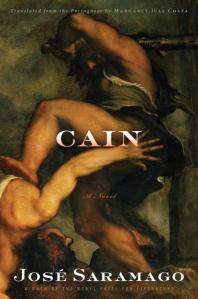
I also love the cover of Jose Saramago’s Cain. Featuring a detail from thepainting Cain and Abel by Titian (oil on canvas, 298 x 282 cm, 1542-44), this cover is both beautiful and powerful. It takes the horror and violence of the Titian painting and makes it personal, by focusing on the brothers. You can almost feel Cain’s rage emanating from the cover. Abel’s death is almost secondary; this is an image of action and movement. You can almost feel that weapon being smashed down. Cain just blew me away, overall. A powerful story, in just as powerful a package.

I am a huge fan of the Penguin Essentials series. I love the cover art so much that I bought that edition of The Great Gatsby, even though I already own another edition of that book. I love the playful cover art, and I love that these books are small enough to tuck into your jacket pocket.
One of my recent favourites from Penguin however is the hardcover edition of Madame Bovary, translated by Lydia Davis. I loved the beautiful, subdued cover so much that I chose to buy the hardcover rather than buy the e-book or wait for the paperback. Then I saw the paperback edition recently, and just love it as well. I especially like how both covers are so different, how they set such a different tone for the same novel, and yet, to me at least, are both equally beautiful.

Paperback

Hardcover

When it comes to Agatha Christie books, I usually love buying super old, ratty, used versions. Call me romantic; I love the idea of a fellow Christie fan having enjoyed that book before me. But the Harper Collins re-releases of Christie’s works have such beautiful covers that I admit I’m tempted to start buying brand-new Christies. You can find a comprehensive list with images on this Agatha Christie website, but here are a few of my personal favourites.


Two of my favourite covers from the past year, both from Anansi:
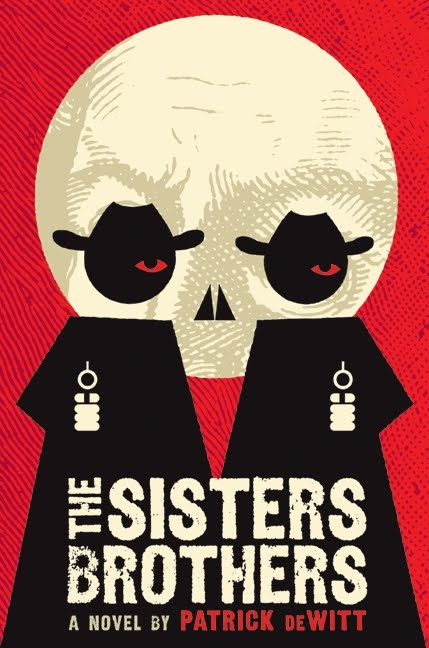 The cover for The Sisters Brothers is just absolutely iconic. Simple, stylized, yet very striking. I love how the Sisters brothers’ heads feature as the skull’s eyeholes. I especially love how the red eyes act as both the eyes of the cowboys (giving them both sinister, one-eyed glares) and the eyes of the skull. You can remove the top and bottom thirds of the cover, and the image is instantly recognizable as The Sisters Brothers, at least for bibliophiles who’ve read so much buzz for this book over the past year. At the very least, I’d say it’s the most striking, most memorable cover among the 2011 Man Booker Prize finalists.
 I also love this cover for Stephen Kelman’s Pigeon English. My boss and I were discussing this cover recently, and she told me she just kept discovering more birds than she expected: “I thought that was just a collar!” At first glance, it’s a simple silhouette with striking colours. But a closer inspection reveals a jigsaw-like fit of birds and boy, and I love that this cover forces you to look closely to see all that.
Finally, a couple of gift editions that I just find so beautiful I think they’re well worth the additional cost:
 The Giver by Lois Lowry changed my life when I first read it, with its story about thinking for yourself and questioning even things you grew up believing were true. I love my copy for sentimental reasons, yellowed pages and all. But this one, with beautiful illustrations by Bagram Ibatoulline, is just absolutely beautiful. I was literally moved when I first saw it. I love that such a wonderful book has been given such a beautiful edition. And I love turning the pages, reading Lowry’s words, seeing Ibatoulline’s art, and just being drawn back in to the magic of Jonas’ world.

Christopher Moore’s Lamb is a classic, a re-telling of the Gospels by Christ’s childhood friend Biff. It’s hilarious, entertaining and just a great book overall, and this is a case, I think, where the design is just perfect for the text. This gift edition of Lamb looks just like an old, fancy Bible, complete with ornate gold lettering and a ribbon bookmark. The utter seriousness of this design is wonderfully cheeky considering the subject matter, and I love it.
How about you? What’s your favourite book cover art? Have you ever bought a book just because, or at least mostly because, it was so beautiful?

 I’d heard that Moira Young’s
  Literary Treats