

What better way for a publisher to celebrate Valentine’s Day than by celebrating a love for books and book lovers? When I got the invitation for Random House of Canada’s Blogger Love Fest, promising “food, fun, books and very special guests,” I was expecting cookies and maybe a free book. Who would the “very special guests” be? I figured we might possibly have an author drop by, or maybe a Random House Canada (RHC) executive who would tell us about their blogger program. To be honest, I got the invitation so long ago that on the day of the event, I completely forgot about the “very special guests” part and was just looking forward to finally meeting RHC online marketing assistant and tweeter Lindsey and to seeing #IndigoTweets pal Jen again.
To anyone not in Toronto, Feb 11th was freezing. Seriously, I went to a Harper Collins event a few months ago and there was a thunderstorm; yesterday, for this event, there was a flash freeze warning. Dear publishers — thank you for making my braving the elements all worth while.
I get into the building and must have looked completely lost because a fellow blogger approached me right away and asked if I was also there for the event. (Giselle — so great to meet you!) Turns out you need a pass to use the elevators, and even though the RHC office is just on the third floor, Giselle and I couldn’t find the stairs anywhere. So we ended up walking around the lobby lost together until a group of women show up and a couple of them had passes.
We got to the office and it was great finally meeting Lindsey from RHC. I love being able to finally put faces to names I chat with a lot online; it’s one of my favourite things about this kind of event. It may be because so many of the bloggers at this event already talk to each other online — the whole atmosphere was so warm and welcoming! Everyone was either hugging people they knew or squee-ing in recognition at people’s names. Random House: brilliant idea to give us all name tags with our blog names on them! The name tags made it much easier to link people to their online persona and to remember names.
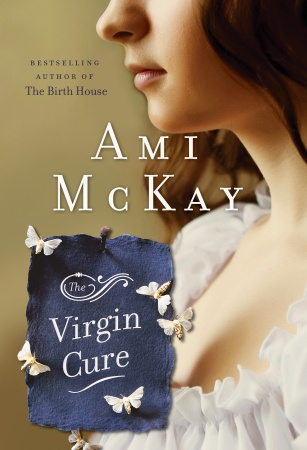


We learned that there were three special guests that day: Ami McKay (Virgin Cure), Paula McLain (Paris Wife) and Erin Morgenstern (Night Circus)! Even better, it turns out Paula McLain was in that group that rode the elevator with me and Giselle! Random House Canada generously provided us all with copies of their books, which we could then have the authors sign. Best part is that the authors were going to be there for the entire event, so we had lots of time to just sit around and chat with them. I have heard such great things about all three books, so thank you, RHC, for this opportunity to meet the authors. Virgin Cure is the only one I haven’t read yet, but I’ve had so many customers gushing about McKay’s Birth House and, months ago, asking when Virgin Cure was to be released, that I can’t wait to read it myself.
I love that Lindsey gave a presentation with excerpts from blogger reviews of RHC titles. I was so excited I tweeted a photo of the first slide, on Night Circus, which included a great quote from Bella’s Bookshelves. My photo turned out really blurry, so here’s a much better one that Angel from Mermaid Vision took:
 As a blogger, this just made me giddy. I get super excited when an author links to my review from his/her website, so seeing a quote from my post on such a professional looking publisher presentation, looking as good as a quote from the New York Times, just made my day. The quote Lindsey chose from my blog was from my review of Alan Bradley’s I Am Half-Sick of Shadows: “[Shadows] features Bradley’s signature mix of colourful characters, mysterious puzzles and heartwarming character relationships.” Okay, I admit it, I love the presentation because it’s such an ego-boost. The idea that Lindsey (or possibly someone else from RHC) actually took the time to read through our blog reviews and choose blurb-worthy quotes like the kind you see from professional reviewers makes me feel how much RHC values bloggers. Thank you for that, Random House Canada!
 Lindsey also talked about upcoming titles from Random House that they’re excited about. I was fortunate enough to have received an ARC of one of them, Grace O’Connell’s Magnified World. I’ve read it and loved it so much I’ve lent my copy to my boss. My review for that will be posted on May 1, when the book will be on sale, but definitely, keep an eye out for it. About a young woman grieving over her mother’s suicide, Magnified World is set in Toronto (with a few chapters set in Port Credit, Mississauga!), and it gives such a wonderful sense of place that I can see it soon becoming part of the canon of Toronto literature.
Another forthcoming title I’m really excited to read is The Unlikely Pilgrimage of Harold Fry. Lindsey described it as similar to Major Pettigrew’s Last Stand, which I love so much that I’ve not only recommended it to many customers looking for a good read, but I’ve also gotten a couple of my co-workers as excited about it as I am. RHC says they’ll be doing some kind of walk-related event to promote Harold Fry — possibly a walking tour of Toronto with Shawn Micallef or a walk for charity event? Cass from RHC also mentioned an upcoming Dr. Seuss event — no idea what it is, but it’s Dr. Seuss, so count me in.
RHC had two tables of books, shirts, mugs and pens, and invited us to take home anything we wanted. Seriously, it felt like more like Christmas than Valentine’s. I saw a copy of Chuck Palahniuk’s Damned on the table — I’m a huge Palahniuk fan, ever since Fight Club, and, unable to believe I could be so fortunate, asked out loud, “Wait, anything on the table?!” Someone nearby confirmed, and like a rabid shopper on Boxing Day, I took (okay, grabbed) the Palahniuk. RHC even gave each of us a Valentine’s Day gift bag with books! When I saw the row of gift bags, I figured they had a couple of books each and we could each get one at random. To my surprise, each one was labelled. So each bag contained books chosen specifically for each blogger by the online marketing team. Way to make a girl feel special, RHC — thank you!
Other blogger posts on this event:
Zara Alexis: A Bibliothape’s Closet
Mermaid Vision
A Cupcake and a Latte
Just a Li’l Lost
Lit, Laugh, Love

 Literary Treats