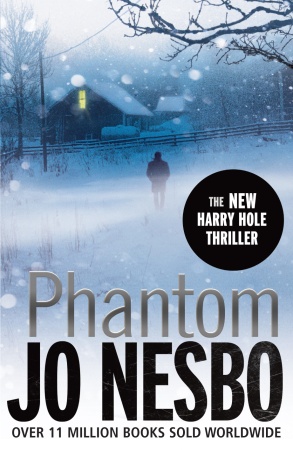
 Holy crap. WTF Jo Nesbo?! That was all I could think as I finished Phantom, the ninth and latest book in the Harry Hole series (seventh to be translated into English).
Confession: I’ve had an author crush on Jo Nesbo ever since I saw him read at the International Festival of Authors (Most. Intense. Eyes. Ever.) but I’ve never read a Harry Hole novel until Phantom. And holy hell, what a book to start with!
First, I have to admit, the beginning didn’t grab me. A chapter narrated by a rat? Worse, this rat narrates a few other chapters in the novel. In contrast to the excerpt from The Leopard that gave me nightmares after Nesbo read it at IFOA, this chapter from a rat’s POV just made me go “meh.”
Fortunately, the story picks up right after. Harry Hole returns to Oslo after three years, and we are immediately plunged into a seamy neighbourhood, where Harry notices a drug dealing set up that had been used in the 80s and 90s, but has since been dropped. “Had the police started arresting street dealers again?” Harry thinks, and it’s a wonderful, atmospheric set up for the mystery to follow.
Throughout the novel, we feel how weary Harry has become, how much he wants to give up dealing with criminals and just retire to a peaceful life in a different country. When we first meet him in Phantom, he already has a facial scar, presumably from an earlier novel, a “path left by the nail from his time in the Congo. It stretched from mouth to ear like a badly sewn-up tear.” Nesbo also includes references to the Snowman case later on, and we get the sense that all Harry wants to do is leave Oslo forever and take the rest of his life to heal.
Unfortunately, a 19-year-old junkie has been shot, and convicted for the crime is Oleg, the 18-year-old son of Rakel, the only woman Harry has ever loved. The case is closed, but Harry feels the need to help this boy he considers a son, and the only way Harry knows to help is to be a policeman and find the truth. Who really killed the junkie? As Harry investigates, he is pulled deeper into the world he thought he’d already escaped, with drug cartels and potentially corrupt police officers. He learns that Oleg has been involved in dealing a drug called violin, a more potent version of heroin, and he struggles with the guilt of having left Oleg behind. To top it all off, Oleg refuses to talk, and someone wants Harry dead.
This is Norwegian noir at its finest. The mystery is compelling and convoluted — I kept changing my mind about who I could trust. Nesbo’s Oslo is wonderfully atmospheric — like Ian Rankin’s Edinburgh and Donna Leon’s Venice, Oslo is as much a character as Harry Hole. We become as weary of the deceit, corruption, and especially the desperation-tinged lives of addiction as Harry becomes.
The crux of Phantom lies in Harry Hole himself. I’ve only just met the man, and already I want to give him a hug. Oleg and Rakel have clearly been hurt by Harry’s dedication to such a horrifying career, and Harry’s own pain at his separation from them feels very real. I love this passage, where Harry speaks about a photograph taken years ago of him, Rakel and Oleg:
“When I look at a photograph that’s how I remember it. The way we were in the photo. Even if I know it’s not true. […] But perhaps that’s why we take snaps,” Harry continued. “To provide false evidence to underpin the false claim that we were happy. Because the thought that we weren’t happy at least for some time during our lives is unbearable. Adults order children to smile in the photos, involve them in the lie, so we smile, we feign happiness. But Oleg could never smile unless he meant it, could not lie, he didn’t have the gift. […] I found a photo of the three of us on his locker door in Valle Hovin. And do you know what, Rakel? He was smiling in that photo.”
This is especially poignant when put together with the scene where Harry first sees the photo: he thinks about how he looks like he doesn’t belong in that family, then wonders:
Was that really him? Harry could not remember having such gentle features.
You can’t help but feel for the man, for all he’s survived, and you can’t help but cheer for him to win this case — not just solve the mystery, but patch things up with Rakel and Oleg, and have that family he longs for so badly. That’s why it’s especially painful whenever he thinks he’s solved the case and is all ready to leave Oslo, only to realize that he’s missed something out.
I remember the exact moment I realized who the killer was, and how the novel would end (page 400, if you’re interested). It was an idea that had been flitting about my mind at various points in the novel, but it was only near the end that I realized there was only one solution possible. And yet a part of me still didn’t believe it until the very last chapter. All I can say about this ending is: bravo, Mr. Nesbo, bravo. Also, of course, holy crap, WTF?
Fans of Norwegian noir, Ian Rankin’s John Rebus series, mysteries and thrillers in general, and, most especially, long-time fans of Harry Hole — definitely check this book out. So good.
Oh, and just because… 🙂

Jo Nesbø © Stian Andersen | jonesbo.com

 Kelley Armstrong cranks up the action in The Calling, Book 2 of the Darkness Rising trilogy. At the end of Book 1, The Gathering, Maya and her friends have been rescued from a forest fire by a helicopter. Maya has discovered that she is a skin walker — able to communicate with animals and will eventually have the ability to change into an animal herself — and that her hometown has mysterious links to a research facility that appears to be genetically breeding children with supernatural powers. In The Calling, a dramatic helicopter crash leads to Maya and her friends stranded in an unfamiliar forest, pursued by a corporation that wants their powers.

 Literary Treats