Review | Lucretia and the Kroons (Novella), Victor LaValle

Being young didn’t protect anyone. Horrors came for kids too. [p. 163/4]

For twelve-year-old Loochie, the horror is that her best friend Sunny is dying from cancer, and no matter what she does, she is helpless to save her. I liked the beginning of this novella — all Loochie wants for her twelfth birthday is to celebrate with Sunny. Unfortunately Sunny is undergoing treatment and so is unable to attend the party Loochie’s mom throws for her. I like LaValle’s delicacy in depicting the mother/daughter relationship — Loochie’s unwillingness to believe that Sunny’s condition is irreversible, contrasted with her mother’s gentle suggestion that she make friends with other girls (somewhat insensitive, but still well-intentioned). I’m a sap for stories about people dealing with loss, as you can see in my highly emotional review of A Monster Calls), and LaValle’s beginning made me think this novella would be emotional as well.

Unfortunately, it falls apart for me once the story really gets going. Lucretia and the Kroons is about Sunny going missing, and Loochie having to travel to the mysterious apartment 6D to rescue her. 6D is ruled by the Kroons, creatures who have reportedly used crack (according to Loochie’s older brother) and have parts of their faces missing. The Kroons appear mostly as zombie creatures who, for some unknown (at least for most of the novella) reason, keep kids in their lair forever, and Loochie believes they now have Sunny.

There are several ways this story could have gone, and I was hoping for a masterfully crafted horror tale that also works as a metaphor for Loochie’s fear at losing Sunny. Instead, I thought the story was a mess. It was confusing, unable to work either as a full on horror piece or a realistic story. As Loochie explores 6D, part of her wonders how a park or any of the other locations and structures she encounters could exist inside an apartment unit. Her confusion is understandable; unfortunately, LaValle never develops his world fully enough for the reader to grasp it either. I eventually just had to ignore all the references to 6D being an apartment unit (the entire “real”/realistic world) just to make sense of the story’s geography.

Loochie’s search for Sunny and her attempts to outrun the Kroons also felt very disjointed. I can understand Loochie not having a plan on how to locate Sunny, but there didn’t seem to be a logical sequence either in her search. I could follow the thread up until she entered 6D, then the events just seemed haphazard. As well, because we didn’t really understand anything about the Kroons, beyond the fact that they looked like zombies, there was never a sense of real menace about them. It is possible to make a frightening monster without much detail (again, see A Monster Calls), and I can understand Loochie not knowing exactly why the Kroons are scary. However, there just isn’t enough about them for the reader to grasp, which makes this reader, at least, not care.

The story progresses as expected, and once we get touches of the real world, particularly about Sunny’s condition, the story strikes some minor emotional notes. But it’s difficult to lose oneself in the deeper layers of the story when the basic framework itself is so unclear.

The last couple of pages, giving a glimpse into Loochie’s life at thirteen, make sense only to remind us that this novella is a prequel (or companion piece, as it’s called in Goodreads) to LaValle’s novel The Devil in Silver. Perhaps reading that one will give me a better appreciation of this novella. As a stand-alone, Lucretia and the Kroons may have some highlights, but the central action was just too problematic.

+

Thank you to Random House Publishing Group for sending me the e-gallery of this book via Net Galley in exchange for an honest review.
Author Encounter | Rachel Joyce

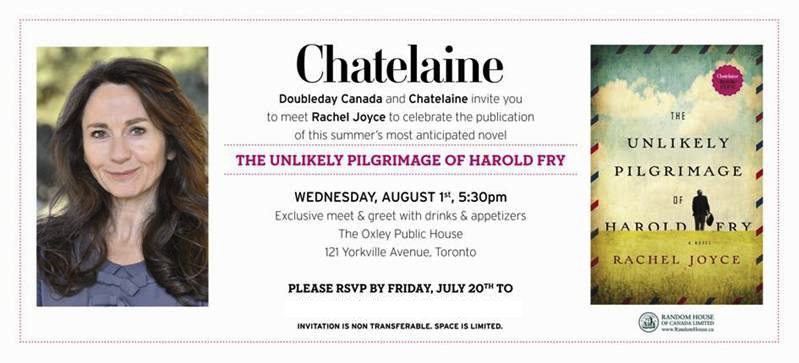
I have been looking forward to Rachel Joyce’s The Unlikely Pilgrimage of Harold Fry ever since the Random House Canada Blogger event, where the book was compared to Major Pettigrew’s Last StandSo when I received the following invitation from Chatelaine Books, I was so excited I sent in my RSVP right away.

The story of Harold Fry begins when he receives a letter from an old friend who has fallen ill. On his way to post a response, Harold instead makes the decision to walk across England to see his friend in person. I’m not much of a romantic, but the image of an elderly man painstakingly making his way across a nation just to see an old friend struck me as lovely. For some reason, Harold reminded me of Stevens, the butler from The Remains of the Day, and a character I imagined as dignified and honourable caught my interest. I still haven’t read the book, so I have no idea how accurate my impression of Harold’s character is. However accurate I turn out to be, however, this is still a testament to the power of Joyce’s concept that her story has captured my imagination so strongly even before I’ve opened the book.

Then, as if I needed even more reason to be excited, the week before the event, I learned that Harold Fry was long-listed for the Man Booker Prize. So, even before I read Harold Fry and post a review, if you’re thinking about checking this book out, know that the Man Booker jury has given it a thumbs up. And yes, I have to admit, the idea of meeting a Man Booker long-listed author in person did have a thrill.

Image courtesy of The Oxley website

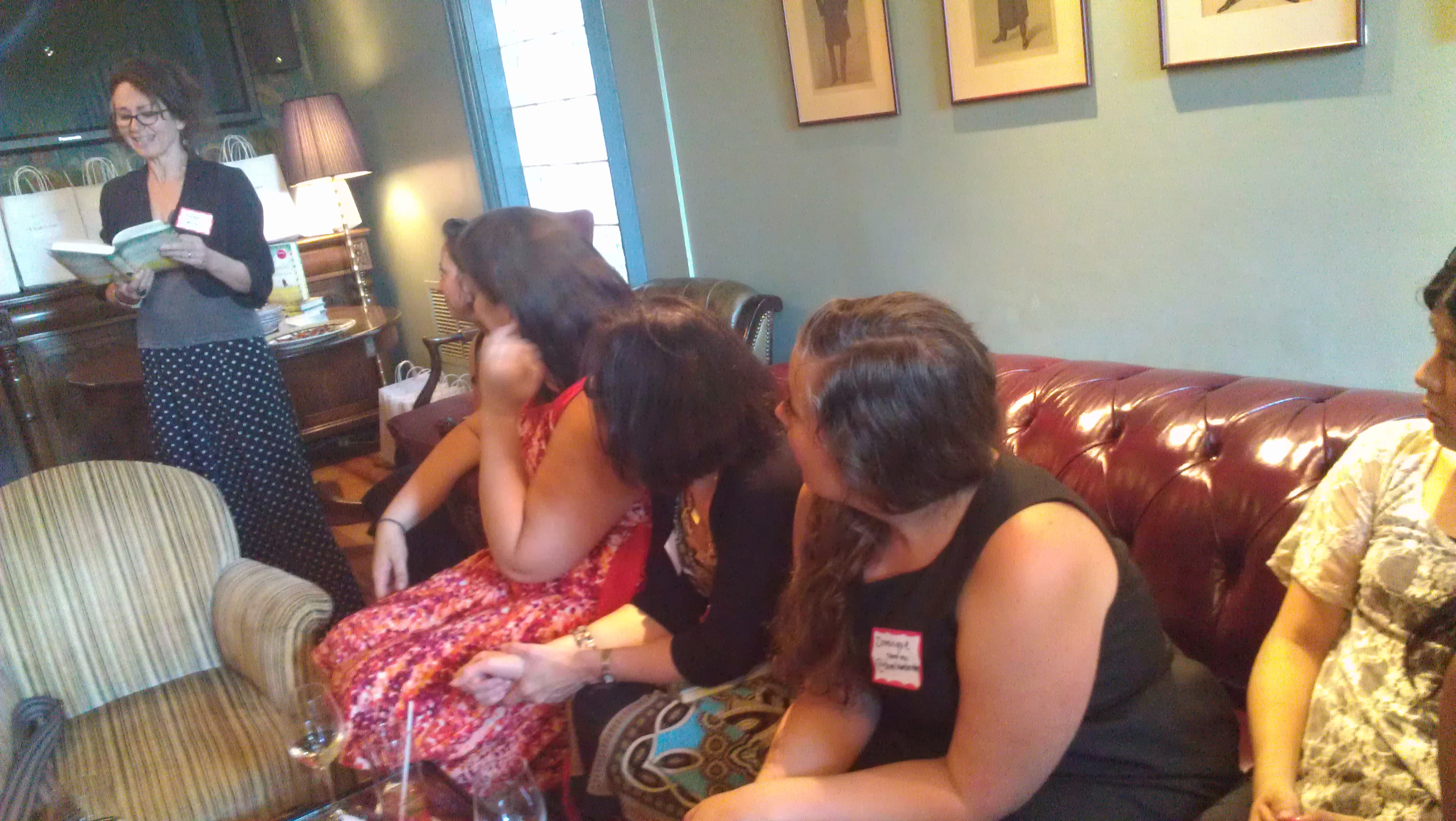
Thank you to Chatelaine Book Club for an awesome event. The Oxley Public House is gorgeous! When I heard the event was going to be at a pub, I was expecting a long table by the bar, or perhaps mingling around a few tables. Instead, it turns out Chatelaine booked the second floor bar, which looks like an old English drawing room.

The bartenders were really friendly. I saw one of them flipping through a copy of Harold Fry in the latter part of the event, and talking to his colleague about it. I love that they seem to be excited about the book as well, and I think I saw Chatelaine give them copies as well, which I thought was really sweet.

The food was also delicious — we had lovely fancy hors d’ouevres, but what I really remember is greasy fish and chips in paper cones. It fit in well with the British ambiance, and I at least mastered the art of eating fish and chips from one hand while still holding my martini in the other.

Rachel Joyce is just lovely in person. Laurie, the Books Editor at Chatelaine, said Harold Fry made her and her colleagues sob, literally. When Rachel read an excerpt, I had an uncomfortable feeling I’ll have a similar reaction. In the excerpt Rachel read, Harold calls the hospice where his friend Queenie is:

“Tell her Harold Fry is on his way. All she has to do is wait. Because I am going to save her, you see. I will keep walking and she must keep living. Will you say that?”

[…] “I see,” said the voice slowly, as if she had picked up a pen and was jotting this down. “Walking. I’ll tell her. Should I say anything else?”

“I’m setting off right now. As long as I walk, she must live. Please tell her this time I won’t let her down.” [p. 19]

After her reading, Rachel explained how Harold’s story, originally written for radio, was inspired by her father being diagnosed with cancer. He was told it would be terminal, yet even after his operation, while lying in his hospital bed, her father would be dressed in a suit and tie, as if on his way to work. Harold Fry is Rachel’s way to honour her father’s legacy.

The book, Rachel says, has gone on a pilgrimage of its own. With each new reader, and in so many countries, Harold Fry has travelled far beyond her and her tribute to her father. I love how genuinely overwhelmed she seems at how much her book has touched so many people’s lives.

Rachel’s story about her father, along with the excerpt she read, touched me deeply. I wasn’t with my mother when she passed away, and I remember vividly the desperate plea — to god, to the universe, to whoever, really — to have her hold on at least until I arrived. I knew it was futile, even selfish, yet part of me wished I lived in a book or movie, where the big dramatic build up just makes the happy ending so much sweeter. So from Rachel’s excerpt alone, I’m rooting for Harold all the way. I don’t know if he’ll make it to Queenie in time; I don’t even know how much the race against time will play into the story. But I am rooting for him. This book has just become personal.

Thank you to Chatelaine Books and Random House Canada for the opportunity to meet Rachel, and to get together with fellow bloggers. It was a wonderful experience, and I look forward to reading the book.

+

Rachel Joyce will be reading at the International Festival of Authors in October. Stay tuned to the IFOA website for updates on her schedule. Trust me: you’ll want to hear her read.

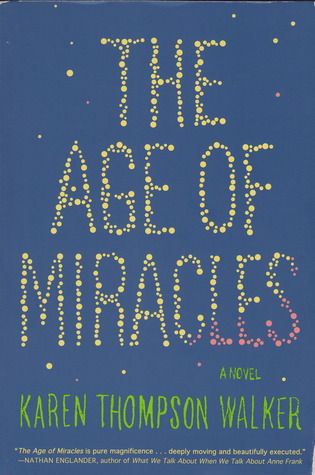
Review | The Age of Miracles, Karen Thompson Walker

What a lovely, lovely book! Karen Thompson Walker’s The Age of Miracles takes a terrifying science fiction idea and turns it into a touching coming of age story. When the Earth’s rotation begins to slow, eleven year old Julia barely even notices. Some people were terrified about the end of the world, but when the entire world is affected, where can you run? The effects are slow but inexorable, and even as a reader, panic turns to horror and, eventually, to resignation. Julia’s world is ending, and Bruce Willis isn’t about to launch a spaceship to save it.

This then is where the power of Walker’s story lies: when you can’t prevent the end of the world, what else is left but to live your life as best you can? Walker creates a complex world, and offers social commentary. Society, for example, is divided into those using clock time (following the 24-hour clock despite the schedule of daylight) and those using real time. “I’ve never liked her lifestyle,” Julia’s mother sniffs, speaking of real time user Sylvia. “It’s not our business how she chooses to live her life,” Julia’s father responds. This type of conversation sounds familiar, eh? The world stops spinning, people will go on being judgmental. Another real time user tells Julia’s family:

You probably think we’re a bunch of pipe dreamers out here […] but it’s just the opposite. We’re not the ones in denial. […] We’re the realists. You’re the dreamers. [p. 214]

Indeed, the clock time users are dreamers, desperately clinging on to a world that no longer exists. Ostensibly about something as quotidian as telling time, Walker creates a powerful metaphor here, a searing portrait of our own society.

Even more potent perhaps is the deeply personal thread to this story. In an especially poignant scene, Julia decides to buy herself a training bra. This insistence on a ritual of growing up, even in the face of the world ending, is a lovely fist pump against circumstances. It also stands out as one of the few times Julia, an all-around good girl who hesitates to cut class even with the world going topsy turvy, deliberately defies her mother. It’s that important to her. And that’s why it’s utterly heartbreaking when she gets home and realizes the bra is much uglier than it seemed at the store:

One of the seams was already coming loose. Even worse was the way the cups rippled unsexily across my chest, like two empty water balloons waiting to be filled. [p. 155]

It’s a young girl’s heartache, and a deeply moving reminder that she may never have the chance to fill those cups. Julia’s concerns about family, friendship and friendship are all rendered even more poignant by the urgency, and inevitable futility, of her situation.

The ending, the final chapter in particular, is absolutely beautiful.

+

Thank you to Random House Canada for a finished copy of this book as a prize in the Random Reader Challenge: John Irving. I read this book as part of Random House’s Random Reader Challenge: Debut Novels.