
Review | Trevor, James Lecesne

The story that inspired the Trevor Project, a 24-hour crisis intervention and suicide prevention lifeline for LGBTQ youth, James Lecesne’ Trevor is a young adult novella whose power lies in its simplicity. Lecesne notes in his Afterword, young adult novels these days “are full of complex lesbian and gay characters.” He cites as examples authors like David Levithan, Alex Sanchez, Jacqueline Woodson, Bill Konigsberg and Mayra Lazara Dole. Unfortunately, stats still show that LGBT youth are “four times more likely to attempt suicide than their heterosexual peers.” I haven’t had a chance myself to read YA that deal with LGBT issues, but I applaud any author who is able to positively change the life of a troubled youth through fiction.

When I think of the issues facing LGBT youth, I imagine kids feeling ostracized, possibly bullied, simply for being attracted to people of the same gender. Possibly because I only really started thinking about these issues as an adult, or perhaps because my friends from school who are LGBT are fairly open about their sexuality, but I never really thought much about the confusion aspect of the experience. I suppose the Q part of LGBTQ (which I learned from this book stood for questioning) was something I was intellectually aware of, without really thinking about what it really means.

That’s why Trevor was such an eye opener for me. The protagonist, a thirteen year old boy, does not identify as LGBTQ. He’s a teen who happens to love Lady Gaga and wants to build a career in theatre. He doesn’t understand why his long-time best friend is suddenly avoiding him, or why a guy he forms an immediate connection to is not allowed to talk to him on the phone.

I found it striking that Trevor doesn’t actually say that he’s in love with Pinky — he’s “the coolest guy I had ever met,” but the whole idea of being attracted to other guys isn’t something Trevor ever really allows himself to reflect on. Rather, his classmates do that for him — calling him derogatory terms and telling him that his interest in musical theatre is “so gay.” In a rather disturbing, yet quite realistic, moment, Trevor’s best friend gives him the friendly advice to be careful.

“Careful?” I said. “Of what?”

“Of becoming a gay,” he answered. “Boys doing it with boys is gross, and you can end up a pervert. Or worse.” [p. 36]

Note that at this point, Trevor has done nothing more than form a new friendship. It’s disturbing to see a friend pigeonholing him into a label, worse still to see it as friendly advice, confidently given.

The whole pressure to be labelled is a recurring theme throughout the story. Trevor deals with it with humour and utter bafflement, which only heightens the emotion at the realization that the situation is actually bothering him much more than he lets on. In a real eye-opener (for me, at least), Trevor says that the Gay Straight Alliance members were the worst, because they kept insisting he identify as homosexual. When he asks them to leave him alone,

They suggested I consider labelling myself as “Questioning” and leave it at that. Or maybe I could declare myself an “ally.” I asked them why I needed a label at all; why did I need to declare myself as anything other than Trevor? Isn’t that enough? [p. 54]

Apparently not. He is bullied for being gay before he even realizes himself whether or not he is gay, and the inability to escape from a label his classmates affix on him is what eventually pushes him past his breaking point.

The story progresses a bit too quickly for the author to really delve deep into Trevor’s psyche — it’s more a narration of events than an in-depth look into his mind. The events are told fairly casually, and the drama lies in the events themselves rather than in Trevor’s reflections on them. The author therefore lets Trevor’s story speak for itself, without trying too hard to elicit emotion from the reader, which actually heightens the impact of the tale.

Trevor is a compelling novella, told in engaging, straightforward language that belies the complexity of emotions its protagonist undergoes. The novella also includes information on the Trevor project, as well as other resources for LGBT youth. An eye-opening book, one that will resonate not just with LGBT youth, but also with anyone who has been labelled as different, and pigeonholed into that label.

A portion of proceeds from the book will benefit the Trevor Project.

+

Thank you to Random House Canada for a finished copy of this book in exchange for an honest review.

Review | The Kill Order, James Dashner

To be fair, I haven’t read The Maze Runner. So while the prologue with Teresa and Thomas may have resonated with Maze Runner fans, I was just mildly curious. Also to be fair, this series is written for a younger audience, though with the narrative sophistication of contemporary YA, that probably shouldn’t say much. If you like Maze Runner, I hear this book is very similar, and so you’ll probably like it as well. If you haven’t read Maze Runner, this book is still fairly easy to follow, though personally I’m wondering if Maze Runner has a more interesting storyline. The prologue, at least, was intriguing enough to make me curious about the original trilogy.

The Kill Order is the prequel to the best-selling Maze Runner trilogy. Sun flares have destroyed a huge chunk of civilization and now a mysterious virus, originally spread by poisoned darts, is turning survivors into raging lunatics. The story follows Mark, Trina and their friends as they struggle to survive. I originally assumed Mark and Trina were teenagers, both because this is YA and because of the way they act. But a passage describes Trina as a woman, so I’m not completely sure about their ages.

The Kill Order is mostly an action-packed apocalyptic zombie story. I liked that Dashner showed how Mark and his friends had to sometimes make the difficult decision to leave behind infected friends. I also really like the Mark and Trina romance and wish Dashner had explored that a bit more. The fight scenes are fast-paced and suitably gory, and descriptions of infected individuals are definitely shudder-worthy.

Kill Order reminded me somewhat of a simplified, YA version of Justin Cronin’s The Passage. The main difference is that Kill Order focused a lot more on the action at the expense of character development. Dashner has created some interesting characters, in particular the heroic elderly soldier Alec, whose sense of duty and emotional connection to fellow soldier Lana compels him to keep going. I only wish there was more character development. I usually like action-packed books, but Kill Order was mostly just confusing, and I ended up caring a bit about characters’ relationships (e.g. the Mark and Trina romance), but not much about the characters overall.

The best part of the novel is when we find out the real reason behind the virus. From an action-packed but mostly aimless zombie story, The Kill Order reveals the beginnings of political commentary. I wish Dashner had explored that angle a bit more — I would’ve loved to find out more about the story behind the people who committed such an act, and how they would’ve reacted to seeing the unintended consequences. I’m unsure if this is explored in Maze Runner, but there are definitely interesting implications from the revelation.

+

Thank you to Random House Canada for a finished copy of this book in exchange for an honest review.

Review | The Emperor of Paris, CS Richardson

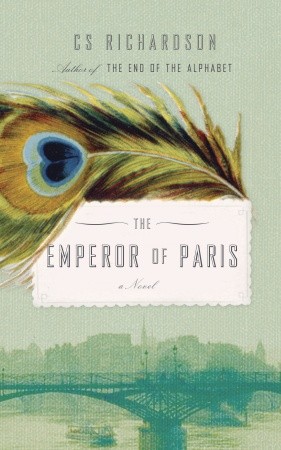
CS Richardson’s The Emperor of Paris is a beautiful book. When I received my review copy, I could barely put it down — the cover, the design on the inside covers and the first few pages are all absolutely beautiful. Kudos to Kelly Hill and Terri Nimmo for such a lovely book design.

Richardson’s story, about the circumstances leading up to the meeting and falling in love of an illiterate Parisian baker and a disfigured woman who loves books and art, is similarly beautiful. I do think it’s the kind of story you need to be in the mood to appreciate — Richardson’s words are clearly meant to cast a spell on the reader and transport the reader to an a historical Paris with an almost magical glow. I happened to read my copy in a coffee shop, and while I enjoyed the story and appreciated the author’s craft, I wasn’t quite transported. I think it’s partly because I had been looking forward to the romance between Octavio (the baker) and Isabeau (the woman), but instead the story focused on the lead up to that romance, as well as the stories of the characters around them. So I was disappointed by the limited interaction between the Octavio and Isabeau. Or perhaps I would have appreciated it more if I were in a different environment, one where I could really lose myself in a fairy tale.

Richardson’s story reads like a fairy tale. While there are references to the war and to soldiers, the language evokes sensation and a sense of timelessness rather than situates the tale within a specific historical framework. There are figures rather than characters, and even though each person in the story has a quirk or defining characteristic that adds texture, they exist mostly to add to the fabric of their community, and form a lush, colourful mosaic. Storytelling forms a big part of the narrative, and Emperor of Paris is more a love story about storytelling as it is a love story between individuals. Isabeau, born to parents obsessed with beauty and disfigured by an accident at a young age, finds refuge in stories. She loses herself in books, but more than that, she also immerses herself in the beauty of visual art. The paintings in the Louvre themselves have stories to tell, and their beauty provides Isabeau a place behind which to hide her own physical flaws.

The significance of storytelling for Octavio and his father and grandfather is even more profound, because their illiteracy compels them to create stories rather than read them. There’s a wonderful moment when Octavio’s father shows him an image from a newspaper of someone getting shot, but then covers the image of the gunman, then asks him what he thinks is happening in the photo. The father-son dynamic in crafting a whimsical tale out of what was originally a horrific image is compelling, and provides one of the most powerful moments in the novel. Octavio’s weekly ritual, later in the book, of going to the Louvre and creating stories from those paintings is both a means to bring him into Isabeau’s world and a touching continuation of a family tradition.

It’s a beautifully written book, and, befitting a story so much about the power of storytelling and visual art, it’s also beautifully packaged. I do think the narrative style requires a bit of receptiveness and desire to fall under its spell. I, unfortunately, wasn’t spellbound, but I do look forward to giving this book another try, perhaps in some musty basement archives of an art gallery, or in a sidewalk cafe far from the city, chocolate brioche in hand.