
Review | Lean In, Sheryl Sandberg

16071764I’ve had Sheryl Sandberg’s Lean In on my Books to Read list for a long time. I believe passionately in her argument that women shouldn’t be afraid to “lean in” and go after what they want. I also saw a tweet from the Lean In organization which posited the question: “What would you do if you weren’t afraid?” This was from Sandberg’s book, as well as an aphorism on her office wall. I also just learned that Lean In has begun using this as a campaign. It’s a great question, a very powerful one, and one that I believe we all need to ask ourselves more often.

Sandberg acknowledges that there are many factors that prevent women from achieving equality in the workplace — social structures, unjust legislation, etc. Yet she also argues that part of what holds women back is internal, and since this is something we can change in ourselves, this is what she chooses to focus on. Her book makes some really interesting observations on how we (perhaps unconsciously) hold ourselves back. For example, after giving a talk on gender equality, Sandberg is approached by a young woman who says she learned from the talk not to put her hand down. Near the end of the talk, Sandberg said she had time for only two more questions — all the women with their hands raised immediately put them down, whereas the men kept theirs raised, and so were called on. Sandberg was horrified that she, even given the topic of her talk, hadn’t noticed the gender disparity at the end. More importantly, however, she uses this example as a call to action for women: keep your hand raised, because even a manager attuned to gender issues may not notice you if you don’t.

The book is filled with many similar examples. As a woman, I found myself realizing how many of these behaviours I am guilty of myself. She makes the case for women needing to lean in more at the corporate table and for men needing to lean in more at the kitchen table — certainly a gender double standard that is slowly shifting, and yet still has a long way to go. She also notes the disparity in gender attitudes towards work, where women are more likely than men to hold themselves back on the off-chance that a higher position would interfere with future child-caring responsibilities.

Some of what she writes is good advice for the workplace in general. For example, she talks about the importance of mentors. She writes about how many young women have asked her to be their mentor, and how when giving a talk to a graduating class, a couple of male students asked about company strategy and a couple of female students asked about more personal things, including how to find a mentor. Sandberg cautions against looking for a mentor as if looking for Prince Charming. Women, she says, are taught from a young age to await rescue, and this is an attitude that needs to change. She does give a few tips on how to go about finding a mentor, but ultimately, it shouldn’t be seen through the lens of a Disney Princess.

Sandberg advocates for setting your own limits for a work-life balance. She gives the example of a company whose employees quit because they felt burned out, and yet the boss later noticed that all of these burned out employees had unused vacation days. As that boss told Sandberg, the company will always make demands of you; it’s the employee’s responsibility to set the limits on how much they are willing to do. Granted, that’s rather naive, particularly when needing to work multiple jobs just to make ends meet, but it’s still advice worth heeding.

I only wish Sandberg had delved deeper. Her arguments are primarily anecdotal, and therefore limited. Even her examples usually focus on public figures or people she knows personally, who are inevitably CEOs or other people in power. She acknowledges her privilege and admits that for women not in power, it may be more difficult to do the things she suggests. I agree with her argument that even with those circumstances, a drive to “lean in” may still be helpful; I only wish she’d included stories and anecdotes from women who haven’t yet achieved the top of the corporate ladder.

The book as well focused only on the challenges women with children faced. As a single woman without a desire to start a family anytime soon, I wish Sandberg had gone beyond arguing that a family life and a successful career aren’t mutually exclusive. What about the issues single women without children face in the workplace? I understand that this book is primarily anecdotal, but when coaching women to “lean in,” I expected some discussion about a wider range of circumstances that prevent women from doing so.

Sandberg does give one example on this subject, with a woman complaining that she has to pick up the slack because her co-workers’ time with their children takes precedence over her own free time. Unfortunately, that woman then continues by saying that her going to a party is just as important as her co-workers’ spending time with their kids, because it’s by going to parties that she can meet a man and then start her own family. In principle, I agree that her right to go to a party should be given as much respect as her co-worker’s right to attend a child’s soccer game. But again, why does the right to go to a party have to be justified by the desire to start a family?

Even when Sandberg tries to be inclusive, she maintains a very narrow view, and I can’t help but think of all the different voices that were left unheard. Single women, women of colour, women from a lower income bracket, and so on. Understandably, no one book can hope to encompass the full range of issues women face in the workplace. However, the core of Sandberg’s message is so powerful, and so important I think for women to heed, that I really wish she’d made more of an effort to represent more of women’s voices.

Review | Smile at Strangers, Susan Schorn

I remember the first time I tried karate. I have never been athletic, and admittedly, one of the appeals of karate class was the rather low-key way the teacher introduced me to the drills. I may not be able to do a jumping, spinning, flying back kick, but even unathletic, uncoordinated me is still perfectly capable of forming a fist and throwing a punch. And the kiai? I thought I could at least mask the wobbliness of my kicks with a karate yell loud enough to rattle windows.

Here’s the thing about karate: you stick at it long enough, you work at it hard enough, and you eventually realize that your body is actually beginning to change. And I don’t mean just getting fitter. Your moves actually get sharper — and more importantly, you’re aware of just how sharp they are and just how much sharper they ought to be. You become in tune with your body, aware of the slightest movements and aware of the slightest shifts in balance. There’s a line in Susan Schorn’s Smile at Strangers where she talks about a black belt’s unconscious grace. I don’t think I ever quite achieved that grace (alas, my natural klutziness has no cure), but I did have a taste of what she meant. And even now, when I see karateka perform, I marvel at the fluidity of movement, the sharpness of force, as beautiful as it can be deadly.

9780547774336Susan Schorn’s Smile at Strangers is a personal memoir of her life in karate. More than just a retelling of stories however, she organizes her book into kowa, Zen proverbs. Fall down seven times, get up eight. If you want to feel safe, be prepared to feel uncomfortable. You’re doing it all wrong, and that’s perfect. The best part about karate isn’t the physicality, but rather the mental preparedness the training instills. Schorn writes about her experiences in the dojo, but primarily to support what she has learned for life outside karate.

In the beginning of the book, Schorn wonders about the math behind “Fall down seven times, get up eight.” If you fall down only seven times, how can you be down an eighth in order to get up again? She eventually interprets it as an added emphasis on defiance. No matter what crap life throws at her, she is going to leap up fighting — and leap up fighting one extra time just for good measure. Later on, however, something happens that makes her realize that, while she was prepared for a battle in her own backyard, the real danger happened elsewhere, far beyond her control, and she was left to wonder what, exactly, she was readying herself to battle for.

As Schorn writes about her karate journey, and how karate classes have helped her deal with personal challenges, we see her progression, from a frightened, outwardly defiant person to a calmer, more confident one much more useful for battle. This isn’t to say that karate transformed her completely — as with my natural klutziness, Schorn still cannot escape certain fears and insecurities. But she does learn a lot, and she takes us on this journey with her.

I read this book from the perspective of someone who has learned quite a bit about karate. So when Schorn writes about how karate has better equipped her to deal with life, I completely understood. Her karate experience differed greatly from mine — she studied Kyokushin (a close fighting, full contact style) and at a women’s only dojo with a focus on self-defence. I started with Shotokan (long-range, point sparring), which is probably the furthest from Kyokushin stylistically, and even though I eventually ended up with a more mid-range style, it was still very different from Kyokushin. So I loved reading about her school’s approach to teaching karate.

Will this book resonate as much with someone who has never studied karate? I don’t know. But there is an especially striking scene that I think most of us, even non-karateka, can relate to. As part of their self-defence training, Schorn and her classmates were paired off, and one had to make a series of requests while the other could only say “No.”

“No,” I told her. “No. No. No. No. No. No.”

This would have been boring if the embarrassment weren’t so agonizing. “I hate this,” I thought; “I hate it so much I can feel it physically.” The sensation of saying “no” to another person’s face made me writhe internally, and it took all my energy not to squirm…

It occurred to me, somewhere around my twentieth “no,” that I had probably said the word more times in the preceding half-minute than I had in the preceding month. I thought back over all the times I could have said “no” and didn’t…

Repeated over and over, without explanation, without placating gestures, without apology, it formed an unassailable verbal wall made of just one brick, one tiny word: no. [pp 15 – 16]

How often have you wanted to say no but then acquiesced to be polite? We’re ingrained to want to please people, and there are people who take advantage. The mere training then, of developing the confidence to say “no,” is something I think many of us will find useful. And you don’t need a black belt to learn it.

+

Thank you to Thomas Allen Ltd for a copy of this book in exchange for an honest review.

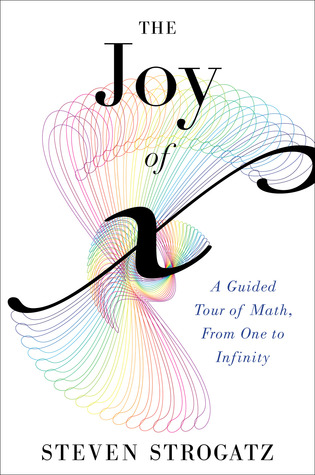
Review | The Joy of X, Steven Strogatz

13356649I’m a nerd. The idea that math can be used to explain everything, including (from the book jacket) whether or not O.J. Simpson did it, or how many people it is optimal to date before settling down, appeals to me. I love patterns, and I love the idea that numbers can be applied in the most esoteric situations in real life.

So Steven Strogatz’s The Joy of X instantly appealed to me. Life, the universe and everything… How can math play a role in understanding all that? And while I’m sure mathematicians can give me various answers, I looked forward to reading about it as written for a layperson’s perspective, and to understanding just a bit of the wonder that math can present.

Unfortunately, this book made the joy of X even more of a mystery to me. Strogatz begins with fairly basic arithmetic, and uses images like rocks and dots to explain addition and subtraction. He writes: “This side of arithmetic is important, practical, and–for many people–joyless. The playful side of arithmetic is a lot less familiar, unless you were trained in the ways of advanced mathematics.” I presume then, that the Tetris-style patterns with rocks represents this more playful side, which appears to be minor tricks with basic functions.

On one hand, I see what he’s trying to do — by presenting even the most basic arithmetic functions in new ways, he’s prepping us for the way he’ll present the (presumably) more fun, more advanced mathematics, such as how to calculate O.J.’s guilt, later on. The problem is, even the first few chapters gave me a headache. The four basic functions are math we as adults are already familiar with, and quite frankly, the struggle to see it from Strogatz’s new, supposedly more playful, perspective, just doesn’t seem worth it.

The book began as a series of columns, and possibly because of this, each chapter is a minor topic in itself, barely leading on to the next one. The result is a fairly shallow overview of various math concepts, and Strogatz seems to try too hard to make the math interesting. He explains the concepts well enough, though I personally think he either overcomplicates or underexplains his topics, yet never quite answers the question: so what? And when each chapter is its own topic, and each chapter begins a new attempt to present an aspect of math in a new light, the repeated sense of “so what?” becomes frustrating.

I remember starting Brian Greene’s The Hidden Realityabout parallel universes. I still haven’t finished it, mostly because it started getting really complicated, and honestly I think I need to start from the beginning to make sense of it all again. But unlike Strogatz’s book, Hidden Reality shows a progression — Greene begins with a really simple, accessible example of parallel universes, then slowly delves deeper into the subject, and explores further into scientific concepts. It’s not an easy read, but the payoff will be worth it — Greene tackles a complex subject and gently takes the reader deeper and deeper into it.

In contrast, Strogatz sounds like the high school teacher desperately trying to convince his bored students that math is fun (cue big grin and exclamation point). I’m not saying that the math he covers is simple — on the contrary, I’m sure most of it, particularly in the later part of the book, is over my head. But I do want to understand, and I feel Strogatz’s approach keeps one firmly in the elementary level of understanding. I’m sure this wasn’t the author’s intention, but I generally found his tone condescending — no way we readers could understand these concepts, so here’s a funny little story to convince you that it’s F-U-N!

I didn’t finish the book, so I don’t know whether or not math says O.J. did it. I did see the chapter about how many people one should date before settling down. It all boils down to a formula, and despite Strogatz beginning with a concrete example, it still ends up being really abstract. By the end of the chapter, I have a general idea of the solution (spoiler alert: it’s nothing you couldn’t have guessed without math), and still no idea of how to calculate it or why I should even bother.

A mostly joyless, shallow exercise, this book is hardly worth the effort.

+

Thank you to Thomas Allen Ltd for a copy of this book in exchange for an honest review.