
Review | Full Frontal T.O., Patrick Cummins and Shawn Micallef

Last year, I returned to the Philippines after about two or three years away. It was an odd experience, driving around the city where I’d grown up — the landscape was both familiar and alien. Every time I saw a place I remember well, I’d see a new addition, new facade, at times even a whole new building beside it — an unescapable reminder that I’d been away, and that the once familiar locales have moved on without me.

I remembered that experience well, during the Coach House Books launch for Patrick Cummins and Shawn Micallef’s Full Frontal T.O. The wall at the entrance to Urbanspace Gallery featured text by Micallef, but for the most part, Cummins’ images were posted on the wall without comment, at times even without dates. So while I viewed the photos with fascination, as a new Canadian (a GTA-er, yes, but not even a Torontonian), I lacked the context that infused others at the launch with nostalgia. “I pass by that area everyday,” someone told me, pointing to one of the photo sets. Another said trips to Chinatown were a childhood tradition, and seeing Cummins’ images of that area brought forth all these memories. Still another loved the pages in the book about her neighbourhood — she remembers how the street has changed and loves how this change was captured on paper. I can only imagine how a similar book on the city I grew up in — Full Frontal Manila, anyone? — would affect me. So for all who grew up in Toronto, all who live in Toronto, or all who love Toronto — definitely give this book a read.

For those like me — I love Toronto, but don’t have that twinge of recognition and nostalgia at photos of the city from the 80s and 90s — Full Frontal T.O. is a fascinating read. Confession: I love old buildings. I love visiting them and imagining the people who lived or worked in them years ago. The stories they can tell! And I don’t just mean official historical monuments — personally, I find hidden history much more fascinating, the stories of ordinary individuals who have made tiny, almost invisible marks on history. Point is, I loved the idea behind Full Frontal T.O. even before having seen the book. Cummins spent years taking photographs of the same spaces over time. We get to see a city change, and we get to imagine the tales that come with these changes. Very cool.

Then you add text by Shawn Micallef, and I’m definitely hooked. Those who have ever asked me for a Toronto book recommendation, or who have read this blog post know how much I loved his previous book Stroll. Micallef has a knack for turning the quotidian into an adventure, and his writing in Full Frontal T.O. is no exception. In his introduction, Micallef writes that because “we know we’re supposed to like pretty or big things,” we immediately associate with Toronto big landmarks like the CN Tower. However, “ragtag” buildings that “would never make it on to a Toronto postcard” are actually “the real Toronto,” the city in which most of us live. He writes,

Because we seem to look elsewhere all the time in Toronto — to a shiny new part of the city, or one of our older gems, or a possible future we might dream of — much of Toronto passes below our radar, even though we’re deep in the middle of it every day. We’re missing out, though.

Full Frontal T.O. calls attention to the city “below our radar,” the “vernacular Toronto,” as Micallef calls it. It’s why people who have lived in Toronto for years feel not just the joy of recognition, but also the thrill of surprise at Cummins’ choice of subjects to photograph. It’s also why people like me, who are relatively new to Toronto, feel an even deeper affinity with the city after reading this book. Full Frontal T.O. reveals a Toronto beyond the usual tourist landmarks, and thereby makes insiders of us all.

Micallef writes that the city is in constant flux, and that’s certainly true. Looking at Cummins’ photograph can be surprising at times by how little a space can change over time — 1042 Queen St W, for example, was a Printing shop from 1988 – 2004 (with a phone number beginning with LE, how long had it been there?). Thing is, and this is something I missed on my first reading, if you flip a couple of pages back, you’ll also see a spread on 1042 Queen St W, showing how by 2009, the Printing shop storefront had been replaced by a mural. Google Street View still shows a mural at this address, though I’m not sure how old that image is, and a March 2012 article at The Grid TO reveals the address is still unoccupied. Things you learn, eh?

Full Frontal T.O. is a fascinating read. Personal favourites include the spread on 148 Huron Street, mostly because of its description as “a feral house. They fed the fence to the plants and the plants liked it.” The images of the trees literally engulfing the front of the house until they were trimmed by the 2011 photo looks almost like the setting for a horror movie. I also loved the section on Gothic cottages. I had no idea until reading this book that Gothic cottages are “those with the peak over the front door.” Personally, I just think it’ll be really cool to say that I lived in a Gothic cottage.

Micallef writes that the book doesn’t contain a map, and doesn’t have the photos in any sort of geographical order because “it’s more fun this way.” He suggests that we “open the book anywhere. It’s all Toronto.” Sounds good to me. I did have fun flipping through Full Frontal T.O. It’s a photographic adventure into Toronto’s past, all in a handy little book. However, the best thing for me is that the book invites readers to explore Toronto themselves. Because the city keeps changing, even the most recent photographs may soon be outdated. When we visit these locations Cummins has photographed, what will we find? Fast forward ten years, or possibly even just ten months from now — what will we find then? Full Frontal T.O. explores the city, but the adventure can last as long as you want it to.

EDIT, May 15, 2012

Publisher Coach House Books has begun a blog for Full Frontal T.O.

From the blog:

The Full Frontal T.O. Blog aims provide an online forum of the work. Did you live in this house? Work in this storefront? Have an amusing anecdote to tell? If so, please add comments to the photos. We can to create an online living history of these buildings, and only you can help us do that!

Check out the blog at http://fullfrontalto.wordpress.com/ and join in the creation of an online living history of Toronto buildings!

Are You My Mother? A Comic Drama, Alison Bechdel

I’ve heard great things about Alison Bechdel’s graphic memoir Fun Home, about her relationship with her father. While I haven’t had a chance to read it myself, when I heard about her upcoming Are You My Mother? I decided to check it out.

Thomas Allen (Canadian distributor for Bechdel’s publisher HMH Books) was kind enough to send me the advanced uncorrected proof of Are You My Mother? to review. It contained only the first chapter of the book, and so while I cannot give a full review, I can certainly tell you my reaction to that excerpt. Here it is: I want to read more.

I looked up the book online, and saw this article that says HMH has planned a first printing of 100,000 copies for Mother, which is “a pretty daring number for a sophomore literary writer, and one of the biggest ever for a [graphic novel].” Great news, especially if you loved Fun Home and can’t wait to read more. Mother is on sale today!

From the blurb: Mother takes a look at the life of Bechdel’s mother,

voracious reader; music lover; passionate amateur actor. Also a woman, unhappily married to a closeted gay man […] [Mother] leads readers from the life and work of iconic 20th-century psychoanalyst Donald Winnicott, to one explosively illuminating Dr. Seuss illustration, to Bechdel’s own (serially monogamous) adult love life.

Personally, I can’t wait to see the “explosively illuminating Dr. Seuss illustration.” In the first chapter alone, Bechdel begins by wondering how best to tell her mother about Fun Home to reflecting on Virginia Woolf, symbolic dreams and psychotherapy. There is a touching glimpse of Bechdel as a child, dictating the events of her day to her mother who wrote them in a journal. Bechdel’s recitation was, she admits, “obsessive-compulsive” in the amount of mundane details, yet still her mother “was listening to me. Whatever I said, she wrote down.” In stark contrast to this is her confession to her therapist that she is drawn to the work of Donald Winnicott because “I want him to be my mother.”

Bechdel’s mother as she appears in the first chapter is a complex figure — loving yet critical, eager to give constructive criticism on Mother yet at other points also seeming to distance herself from the work. I am already fascinated by this woman, and am eager to read more about her. The excerpt ends with a powerful montage, a cluster of photographs Bechdel discovers and arranges “according to my own narrative.” Apparently taken as a continuous series of shots, the images of Bechdel as a baby in her mother’s arms reveal the mom making funny faces and the baby getting progressively more delighted. In the second to the last photo, the baby is practically screaming with laughter, only to end with the baby’s wary glance at the man behind the camera in the last photo. So much is said in two pages. The juxtaposition of her mother’s chatter about Lady Gaga in the present day (in jagged boxes) with Bechdel’s narration about the photographs (in regular rectangles) heightens the poignancy of the moment. You can almost feel the past and the present merging, and you are pulled right into this family’s tale.

Bonus: the proof I received also included a peek at Alison Bechdel’s process of creating this memoir. I had no idea how much work went into creating a graphic memoir. I always just assumed the cartoonist drew the page by hand and then scanned it onto the computer and then somehow ink and colour it digitally. Okay, to be honest, I was more than a little blurry on the details after the drawing by hand part.

For Bechdel, I learned it is a twelve-step process using practically the entire Adobe Creative Suite. I was most fascinated by the fact that her first step is writing the story on Adobe Illustrator: “even though I’m on the computer and not holding a pencil, I’m conceiving of the page in terms of images and design at the same time that I’m writing the narration and dialogue.” Confession, in case you haven’t figured it out by now – my only experience in cartooning is doodling comic strips, usually when bored at school. My process consists of drawing stick figures (or if I’m especially creative, peanut figures) and then having talk bubbles beside their heads. So I find it utterly fascinating that Bechdel (and, for all I know, perhaps lots of other graphic novel writers) designs the layout of the panels first, before drawing anything.

I don’t know if that glimpse into Bechdel’s creative process will be in the published book, but I certainly hope so. I’ve always respected writers and artists of graphic novels. Seeing Mother under step-by-step construction fascinated me, and made me respect them even more.

Great news, by the way, for Bechdel fans — she’ll be at the Toronto Comic Arts Festival on Saturday, May 5th! Tip: show up early. She’ll be at TCAF for only a day, and I bet there’ll be a huge line.

UPDATE: I’ve just received a review copy of the entire book from Thomas Allen Ltd. Thanks Thomas Allen! My review of the finished book will be posted later this month.

Review | The Devil’s Cinema, Steve Lillebuen

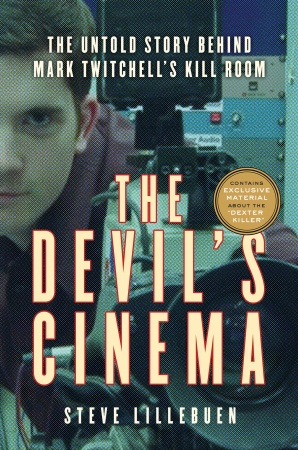
Meet Mark Twitchell. Film maker, Star Wars geek… and a Dexter-obsessed killer. Steve Lillebuen’s The Devil’s Cinema is an absolute page-turner. We begin the book already with an idea of how the story ends. Or, if, like me, you didn’t know about Mark Twitchell, it should be easy enough to google his story. Yet reading The Devil’s Cinema was like reading a really action-packed thriller. I got sucked into Twitchell’s story, the horror of his kill room, the details of his film making dreams, and, above all, the excitement of police officers are they methodically find evidence to build their case.

I recently told someone about all the evidence against Twitchell, most notably the diary where he wrote S.K. Confessions (S.K. stands for serial killer, and is also a nice nod to writer Stephen King) and pretty much recorded all the details of his crime, making only minor changes to the names. When I later mentioned that this was a true story, the person I was talking to looked startled. She admitted that, the whole time she thought it was fiction, she kept thinking the writer was being lazy — how convenient would it be for the murderer to have written everything down? Yet it happened, and in another particularly interesting piece of evidence, Twitchell even left behind a sticky note with a Things to Do list, which included “kill room clean sweep.” One of the detectives on the case even admitted he was 50/50 on Twitchell as a viable suspect — the methodical mind who plotted the murder in S.K. Confessions could not be the same person who left behind so much evidence. That poor detective is teased for his 50/50 remark to this day. Seriously — you can’t make this up.

Part of the reason Twitchell’s story was so enthralling is that it hits so close to home. By all accounts, Twitchell seemed like a nice, harmless, geeky fanboy. He got giddy over winning costume competitions, and he dreamed about completing a 3D Star Wars fan film on a small budget. He does have his non-murderous dark side — he cheats on his wife and lies about having a full-time job. In fact, he has a chronic tendency to lie, even when there’s no need to. Lillebuen is fantastic at forming a complex, multi-faceted portrait, and you can almost feel like you know Twitchell.

I was creeped out that Twitchell used plentyoffish.com to lure his targets. He posed as a young woman and targeted single men. Have you ever tried online dating? Perhaps even at Plenty of Fish? It’s a free online dating site, perfect for people who want to try online dating out without having to pay eHarmony fees. Here’s the lesson: if someone you meet online wants to meet you at their garage — they won’t give you the street address, they tell you to take a circuitous route and park in the nearby woods and enter through the back door — don’t. Seriously creepy.

Lillebuen is a great storyteller, and I love that the book read more like a novel than a journalistic report. Lillebuen includes dialogue that sounds real, and in fact, he claims that they’re all as close to the original dialogue as actual witnesses remember. I also love how much of the material came from the Internet, with Twitchell’s Facebook updates and messages. His email exchanges with an American woman, Twitchell using a fake Dexter Morgan account, are chilling. The woman sounds like she really understands Twitchell and his fantasies, which is creepy on one hand, yet on the other hand, also sad when she distances herself from him later on.

Despite Lillebuen’s insistence that he wants to give a lot of attention to the victim’s life, it’s really Twitchell’s character who shines here — Lillebuen presents a very human side to a murderer. Lillebuen is far from sympathetic towards Twitchell, but his relating of all the facts does humanize him, and make him real. In a weird way, Twitchell’s humanity makes his crime even more chilling. When Twitchell admits to his wife that he can’t feel empathy, when Twitchell himself realizes he meets all the checkbox characteristics of psychopathy, you almost feel sympathy, until you realize that despite his realization, he feels no strong compulsion to seek help.

When we think of serial killers, we imagine truly horrific, larger than life, monstrous figures whose minds we can’t even begin to understand. However, the Twitchell revealed in Devil’s Cinema appears a sad, almost pathetic, figure. He may dream of being the super efficient, Dexter Morgan-level serial killer in S.K. Confessions, but he just couldn’t pull it off as he’d planned. And his career, however horrific his crime, was cut off pretty quickly. His crime is monstrous, yet, given the level of his ambition, he failed as a monster. Devil’s Cinema humanizes Twitchell even as it deflates him — he is, ultimately, just a man.