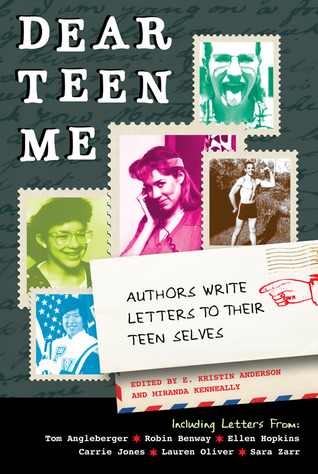
Review | Dear Teen Me, edited by E. Kristin Anderson and Miranda Kenneally

If you had the chance to write a letter to your teen self, what would you say? In Dear Teen Me, YA authors do just that. This book covers topics such as bullying, eating disorders, absentee parents, and teenage crushes. At least a couple of authors mentioned the adage that what doesn’t kill you make you stronger — in the case of Mari Mancusi, she tells her teen self, “What total BS!” Her letter is about being bullied, and her point is that life is hard enough without having to deal with the idea that being bullied can be beneficial. She’s angry at the boy who bullied her and, quite rightly, she’s angry at adults who, well-intentioned though they may be, brush away her feelings with platitudes.

Remember when you were a teen, and adults told you they knew just what you were going through because they’ve been through it themselves? Even then, you know they didn’t, really. You knew they were just trying to help, but even though they may have also gone through a breakup, a flunked test, a mean classmate, whatever, they could never understand exactly what you were feeling. However, what if that adult was you, years in the future?

Dear Teen Me is refreshingly free of the smug, platitudinal knowingness I remember seeing in adults when I was a teen. Or perhaps it’s just because in this case, knowing it all is okay. Somehow it’s easier to accept assertions like “it’ll get better” from someone who knows first hand that your life really does get better. Don’t worry about that boy turning you down; years later you really will find someone else, and you’ll be happily married to him.

Even more powerful are the letters that admit that, guess what, it does get worse. You will get a debilitating nerve disorder. The absentee father you’re jumping through hoops to impress will never notice you. That boyfriend who convinces you to have sex with him will still break up with you. These letters are mostly gentle when imparting harsh truths, because the letter writers know exactly how much it will hurt. Even better though is the message at the end of these letters — it may take years, possibly even decades, but you will survive, you will even thrive.

Reading the book, I kept hearing Kelly Clarkson’s “Stronger” running through my head, to the point that I watched it on YouTube just to get rid of the ear worm. Certainly, the authors writing to their teen selves have become stronger and wiser. Some authors observe their teen selves making mistakes and wryly comment that their teen selves aren’t fooling anyone with their attempts to be cool. Other authors observe more serious mistakes and tell their teen selves to stop — it’s not worth it. One author even told her teen self to go ahead and commit those mistakes, because they’ve shaped who she became. Through it all, however, the primary message seems not so much to be “Do this,” or even “It gets better,” but rather: I understand.

YA authors wrote the letters in this book, and I can imagine the impact this book will have in revealing that these authors grew up just as dorky and out-of-place, perhaps going through similar experiences, as their readers are. I have to admit I haven’t read most of the authors in this anthology, so I felt the impact of these letters, not as a reader discovering a human side to someone I admire, but rather as a lifelong dork reading about other lifelong dorks. There were some things in these letters I would have wanted to tell my teen self, and I’m sure other readers will also find aspects to relate to.

What would you tell your teen self? I’m not quite sure myself, but this book has certainly got me thinking. I probably will write a letter to teen me — I’ve been composing it on and off as I was reading this book. Then I’ll stick it in some journal or other, and ten years from now, write another letter to teen me. I wonder how different it’ll be.

Now to end with some Kelly Clarkson:
 

Review | Seriously… I’m Kidding, Ellen DeGeneres

Reading Ellen DeGeneres’ Seriously… I’m Kidding is like having a casual, one on one conversation with Ellen herself. The book is hilarious, rather sweet and oddball, with the wonderfully sunny outlook on life that has become Ellen’s trademark. It also often veers into the pointless, with sight gag chapters that probably would work well as minor sketches on her show, but are just worth skimming in a book. On the bright side, I’m Kidding is overall a feel good book, cheerful and optimistic without being preachy. It’s Ellen, on the page, and a fun way to spend your commute.

There are a few completely random chapters. One can almost imagine her Finding Nemo character Dory narrating some of the passages, with their pointless digressions and wide-eyed punchlines. In one chapter entitled “Ideas,” for example, Ellen rambles about everything from smiling to astronauts. Presumably, she means to mimic the brainstorming process, how each idea leads on to another with the barest minimum of connections, and so on. Except it plays out like a comedy routine that seemed funnier than it really is, and the punchline, “I’m sorry, maybe I shouldn’t have written this chapter,” backfires when the reader reluctantly agrees.

Others, like “For the Teenagers” and “Magic,” are sight gags, possibly worth a chuckle when read, but nothing that will make you remember once the page is turned. These stand in sharp contrast to some genuinely great bits of comedy in the book. Take for example “How to Be a Supermodel,” a how-to guide based on Ellen’s experience as a Cover Girl model. The tips in this chapter are sharp and insightful, comedic gems. Take for example:

One: The Look
Always look like you’re angry at the universe for making you too pretty. [p. 11]

Ellen is at her best however in the somewhat more serious chapters. She never allows herself to become Oprah-esque, pulling back with a wisecrack just when she’s dispensed some bit of wisdom. The overall effect is that of a woman who is afraid to let the mood get too sombre, and who therefore undercuts her own advice with humour. That being said, in many of these instances, the humour actually enhances the impact of the advice, and at times reveals further insight.

Take for example a thoughtful chapter on the meaning of life. Ellen observes that people disagree about the nature of happiness — some say we should live each day as if it were our first, and others say we should live each day as if it were our last. It’s confusing, Ellen admits, then immediately quips, “Either way you should probably have a diaper on.” Good point, a quick joke, and a good reminder that prescribed methods of finding happiness aren’t foolproof.

Ellen’s chapter on “Labels” stands out as possibly the most serious. Apart from an offhand joke about her Cover Girl endorsement and a gentle scoff at musical theatre, Ellen reflects on how much she’s been labelled. In a particularly striking line, she admits,

It didn’t occur to me that when I announced I was gay I would have to clarify just how gay I am. What does it matter? What does it mean? All I can say is I’m gay enough for me. [p. 93]

In one of my favourite chapters, “What Would Jesus Do?” Ellen talks about magazine polls and the culture of judgement. Much like the chapter on the meaning of life, Ellen switches from thoughtful observation to quick quip and back again throughout this chapter. Giving the example of a poll that asks “Hot pink dress — is it a do or a don’t?” Ellen demands:

Who cares? If you want to wear a pink dress, wear a pink dress. It doesn’t matter what other people think. One hundred percent of the people polled could say a pink dress is a “do” and guess what? I still ain’t wearing one. [p. 54]

Ellen’s independence and self-confidence are among the many things that make her such a great role model. That passage just about made me applaud. Ellen continues:

All these polls do is make everyone so judgmental. And I don’t believe in judgment. Unless is judgment of judgment. I don’t think someone has to “wear something better” or have a better hairstyle. That’s why the word “different” exists in our language. [p. 55]

Hear hear, Ellen DeGeneres, hear hear!

She immediately undercuts that inspiring passage with a joke, but then switches right back into incisive observation so seamlessly that the interjection of jokes feels natural.

Seriously… I’m Kidding is very much hit or miss, on a chapter by chapter basis. Overall, however, it’s a fun read that just has Ellen’s wonderful personality shine through. You’ll feel good while reading it. The flapjacket copy that promises

If you buy it, you will feel better, look better, be happier, grow taller, lose weight, get a promotion at work, have shinier hair, and fall madly, deeply in love.

is a joke, but like many chapters in the book, holds a grain of truth. Ellen’s humour is so infectious that this book will most likely cheer you up, and if you haven’t fallen in love with Ellen yet, some chapters in this book might make you do just that.

+

Thank you to Hachette Book Group for a finished copy of this book in exchange for an honest review.

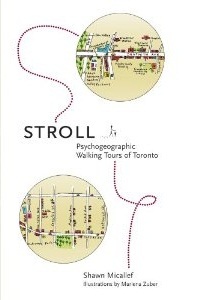
Review | Stroll, Shawn Micallef

…there’s something about the proximity of those quiet woods to the nearby village that makes Frost’s poem [Stopping by Woods on a Snowy Evening] seem cozy and urban – a quick escape into the wild but never far from civilization. How wonderful it would be to walk through a forest on the way to a friend’s house, or to a tavern or movie in another part of the city. In Toronto, the best of nature and the city often intersect… [p. 202]

Only Shawn Micallef would pair “cozy” and “urban,” and only he would link Robert Frost’s poem about the woods to a city, let alone Toronto. His view of Toronto having the intersection of nature and city is a tad more romantic than I would normally think, and it’s just this romanticism that makes Micallef’s Stroll such a great book. Micallef views his city with an almost childlike sense of wonder. Informed, certainly, by his vast knowledge of the city’s history, as well as conversations he has had with various others, but there’s a youthful excitement in Micallef’s approach to exploring Toronto. Remember how when you were a child, even an office cubicle can transform into a land of adventure? That’s the view Micallef presents of Toronto — every sidewalk is a path to adventure, every building a potential locale for a story.

I remember when the book first came out. I was working as a bookseller then, and what began as an easy database-search-type recommendation for tourists looking for a book on walking tours in Toronto turned into my go-to recommendation for anyone looking for a book on Toronto. What swayed me is this fantastic bit from Micallef’s “Flaneur Manifesto”:

Over and over, we’re told that Toronto is not Paris, New York, London or Tokyo. We’ve been trained to be underwhelmed… Any Toronto flaneur knows that exploring this city makes the burden of civic self-depracation disappear. [p. 10 – 11]

Hear hear, Mr. Micallef. In Stroll, Micallef chronicles his wandering walks around Toronto, covering the downtown core, and, more significantly, spreading out into Pearson Airport, North York, Scarborough and the Port Lands. I know of Stroll readers who take their copy with them as they walk around Toronto themselves, perhaps using it as a guide, to point out things they may not have noticed on their own. I opted instead to read Stroll at home, enjoying the treat of dipping into it and checking out a neighbourhood or two at a time, mini adventures where my imagination took me on these tours. Reading about neighbourhoods I was familiar with is quite an experience — as Micallef’s narrative moved along certain roads and noted certain landmarks, I could picture these areas clearly in my mind. Once in a while, I’d learn a fascinating tidbit about the history of a building I’d passed numerous times without noticing; other times, Micallef would mention a detail I hadn’t noticed at all, and I make a note to take a look myself next time I was in that area.

Reading about neighbourhoods I’d never visited is a different kind of adventure. In a way, it’s not quite as thrilling — I no longer had the memory of the landscape to guide my imaginary tour. On the other hand, this just means that all these neighbourhoods are still waiting to be explored. As Micallef says, you realize how large Toronto is, to be able to fit all of this in it.

Toronto through Micallef’s eyes is an adventure. His affection for the city is infectious, and he punctuates informational tidbits with humour and whimsy. I highly recommend this book for tourists, new Torontonians, people moving away from Toronto, and anyone, really, who wants to view the urban landscape in a new way.

I recently joined a Jane’s Walk that Micallef led. At one point, he stopped walking, glanced around and, for no discernible reason (at least to me), stepped onto a patch of dirt and grass and zigzagged through that rather than stick to the pavement. So much of my walking around, at least, involves getting from one point to another (in other words, I would most likely have stuck to the pavement). Micallef’s seemingly aimless wander opens up familiar locales to adventure, and that’s why Stroll is such an amazing book.

It helps as well to have Micallef’s highly romanticized view of his surroundings, picking out random details that would usually escape attention and finding the whimsy in them. During that Jane’s Walk, Micallef stopped by the 403 and told the group to close our eyes and listen to the cars zipping past. You could almost believe, he said, that you could hear the ocean. That’s a bit of a stretch, Mr. Micallef, but hey, why not? I’ll give it a try.