 Mr. Penumbra’s 24-Hour Bookstore is my book soulmate. Seriously, if ever a book were to combine all the elements that would make me fall in love with it, this is it.
The title alone is enough to hook me, and, I suspect, any fellow book lover. The idea of a bookstore open 24 hours sounds like heaven. And no, online retailers don’t count — sure you can download an ebook or order a print book at any time, but there’s a magic to actually being in a bricks and mortar place. And Mr. Penumbra’s store in particular has the musty, old book charm that makes me want to spend hours in it.
Even better, Penumbra’s store is an indie! Bookseller protagonist Clay is used to customers asking for book recommendations, then leaving to buy it on their e-reader. As a bookseller at an indie myself, I could relate, and the scene where author Robin Sloan creates a clever reversal of this scenario made me as baffled and overjoyed as it did Clay.
I’m an avid mystery reader, and Sloan teases his reader with a creepy, utterly compelling one: What books are in the dark stacks Clay is forbidden to read? Who are the customers who come in the dead of the night to return a book to those stacks and pick up a new one? I was definitely hooked. Where would the author take this?
To his credit, Sloan completely blindsided me. When I think of a book about an indie 24-hour bookstore, with mysterious leather-bound tomes taken out in the dead of the night, I have a certain type of storyline in mind, and I bet you do too. So it took me completely by surprise when Sloan introduced a digital element — 3D mapping, Google search capabilities, computer wizardry — and somehow managed to make it all work with the mysterious, musty atmosphere of the old-fashioned bookstore. I admit, as a total book and mystery geek who also happens to be a tech geek, all I could think was, this book was tailor made for me.
Too often, the divide between the physical and the digital, the old school and the new, is posited as a one or the other type deal. You’re either a print book person or an ebook person, someone who appreciates the handwritten card or someone who loves the 3D IMAX 42fps type movie. Obviously, reality is rarely so clearcut, but in books at least, I usually find either nostalgia for the way things were or all out Cory Doctorow-style techno-geekery. To have both so seamlessly in one book just blew me away.
To be honest, the reason behind the mysterious customers disappointed me at first. On one hand, it would’ve been really difficult for any author to come up with an explanation impressive enough to live up to amazing build up, but then again, it also made me feel like Sloan settled for safe, overdone Dan Brown territory. Not a spoiler — Mr. Penumbra has nothing to do with Mary Magdalene, but the customers are using the books to search for something, and the object of their search disappointed me. Sloan reverts to a classic trope, and after having build such an exciting, esoteric world, the familiar was a letdown.
But then, again Sloan surprises me. And again, it’s with his masterful integration of the digital with the physical. The object of the customers’ search may be overdone (in my view, at least), but the combination of ways in which Sloan makes his various characters conduct this search is highly original. The final answer is highly original as well, and quite frankly, brilliant. Bravo, Mr. Sloan — you’ve blown me away.
I am in love with this story. I love that it manages to bring together so many things I love, including science fiction and fantasy, an absolutely awesome romance, even typography and design! My copy is filled with underlined text, marginal notations, and at the very end:

Sometimes, words aren’t enough.
+
Thank you to Harper Collins Canada for an advanced reading copy of this book in exchange for an honest review.
[Note: If you live in the US, your edition of Penumbra has a glow-in-the-dark cover!]
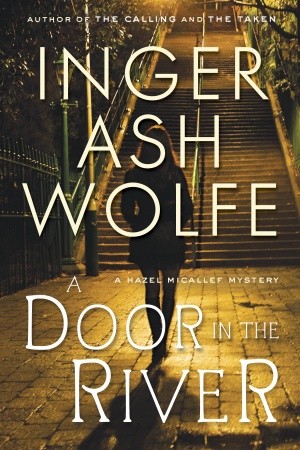 Inger Ash Wolfe’s A Door in the River is my first Hazel Micallef mystery, and at first I didn’t believe the person on Twitter who told me the series was disturbing. After all, I’ve read Stuart MacBride and Val McDermid, and at first glance, the mystery of a well-liked man being killed by a bee sting didn’t sound too horrific. The book doesn’t get quite as gruesome or horrific as MacBride and McDermid, but it does enter some pretty emotionally and psychologically intense territory.
 Literary Treats