
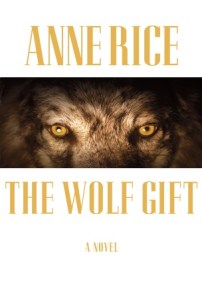
Review | The Wolf Gift, Anne Rice

I devoured Interview with a Vampire in high school. The movie version was notable for a truly nightmare-inducing scene where the child vampire played by Kirsten Dunst pretended to cry and, when a kind elderly lady hugged her to comfort her, Dunst immediately sank her fangs into the woman’s neck. That, and hotties Brad Pitt, Tom Cruise and Antonio Banderas, of course, but seriously, it was the Kirsten Dunst scene that made me cringe away from any hug for months afterward. The movie is great, but the book is amazing. Rice created such an enthralling, tragic, and yes, seductive mythology around vampires.

So when I heard Rice was coming out with a werewolf novel, I looked forward to seeing the mythology she’d create for werewolves. The Wolf Gift is a solid novel. It didn’t transport me like her vampire novels did, but it did entertain me, and Rice did introduce a fascinating twist to the werewolf mythology.

Reuben, a handsome young reporter, is bitten by a werewolf, and receives what he calls the “Wolf Gift.” Whenever he transforms into the Wolf Man, he can hear cries of distress and can smell evil. Wolf Gift reminds me of the standard superhero origin story — Reuben as the Wolf Man follows his wolfish super-instincts to track down evil and save the innocent, all the while yearning to find out more about the origin of his condition. In an ironic twist out of Spiderman and Superman, Reuben is assigned to cover the Wolf Man stories for his newspaper, and dryly wonders where Lois Lane and Jimmy Olsen are. The public views Wolf Man as a hero — who wouldn’t want rapists and killers to be ripped apart? — but, as with all superhero stories, I kept waiting for the part where the public turns on the hero.

Some members of the public do turn against the Wolf Man, but mostly it is Reuben himself who is attacked by his conscience. His brother, a priest, points out that by killing evil people, Reuben is taking away from them their chance at redemption. A strong thread of Catholicism runs through Wolf Gift — Reuben only tells his brother about his Gift under the seal of Catholic confession, some of the characters debate Gerald Manley Hopkins and a book by a Catholic theologian, and Reuben himself, while unmoved by his brother’s point about redemption, is highly philosophical about his Gift. His articles for the paper, while sympathetic towards his Wolf side, also caution the public that the Wolf Man isn’t a straight up hero — what right does any one have to be judge, jury and executioner? To be honest, I found myself missing Lestat’s utter amorality, or even Louis’ pathos. Reuben’s approach to his moral dilemma felt very cerebral, and I didn’t really feel that he was torn at all. At least until he commits a major mistake later on and feels truly, horribly guilty about it, then I could truly see how he might view his Gift as a Curse.

I do like the idea of werewolf as superhero. Most werewolf stories I read focus on the primitive, animal side of the werewolf, and the joy and freedom in giving in to pure animal instinct. I like how Rice turns that on its head and turns the animal instincts almost metaphysical — werewolves retain their human intellect, but can smell evil. They, quite literally, are compelled to destroy evil and protect the innocent. In one scene, Reuben observes how another werewolf, about to kill an innocent, felt compelled to confess to this innocent first, and practically beg forgiveness — almost at a biological level, they are unable to harm good people. It’s an interesting idea, and while I personally cringed at the possibility that werewolves are actually some creatures from heaven, I like the more scientific and historical explanation eventually provided.

Rice’s vampires always struck me as incredibly sensual, and I figured the more animalistic werewolf would be even more erotic. Rice’s depiction of the initial transformation:

There was a limitless reservoir of heat inside of him, and now it broke out on the surface of his skin as if every hair follicle on his body was expanding. He’d never felt such exquisite throbbing pleasure, such raw, divine pleasure.

“Yes!” he whispered… What mattered was the wave after wave of ecstasy passing through him.

Every particle of his body was defined in these waves, the skin covering his face, his head, his hands, the muscles of his arms and legs. With every particle of himself he was breathing, breathing as he’d never breathed in his life, his whole being expanding, hardening, growing stronger and stronger by the second…

Confession: I laughed. I felt like a thirteen year old schoolgirl giggling at this passage, but I really couldn’t help it. The rest of his transformations weren’t quite so graphic, mostly limited to it just happening, or him going off alone to induce it to come. There is a love story as well, where the woman is turned on by his wolf form. Yet other than a couple of sex scenes, the romance was surprisingly less erotic than I expected. She was mostly like Mary Jane watching her superhero man go off to fight evil.

Wolf Gift offers an interesting twist to the mythos, and provides an interesting origin story, but I wish Rice had gone deeper and darker with the characters. Reuben was somewhat afraid of scientists experimenting on him, but other than a couple of scenes, I didn’t really feel the urgency. Neither did I feel that there was an actual danger of society turning against the Wolf Man, nor did I really feel Reuben’s internal moral conflict over his dual nature. I like the character of Stuart, near the end, but I really dislike the nickname Reuben gave him. Wolf Gift is entertaining, and there are hints at a richer mythology than what is in the book, which I assume Rice may well explore in a future novel. Wolf Gift mostly struck me as a superhero story, with Catholicism and a bit of sex. Not bad, but not amazing either.
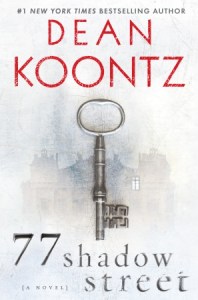
Review | 77 Shadow Street, Dean Koontz

I like haunted house stories. Andrew Pyper’s The Guardians literally kept me up all night, and I identified with Joey Tribbiani when he had to keep Stephen King’s The Shining in the freezer. Still, Dean Koontz’s 77 Shadow Street, about an apartment complex with a history of its inhabitants mysteriously disappearing, mostly left me unmoved. In fairness to Koontz, 77 Shadow Street is a solid, well-written horror/thriller. I haven’t read Koontz in years, and remember only being seriously freaked out by Tick Tock. So I can’t really say how much avid Koontz fans will enjoy 77 Shadow Street.

The books that really creep me out are those where the threat is left intangible. You can sense the malevolence, but you have no idea where it’s coming from, or what its source wants. So when Koontz introduces his antagonist in the first thirty pages as a sinuous “black form,” I was disappointed. The creature is certainly menacing enough, and at parts, downright disgusting, but I was more grossed out than creeped out. We are introduced to the One fairly early, an amorphous evil entity who announces it will kill most of the residents, and presumably as many humans as it can. Scary, yes, but its grandiose tone and generic aim lacked menace for me, more like a cartoon villain’s evil master plan than like Hannibal Lecter’s far more chilling plots.

There are chilling moments, like when a woman tries to call the concierge only to be connected to a telephone operator from the 1930s, which has a Twilight Zone-like inexplicability that I love. There are also scenes where humour enhances the horror, like when the concierge is attacked: “Until now she hadn’t realized that in her right hand she still held the fork with which she had been eating Mausi Anupama’s delicious uttapam. […] She thrust with the fork and stopped her assailant […]” The idea of using a fork to stop a supernatural creature is absurd, yet when it’s the only viable weapon on hand, you can almost cheer when it works.

The potential victims are sympathetic enough, especially the children. I don’t usually like child characters, but Winny’s desire to be a hero is charming. I also really liked the pair of sisters; they added a nice touch of eccentricity and humour. Still, there were so many characters that it got confusing at times, and while I was generally sympathetic for all of them, I didn’t really feel invested in any of them.

The story picks up a bit for me near the end, with characters coming up  with possible scientific explanations. I also liked the story behind the origin of the One, and the moral dilemma it presented some of the characters. I thought the One’s motivation was fairly standard and therefore unexciting, but I did enjoy the twist in the origin story.  Still, overall, 77 Shadow Street didn’t really grab me. To be honest, I might have enjoyed it more as a movie. It would’ve been a gory, entertaining scream-fest and I would’ve left the theatre with no problems turning the light off that night. But as a book, it didn’t even make me scream.

Hunger (Book 2 of Gone series), Michael Grant #50BookPledge

Michael Grant’s Gone series just keeps getting better. In the second installment, Hunger, the kids in the FAYZ have run out of food, some of the normal teens have drawn battle lines against the kids with powers, and the mysterious entity called the Darkness keeps sinking its claws even deeper into Lana and Caine. Sam and his crew have discovered fields with vegetables, but there are giant killer worms guarding their territory (sounds ridiculous, but they’re actually quite horrifying… and gross).

Worse, kids in the FAYZ don’t want to work. “I’m just a kid” becomes a common refrain, understandably frustrating Sam’s team, all of whom are kids themselves. My sister, who introduced me to this series in the first place, commented that she found it hard to believe that only Sam’s friends are stepping up, and the rest are content to whine about their hunger and play video games all day. She understood about the younger kids, but wouldn’t the tweens and teens at least band together and help organize something? My initial reaction had been that this situation seemed very realistic, but my sister raised a good point — is Michael Grant, and are readers like me, underestimating the potential for maturity in young adults?

Then again, it’s not just that it was only Sam’s friends stepping up; it was just that those who did step up naturally became part of Sam’s “government.” One of the characters also said something that struck me as logical: the kids have no incentive to do hard labour, because they know that even if they do nothing, Sam’s team will make sure they’re fed. One of my favourite secondary characters from Gone, Albert, comes up with what I consider a brilliant solution: he sets up a market economy, first a barter system, then eventually establishing a currency using McDonald’s Monopoly money. Astrid’s response to this disappoints me, considering how brilliant she is supposed to be: she tells Sam to shut Albert down, saying they now have the opportunity to establish a class-free society, where money doesn’t exist and therefore no one is richer than anyone else. Would socialism have worked in the FAYZ? Possibly, but only if established from the very beginning, before they ran out of supplies and most kids show no motivation to work “for the greater good.”

What I love most about Hunger is that we see the vulnerability in so many of these characters. Sam’s heading for a breakdown: “I’m not their parent,” he constantly tells Astrid, to which she reminds him, “They’re just kids,” who need parenting. Sam, of course, is a kid himself, and even adults would prefer to focus on the bigger issues like finding food or preparing for Caine’s next attack rather than have to deal with complaints of who pulled whose hair and who called whom stupid. Lana, as the Healer, feels a similar pressure. Kids come to her with everything from bloody noses to loose teeth to skinned knees. She’s like a celebrity hiding from paparazzi; everyone demands her attention, and all she wants is privacy. Astrid’s brilliance reveals its cracks. While Sam is the official leader, Astrid definitely holds the power, and a lot of her decisions (shutting down Albert’s enterprise, curtailing Quinn’s initiative in going fishing) reveal short-sightedness. I can understand why some of the kids in the FAYZ have grown resentful. I especially love the bigger role other characters play: Mary’s eating disorder grows much worse, Albert and Quinn reveal economic savvy, Edilio takes a much stronger leadership role, Brianna, Taylor and Dekka become essential to battle, and even Caine reveals his softer side.

Gone was thrilling and action-packed, with characters you grow to admire. Hunger is even more thrilling, and makes these characters even more real and tangible to us. Fantastic sequel, darker and more introspective than the first, Hunger takes the FAYZ kids from trying to survive a battle to taking the first steps in creating a long-term, sustainable society.