 Dr. Brinkley’s Tower is a lush, beautiful novel about Mexico in the 1930s. The tiny town of Corazon de la Fuente has just survived a long, bloody revolution, the scars of which are beautifully illustrated in the condition of a mirror in the opening scene. A century of the Ramirez family’s use has created “undulations” in the glass and “a spidery hairline crack near the bottom,” but the “real dissolution” is the faint, sour smell that still lingered from the time Francisco Ramirez’s father hid the mirror under fermenting wheat to keep it away from government soldiers during the revolution.
It is easy to lose oneself in Corazon de la Fuente. Hough’s writing portrays the flavour of the small town beautifully. We are overwhelmed with the sights and sounds of the town coming together for a lucha wrestling match, our ear quickly becomes attuned to a natural blend of Spanish and English, and we are absolutely captivated by the fragility of this town’s innocence. At times, Hough gets heavy-handed with his symbolism. For example, a character describes tequila as “the taste of Mexico, captured in a glass.” What an apt, beautiful and evocative metaphor! Unfortunately, I found its impact diminished by the almost overbearing two pages of description that preceded it. That being said, I enjoyed the language overall. The publisher’s description compares Brinkley to Gabriel Garcia Marquez, and while the novel isn’t magical realism at all, there is a strong sense of nostalgia, and the potential for magic, throughout.
Central to the story is the romance between Francisco Ramirez and Violeta Cruz. I love, absolutely love, this love story. Francisco’s Quixotic devotion to Violeta is simply endearing, and I hated Dr. Brinkley before he even appeared, simply because I knew from the publisher description that Dr. Brinkley will catch Violeta’s eye. Violeta is torn between the wild animal passion she feels for Francisco, and the escape from Mexico offered by a relationship with Dr. Brinkley, so while I was rooting for Francisco all the way, I did understand her dilemma. Hough does a fantastic job portraying the town in its socio-economic context. Because Corazon de la Fuente is poor, and poorer still for the effects of the revolution, Dr. Brinkley’s radio tower does appear as a god-send, providing jobs and enticing foreigners with deep pockets to spend money in the town.
I grew up in the Philippines, where many live below the poverty line and, unlike in Canada, there is no social safety net to ensure everyone has food, housing and education. I was struck by how relevant this tale of 1930s Mexico can still be relevant today. After an incident where a contest literally leads to a riot over gumballs, Violeta realizes how much she longs “to live in a place where a simple contest didn’t turn into a showcase for violent degeneracy.” It’s a sad state, yet I remember an incident years ago where people were trampled while trying to enter a contest for money. Poverty leads to desperation.
Also striking is a scene where the Corazon de la Fuente mayor encounters racism in his own town:
– No speeky the Spanish, said a large gringo at the front of the line. – Go back to Mexico…
– I am in Mexico, said the mayor in English. – And you’re in my country, pendejo.
My ARC has that passage underlined and, in the margin, a scribbled “Yay mayor!” It’s an odd form of racism, yet it’s all too prevalent. Growing up in the Philippines, I remember how many skin whitening products are advertised, and also how much more intimidating it is to be berated in English rather than the local Tagalog, simply because the use of the English language is viewed as intellectually superior. I remember a story my aunt once told me, about a sales clerk who signalled for a tourist to jump the queue simply because he was Caucasian. The tourist was embarrassed and refused to do it, but it bothers me that it was the Filipino sales clerk who slighted other Filipinos in the first place. So when I see the mayor of this tiny (albeit fictional) town stand up for himself, I raise my glass to him. One of my favourite passages in the book.
The radio tower Dr Brinkley introduces to Corazon de la Fuente brings progress and prosperity, but it also creates problems. Other than the racism and the increase in homelessness, the radio waves also cause sound to come from metallic objects. It’s the classic debate between progress and purity — does the town sell its soul for a few pesos? — and Hough’s prose has a wonderful, nostalgic, rather regretful tone that makes his stance clear. The cast of characters is colourful. I already mentioned how much I love the mayor and the young couple in love. Also memorable is the cantina owner who goes for Dr. Brinkley’s infertility treatment (extracted from goats!) so he can make love to his wife again — such a charming man! Finally, there is the aging molinero and Laura Velasquez, a plain woman who nevertheless is the heart of the town:
In the workings of a small town, the satisfaction of a person like Laura Velasquez functioned as a sort of inspiration for those who were far luckier but who nevertheless considered themselves to be having a bad day. Her inner peacefulness… functioned as a source of illumination, particularly in difficult times…
I love that a plain woman has such a vital role in the town, and precisely because of her plainness! I also love that the molinero, a Don Juan all his life, sees her beauty, and falls in love with her. It’s a beautiful romance, and one that made me cheer.
Hough makes you cheer for the characters, and for their town, as they struggle against the compromises imposed by “progress.” I especially love how relevant this story feels, even as I felt transported into the past. Above all, I fell in love with Corazon de la Fuente and with Francisco, Violeta, the mayor, at all their neighbours.
AUTHOR Q&A
Stay tuned to my blog tomorrow for a Q&A with author Robert Hough!
WIN A COPY OF DR. BRINKLEY’S TOWER!
Would you like to be transported to 1930s Mexico? Win a copy of Dr. Brinkley’s Tower, courtesy of House of Anansi!
To win, simply comment on this post, and answer this question:
If you could re-visit any place from your past,
where would you go and why?
Contest ends March 22, 2012. (Canada only)

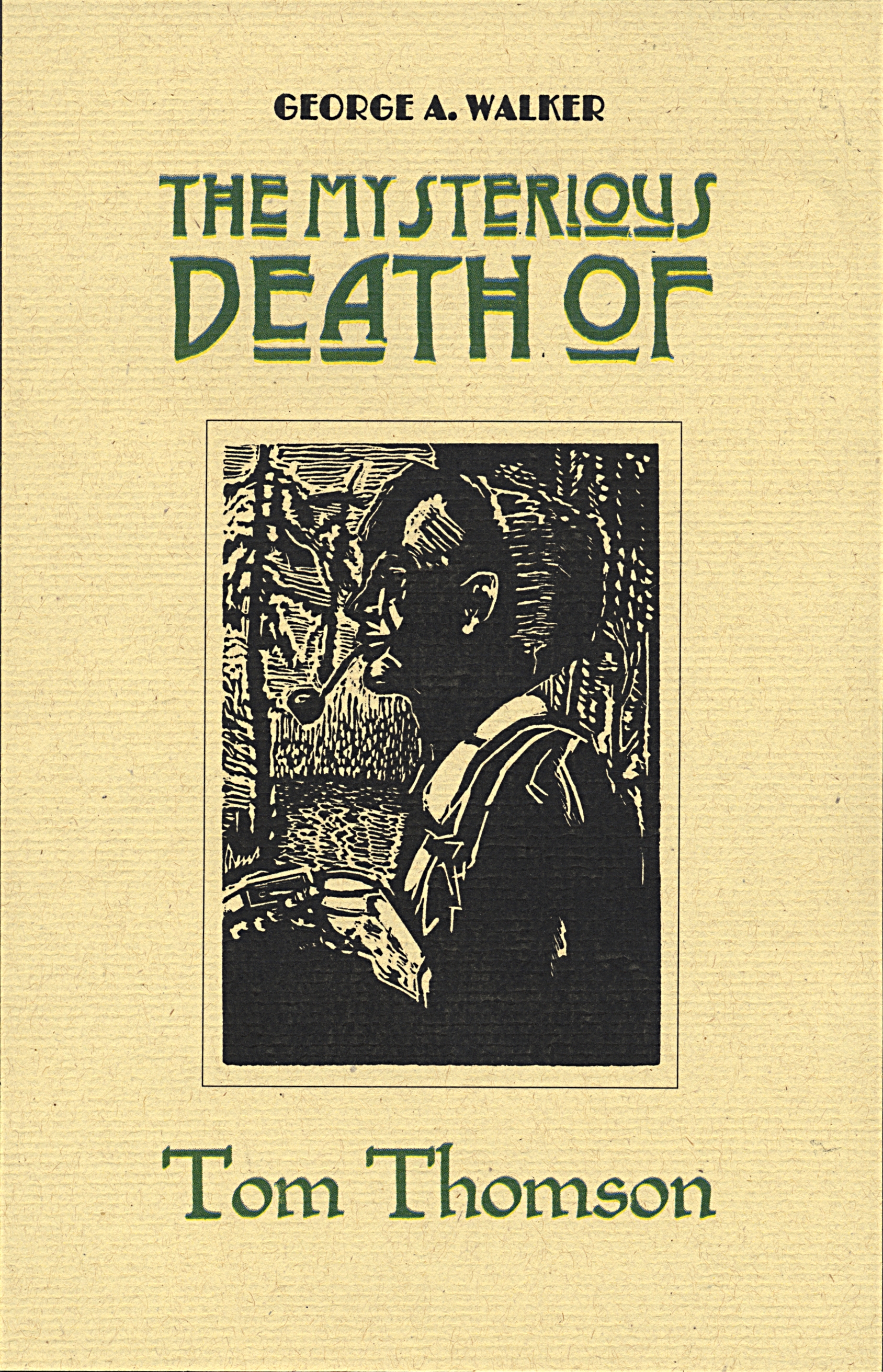 George A. Walker’s The Mysterious Death of Tom Thomson is a beautiful addition to the list of books on Tom Thomson. Curator Tom Smart calls it a “visual elegy,” and I think that describes the book perfectly. Mysterious Death contains a hundred and nine woodblock engravings that cover Thomson’s life from his youth in the city to his death in Algonquin Park. I’m a fan of Porcupine’s Quill books in general — I love their textured pages, and think this is such a fitting format for the starkness of Walker’s medium. Mysterious Death is a wordless narrative, so all we have is a single black and white woodcut print at the centre of each page.
 Images from the book, from the Porcupine’s Quill website


 Literary Treats