
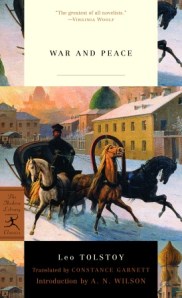
 Well, I’ve done it. A couple of years of failed attempts and a couple of weeks of dogged determination, and I’ve done it: I finished War and Peace. How was it? Easier than I expected. Tolstoy’s a master storyteller, and Anna Karenina is probably one of my favourite all-time classics. War and Peace was difficult to get into at first — it felt like dozens of characters were introduced in the first few chapters, and when my sister asked me what it was about so far, I mentioned at least four different story lines before her eyes glazed over and I realized I was narrating the entire book so far instead of summarizing. That’s because I had no clue at that point what the book was about yet; I was too busy juggling all these different characters. My edition (pictured above) didn’t have a family tree or character list in the beginning, so I took out a pen and started marking away. To whomever picks up my copy at a used booksale, I hope my minor notations help somewhat.
After reading the book, can I give a summary? War and Peace is about several Russian families during the Napoleonic War. That really only begins to get into what the book is about, but it’s a start.
Good news — shortly after the war scenes got into full swing, the characters became more fully fleshed out, and much easier to distinguish. To my surprise (given how frustrated I felt at the beginning of the book in keeping the characters straight), I started to feel strongly about these characters. I expected to be captivated by the war scenes, and definitely the stories of friendships among the soldiers were striking. But it was really the drawing room scenes that fascinated me — the romantic entanglements among the main characters could rival The Bachelor in melodrama. An example: Nikolay and Sonya were childhood sweethearts, but Nikolay’s mother wants him to marry a rich heiress instead to help the family’s financial situation. Nikolay thinks marrying for money is reprehensible, yet, to my horror, at one point encourages Sonya to accept another man’s marriage proposal. “WTF!” I wrote on the margin. (To whomever gets my copy of this book, I apologize. I couldn’t help myself.) Don’t worry about having been given a spoiler — with over 1400 pages of storytelling, so much more happens to that particular plot thread.
Sonya’s love life is one of my personal favourite plot threads in War and Peace, but Tolstoy has certainly created a lot of interesting characters. The vivacious Natasha is usually called the heroine, but I’m more intrigued by Princess Marya Bolkonsky, a woman with “a plain, sickly face,” but with beautiful eyes — “large, deep and luminous (rays of warm light seemed at times to radiate in streams from them) […] her eyes were more attractive than beauty.” I love that phrase: “more attractive than beauty.” Oh wow, Mr. Tolstoy. Princess Marya however knows she is plain, and so believes she is destined to take care of her aging father rather than find romance. Fascinating, sympathetic character.
There’s also a touching scene where a married couple throws a dinner party and invite VIPs in order to increase their own social standing. They consider their party a success because it was just like everyone else’s. This couple is probably not meant to be very sympathetic — the woman was shown being cruel as a child — but there was something really pathetic, and sympathetic, about their desire to be like everyone else.
I was somewhat disappointed by Natasha’s attitude after marriage. Spoiler free excerpt:
Every minute of [her husband’s] life belonged to her and their home. [He] was so far under petticoat government that he did not dare to be attentive, or even to speak with a smile, to any other woman; did not dare go to dine at the club, without good reason, simply for entertainment […] To make up for all this [he] had complete power in his own house […] In their own home Natasha made herself a slave to her husband; and the whole household had to go on tiptoe if the master were busy reading or writing in his study. (Epilogue Part 1, Chapter X)
Seriously? From both perspectives, doesn’t that seem a bit stifling? That was also shortly after Tolstoy wrote that the primary significance of marriage was the family: “Natasha needed a husband. A husband was given her; and the husband gave her a family. And she saw no need of another better husband.” Interesting switch on the idea of women as baby machines (in Natasha’s case, her husband appears to be the baby machine), but not very romantic.
Even in the war scenes, I was most fascinated by the characters whose families I’ve read about in the domestic scenes. For example, in one scene, Tolstoy writes that Andrey wasn’t happy about running into someone from his past because of all the memories of his most recent visit home. Details like this make the soldiers real to me, and intrigue me much more than the passages when leaders meet to discuss war strategy or when Tolstoy pontificates about Napoleon and history and the role of chance. Tolstoy does talk quite a bit about his ideas on history, and I can certainly imagine long academic discussions about these passages. However, it was the characters that kept War and Peace real for me.
That being said, a couple of lines from Tolstoy’s essay-like passages struck me as being especially profound:
To the flunkey no man can be great, because the flunkey has his own flunkey conception of greatness. (Part 15, Chapter V)
Why does a war or a revolution come to pass? We do not know. We only know that to bring either result to pass, men form themselves into a certain combination in which we all take part; and we say that this is so because it is unthinkable otherwise; because it is a law. (Epilogue Part 2, VII)
True dat, Mr. Tolstoy.

 Literary Treats