
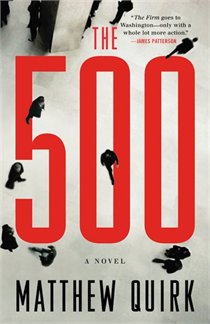
Review | The 500, Matthew Quirk

James Patterson compares Matthew Quirk’s The 500 to John Grisham’s The Firm and it’s easy to see why. Just like Grisham’s protagonist, Mike Ford is a fresh-faced hot talent who gets in way over his head in a high-powered career. Quirk takes the premise to Washington — “The 500” refers to the 500 most powerful people in Washington, usually those pulling the strings from the sidelines. Mike Ford has been hired straight out of Harvard Law School to join the Davies Group, Washington’s most powerful consulting firm. The Davies Group mandate is to make things happen for their clients, and that usually entails convincing one or more of the 500 to agree to something. As an ambitious young man raised in poverty and with a con man for a father, Mike’s street smarts provide fresh perspective for the Davies Group, otherwise staffed with privileged intellectuals.

The 500 is more action-packed than I remember The Firm to be. While The Firm, from what I remember, dealt a lot with the protagonist’s loss of innocence and the development of his relationship with his wife, The 500 focuses on the mystery — what are Mike’s bosses hiding? What do they want with an alleged war criminal? Why are they shutting Mike out and can Mike trust them? Unlike Grisham’s protagonist, Mike begins this story no longer an innocent. He has been trained by his father to be a con man, and has since struggled to live on the right side of the law. Unfortunately, his employment at the Davies Group forces him to use his long-suppressed con man skills, first to succeed, then later on, to survive.

Davies Group founder Henry Davies has built his empire on the tenet that everyone is corruptible. There’s an interesting reversal here — the law-abiding “good guys” manipulate people into corruption, and Mike’s old law-breaking “bad guy” acquaintances may be the only ones he can trust. It’s an old notion, and one that I think Quirk hammered home far too much. At one point near the end, just in case we hadn’t gotten the point yet, the narrator makes just that observation. It turns an otherwise fascinating story into a morality tale, and I wish it had been handled more subtly.

I do love the relationship between Mike and his father. Mike has tried his whole life not to become like his father, yet we see early on how much his father has influenced his life. I love the way Mike’s understanding of his father develops — it felt more genuine than Mike’s romance with a co-worker, and added a nice touch of emotion to this thriller. The romantic subplot was okay. At times the love interest felt more like a kick-ass Angelina Jolie fantasy figure — the perfect partner for a con man, who may or may not be trustworthy — than an actual woman.

Overall, the best part of The 500 is the mystery. I love that I couldn’t figure out what the Davies Group was up to, nor could I tell who Mike could trust. More than the Davies Group tenet that everyone’s corruptible, the House M.D. idea that everyone lies holds true in this book. The mystery was fast-paced and exciting, with unexpected twists. A lot of the action scenes and coincidental twists were a bit far-fetched, and would probably work out better on a TV or movie screen than a book. As well, despite the Washington D.C. setting, I would not consider The 500 to be a political thriller — I know there are major political consequences to the actions of the Davies Group, but the narrative was too focused on Mike’s experiences within the company to explore the bigger political picture. That being said, The 500 is a fun read and hard to put down.

+

Thank you to Hachette Book Group Canada for a finished copy of this book in exchange for an honest review.
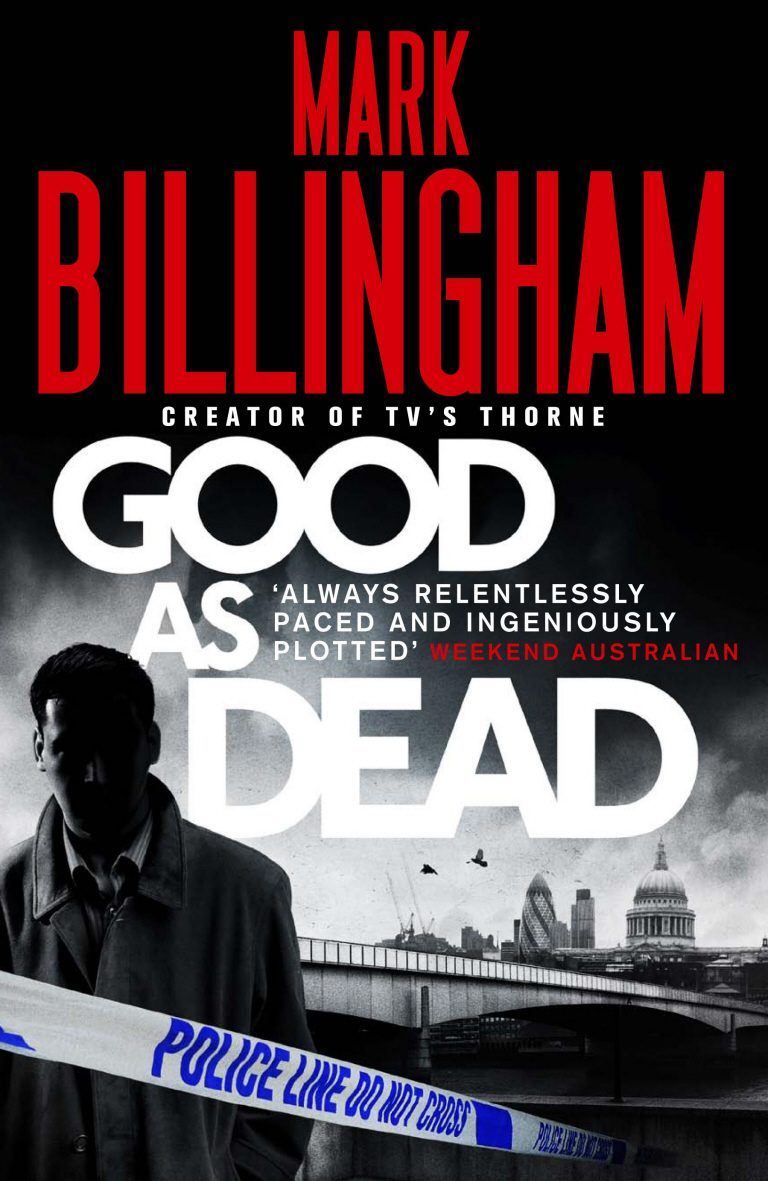
Review | Good as Dead, Mark Billingham

Shop owner Akhtar takes police officer Helen Weeks and a civilian hostage. His demand: that DI Tom Thorne investigate the apparent suicide of his son in prison, which Akhtar believes is a murder. Mark Billingham’s Good as Dead is a fast-paced mystery and an exciting read. It’s my first Tom Thorne book, as well as the first time I’ve heard of the Thorne TV series. I hope the TV show will be aired in Canada; it looks really interesting.

I had zero sympathy for Akhtar. I’m sure that’s partly because I just finished the deeply disturbing Into the Darkest Corner, and because of the recent real-life body parts case and Eaton centre shooting, all of which make me especially angry at people who use violence to ruin the lives of innocents. So Akhtar believes his son was murdered, and that the justice system failed his family. That in no way justifies, to any extent, his threatening the lives of two innocent people. While I understand that Thorne’s race to find out the truth about Akhtar’s son is motivated by his desire to see the hostages safe, a part of me hoped that it would turn out that the son had committed suicide after all, and that Akhtar realizes how pointless his drama is.

To Billingham’s credit, he also holds back on whatever sympathy he has for Akhtar. Rather, he emphasizes Helen’s concern over her one year old son, and the other hostage’s hysterical focus on his missing a meeting regarding his promotion at work. Even when Helen chooses to hide information from the police trying to rescue her, it’s not because of Stockholm syndrome, but rather because she wants to survive to see her baby again. Her decision seemed more like a convenient dramatic device to keep the story going rather than the smart choice, but I like that Billingham explained her reasoning behind it. I also like the scenes where Akhtar’s wife confronts him — Thorne reasons that in any couple in crisis, at least one of them has to remain strong. In the case of Akhtar’s wife, she couldn’t afford to fall apart, because someone has to take care of the other kids in the family. I like her as a character, and felt sorry for what she must be going through, first with her son, and now with her husband.

I have no sympathy for Akhtar, but his son did get a pretty raw deal. Billingham takes us into the son’s life, and the real reasons behind his imprisonment. It’s not a pretty story, and Billingham reveals a harsh, tragic type of party scene, where it’s so easy for boys like Akhtar’s son to get in way over their heads.

Good as Dead is a pretty solid, entertaining thriller. Nothing that particularly made me want to read all the other Tom Thorne novels, but definitely a good read for the weekend or an afternoon at the beach.

Review | Beautiful Creatures, Kami Garcia & Margaret Stohl

To be honest, I’ve been feeling a bit of YA fatigue lately. I’m a huge fan of Harry Potter and The Hunger Games, I have read quite a few really good YA books, and to be honest, I wish we had this much variety available when I was younger. That being said, it feels like wherever I turn, there’s the Next Big YA Series coming out, the one perfect for fans of Hunger Games. After a while, even the well-written ones start to sound the same to me — yet another dystopian world, yet another kick-ass heroine, yet love triangle, and so on. Full respect to the writers who create these stories and to the readers who love them, but I, at least, need a break.

So when my sister brought home Kami Garcia and Margaret Stohl’s Beautiful Creatures, finished it (all 563 pages!) in a single day, and suggested I read it, I was hesitant. Beyond my YA fatigue, there’s also a movie version coming out, so I was expecting to soon be overwhelmed by online buzz. Still, I figured I might as well give it a try. And I am so glad I did.

Beautiful Creatures is a brilliant Southern gothic — atmospheric, romantic, and haunting. I love that Garcia and Stohl tell the story from the guy’s perspective, and that there is no love triangle. I especially love that, while the focus of the story is the romance, there is an entire world beyond the love story, and the characters’ actions have significance far beyond their relationship. From the first chapter, I felt myself drawn into this world, and I wanted to find out more. The book did strike me as long, but the story is fascinating. It’s also really scary — I can definitely imagine it playing out well on screen, and I can just picture myself covering my eyes in the theatre.

When Lena Duchannes moves into the mysterious Ravenwood house in the small Southern town of Gatlin, Ethan Wate recognizes her from his dreams and is immediately drawn to her. Her family is cursed. They are Casters (they can cast spells), and while other Casters can choose their destiny, each Duchannes is Claimed at the age of 16 by either Light or Dark. As a powerful Natural Caster, Lena is a prize to both the Light and the Dark, and a prophecy later in the book reveals exactly how significant she is. Ethan is an ordinary boy, but he’s determined to protect Lena from the Dark as much as he can. At the very least, he fights to protect her from the other kids in school who have labelled Lena a witch simply because her uncle is the town recluse.

Beautiful Creatures has romance, but more than that, it has curses, ghosts, mystery, and, well, very real emotions. I love how, even though Lena has to deal with Dark Casters and curses, one of her major concerns is how to have a normal teenaged life before she is Claimed. Like an ordinary teenager, she just wants to have a good time at the school dance and to face a school day without being teased. In one particularly heartbreaking scene, she is invited to a party by the popular girls in her class. Lena knows they are under a spell by another Caster, but she pleads with her uncle to let her go anyway: “I want to go to a party I’m invited to. I mean, I know it’s all Ridley [casting a spell], but is it wrong if I don’t care?” As Ethan notes, “She wants to be part of all this, even if it wasn’t real.” How sad is that, and how much can we all relate to it?

Speaking of Ridley, I found myself very fascinated by her character. A childhood friend of Lena’s, she was Claimed by Dark at 16 and is now no longer welcome to her own family. She seems genuinely pained by this rejection, which makes me wonder if being Claimed as a Dark Caster makes one as absolutely evil as everyone seems to think. I love that Garcia and Stohl made her character a bit ambiguous; in her own way, she appears just as vulnerable as Lena, and I’d love to find out more of her thoughts.

The secondary characters in this book were also fascinating. I love Amma and Macon, both mentor figures who seem to have exciting pasts of their own. I also love Ethan’s best friend Link, the comic relief who I hope may be able to get through to Ridley. Finally, I love how much of this book revolves around a library — the town librarian works at a Caster library on bank holidays, and that just seems like such a magical, fascinating place.

Beautiful Creatures is such a fascinating book, and I can only begin to imagine where Garcia and Stohl will take the rest of the series!