
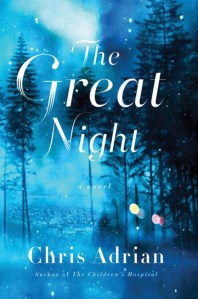
The Great Night, Chris Adrian #50BookPledge

When I think of A Midsummer Night’s Dream, I remember my university English professor lecturing about the farcical hilarity of the young lovers running after each other in the woods and getting lost. I remember Robert Sean Leonard in Dead Poet’s Society, one of my all-time favourite films, as Puck, with a crown of leaves gleefully explaining his plan to another fairy, then looking absolutely dejected in the final soliloquy, as he notices his family in the audience. I do not imagine the world of Puck transported to present day San Francisco, but I’m so glad Chris Adrian has. The Great Night has transformed one of Shakespeare’s most delightful plays into a dark, contemporary novel that blends horror, fantasy, humour, and, if I may say so about a novel populated by fairies, realism.

No longer a mischievous trickster, Adrian’s Puck is a malevolent being who has been held captive by fairy royals Titania and Oberon. Puck in The Great Night is scary – “he was often the image of one’s worst fear or most troubling anxiety.” Titania becomes a grieving mother – her adopted son has died, and her husband has left her. She releases Puck in despair, hoping this would bring Oberon back to her, and instead setting off the series of events in the novel. Midsummer’s young lovers are now three young people who are broken hearted in some way, and the troupe of actors are now a group of homeless political activists who plan a Hamlet Mousetrap-esque musical for the Mayor.

I love what Adrian has done with this story. While he uses Midsummer characters like Titania and Puck, and some Midsummer plot devices, The Great Night is in so many ways a completely original story. Titania in particular is such a nuanced character. She cattily insults a human nurse, barely bothering to maintain the fairy glamour that makes humans perceive normality and social convention in the presence of a fairy. Yet even in that scene, she is terrified of losing her human Boy, whom Oberon has given to her as a gift and whom she has grown to love, even more than she loves Oberon. She is a fiercely protective mother, and the tragedy is that, even with all her fairy powers, she is still utterly helpless against human illness.

The young humans are fascinating as well. They each have detailed back stories, and are all seriously messed up, in quirky and endearing, but also heart-tugging ways. Molly, for example, grew up in a foster family that had a gospel band, and is now dealing with her boyfriend’s suicide. Harry has a phobia of dirt and has just broken up with his boyfriend, and Will wants to get a girl’s attention.

Adrian alternates between chapters about their current predicament – being trapped in San Francisco’s Buena Vista Park on their way to a party – and glimpses into their lives. At times, this got a bit confusing, as Adrian travels often not just between present day and background, but also between layers of back story. I found myself having to go back sometimes to check who a particular character is. It was mostly an odd mix between being solidly grounded in reality and being kept off-balance by rapid jumps in time and between characters. Adrian is nowhere near as skilled as Ishiguro who, in The Unconsoled, created such a wonderful world of unreality yet with such a core of reality. Then again, I don’t think he aspired to do that. On the contrary, Adrian grounds his story in realism, yet with enough fantastical elements to keep us off-balance, and I think his writing style helped enhance that experience.

I enjoyed reading The Great Night. The characters are wonderfully fleshed out – even Puck is revealed later in the novel to have an almost human motivation for his actions. Adrian’s tone moves from humour (both dark comedy and slapstick) to screwball eroticism to straight up terror, but all with a strong emotional core. Adrian is one of The New Yorker’s “20 Under 40” to watch, and I can see why.
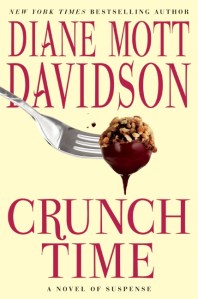
Crunch Time, Diane Mott Davidson #50BookPledge

I’m a huge Goldy Schulz fan, so when I saw Diane Mott Davidson finally had a new book out, I pre-ordered the e-book immediately. Unfortunately, I did not like Crunch Time. I suppose I should have been warned by “A Novel of Suspense” on the cover. Goldy Schulz novels have never been about the thrills – they’re about the warmth, the humour, and yes, the food. Crunch Time tries so hard to be about the “suspense” that it ends up with a whole lot of half-developed plot points, frenetic plot twists and new characters who just don’t make me care.

Ernest, a private investigator, is killed, and his live-in cook Yolanda and her great-aunt Ferdinanda are friends of Goldy, so they come to live with her while looking for a new place. Ernest was working on several cases (a fishy dog breeding mill, a divorce case involving possible adultery, a generations-old stolen diamonds case, and Yolanda’s abusive, stalker ex-husband), so he had quite a list of people who’d wanted him dead. Yolanda is a suspect and Goldy, being Goldy, decides to help her out by finding the real killer. Classic Goldy Schulz plot.

Here are the problems. Yolanda and Ferdinanda are just plain annoying. Ferdinanda is the classic feisty elderly lady. She talks non-stop, she takes over Goldy’s kitchen, and she confidently wields a baton against men. She does have her likable moments, but for the most part, I felt more sympathy for the man she was yelling at or whacking with the baton. Yolanda claims her ex-husband abused her (again a classic theme in Goldy Schulz novels), and so is understandably jumpy. Unfortunately, Davidson handled this type of character much better with Goldy (whose fear made her sympathetic) and Marla (whose spunk made her admirable), mostly because we saw just how bad their ex-husband, the Jerk, could be. Yolanda’s ex is barely developed and even Goldy sometimes questions whether Yolanda has even been abused in the first place, so Yolanda just comes off as hysterical. Characters in fiction need not be likable, but if the lovable protagonist risks herself and her equally lovable family for them, they should at least be likable enough to be worth that risk.

Other minor characters irked me as well. One suspect for example is a man who literally faints at the sight of blood. He had at least three scenes of blood-related fainting incidents, which I personally thought was at least two too many. The first time was surprising, and somewhat amusing. After a while, it turned into slapstick that tried too hard either to be funny or to establish that this character is a wimp.

Also, I don’t know if Goldy’s nosiness has always been this annoying, or if I just don’t think this case is worth her meddling. I’ve always found Goldy charming – I like how she mostly just wants a quiet life as a caterer, and yet ends up embroiled in mysteries because she or a good friend (like Julian Teller) or family member (like the Jerk) is accused of a crime. Because the stakes are usually so high and she tries to find an answer quickly so she can get back to her usual life, I cheer her on when she bends the rules, ignores police warnings and gets into dangerous situations. In Crunch Time, Goldy seems to have developed a taste for detecting, and has morphed from an ordinary mother/caterer into a wannabe cop/busybody. At one point, she enlists someone’s help to drug a suspect so she can collect evidence, then later fabricates evidence to collect even more evidence. This type of mystery always requires a suspension of disbelief when it comes to chains of evidence, but even I couldn’t swallow all that. Nor could I help thinking, Goldy’s police officer husband Tom seems more than capable, why not tell him what she knows and let him handle things?

The plot twists and red herrings in this book just pile up, and it wasn’t so much confusing at it was unnecessary. Davidson emphasizes the most random things, which make me think they are significant, but end up being just bits of colour to add to characters. At least two people for example ask Yolanda why she calls Ferdinanda Aunt instead of Great Aunt. In real life, I just don’t see people caring about that, so I thought the inconsistency would mean something later on. Spoiler: either it didn’t, or I missed it completely. Later on, Ferdinanda hangs a Santeria mask on Goldy’s door, which makes Tom protest. Santeria masks do play a role later on, but the fact that Ferdinanda insisted on hanging the mask up despite Tom’s (the house owner’s!) objections meant nothing at all, from what I could tell.

It was good seeing old favourites again, and I love seeing Goldy’s son Arch, whom I first met as a shy, awkward eleven year old, now a popular, confident athletic sixteen year old. So he’s a fencer, which isn’t exactly the height of cool, from what I can remember of high school, but still, it’s nice to see him all grown up. The always entertaining Marla was, like Goldy, more annoyingly gossipy here, but even worse, she was barely involved at all in the case. Even an annoying Marla is much better as Goldy’s sidekick than Yolanda and Ferdinanda. Tom and Goldy’s relationship has progressed somewhat, and it’s nice seeing them having sex more often than in previous books. They’re a cute couple, and I like seeing them happy.

Finally, and I admit this should a minor, ridiculous gripe, I miss Goldy’s constant cooking. In previous books, she cooks every time she gets stressed out (which is often), and Davidson describes the most mouth watering recipes in these scenes. Goldy still does cook, and Davidson does include a list of recipes, but at least half the time in this book, when Goldy goes to the kitchen, she finds that Ferdinanda has already cooked something sumptuous. We still get the description of how heavenly Ferdinanda’s meals are, but it isn’t quite the same as seeing the meal created.

Minor question to Goldy Schulz fans – how religious was she in previous books, beyond teaching Sunday school and catering church functions? She just seemed very preachy here (commenting about sins and commandments), and the scene where she is stressed out and goes to light candles in church rather than cook surprised me. Not a big deal, and certainly, a character can change. Just struck me as odd.

Spells, Aprilynne Pike #50BookPledge

Spells is the second book in Aprilynne Pike’s YA series about Laurel, a sixteen year old girl who just recently discovered she is really a Fall fairy. She has a human boyfriend, David, and is very much attracted to a fellow fairy, Tamani. As a Spring fairy, Tamani is below her in the fairy social hierarchy, so there’s an interesting tension between him being her guide to the fairy world, and thus someone on whom she depends, and him having to walk behind her and having to ask her to ask him to dance. Spells has Laurel spending a summer in the fairy world and learning how to be a fairy. When she goes back to the human world, she then has to deal with trolls, and with David encouraging her to live a more fully human life.

I didn’t read Wings, the first book in the series, but it’s fairly simple enough to catch up, with Pike giving enough background to keep me in the loop without boring those who have read Wings. I did have some unanswered questions though, which I suppose must have been tackled in Wings – what’s this land that Laurel is supposed to protect, why are the trolls after it, and is there any reason (other than her being the only fairy raised as a human) that Laurel is special to the fairy world?

There are some interesting elements in the story. I like how Pike depicts Laurel’s more complicated relationship with her parents now that they know she’s a fairy; Laurel’s mom’s reaction in particular is very realistic. I also like the social hierarchy in the fairy realm, mostly because it enhances the Tamani/Laurel romance. Laurel is clearly uncomfortable with it, and there’s the hint that Laurel may some day lead a fairy revolution. I enjoyed learning about the fairy world, especially about the potions class.

That being said, Spells didn’t grab me. Possibly, there was just too much fairy school and not enough troll-fighting, but I actually liked the fairy realm parts all right. I think it’s more that with such amazing YA series in the market (Hunger Games, Harry Potter, Percy Jackson and the Olympians), this one just pales in comparison. Spells has an okay story, with okay characters and some interesting elements, but it’s nothing special. If you’re an Aprilynne Pike fan, or a fan of fairies in general, and you think you’ll be interested in this story, the paperback of Spells and the hardcover of the third book in the series, Illusions, are both coming out this April.