
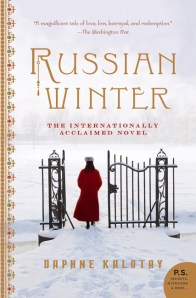
Review: Russian Winter, Daphne Kalotay

Daphne Kalotay’s Russian Winter is a beautifully written book. The pacing is a bit slow, but that somehow fits with the book’s reflective, nostalgic nature. And once in a while, Kalotay injects a cheeky line or two into an otherwise serious scene. Take for example a character whose ex-fiance’s new woman had “all her ducks in a row.” The character’s mother “let slip” that the ex-fiance was moving to Seattle with “the woman with the ducks.” It’s a toss away phrase, but one that turns a cliche into an opportunity to giggle. Later, a solemn TV interview scene includes a nurse who sneaks into camera view, waves, and scurries back off screen. It’s farcical, and definitely welcome, keeping the book from taking its heavy subject matter too seriously.

Nina Revskaya is an elderly former dancer from the Bolshoi ballet. Now living in Boston, she has decided to auction off her jewelry. This dredges up memories she would rather forget, of her life in Stalinist Russia. The auction also reveals a mystery in the present — why is Nina so reluctant to meet Grigori Solodin, a Russian professor with an amber necklace so apparently part of a set Nina owns?

The Russian scenes are beautiful and captivating. I loved reading about Nina’s rise to principal dancer. Kalotay describes ballet with a storyteller’s eye. We are drawn into Nina’s dancing because Kalotay goes into such detail that we can almost imagine we’re watching the ballet and feeling the magic of live theatre. Take for example:

Nina revels in the leaps and kicks and high jumps her body loves. […] She greets her Spanish girlfriends in mime and flirts with some of the young men, all the while aware that Stalin is watching–yet even as she makes her sequence of leaps around the square, slapping the ground firmly with her fan, Nina feels fully in control. When she dances her first variation, clicking her castanets defiantly, her sissonnes are fully split, so that as she arches her back in midair, her head points back parallel to her leg and her arm behind her almost touches her outstretched back foot.

We can practically see Nina happily flirting with men onstage. Her joy is marred by the presence of Stalin in the audience, the man responsible for her friend Gersh’s fall from grace and eventual arrest. Yet, with that final pose, Kalotay presents us with such a beautiful image of triumph. It may not mean anything in practical terms, but, reading that passage, we can believe that Nina has defeated Stalin, that she is free from his regime’s control. And we realize, isn’t that the power of art? Doesn’t art provide us with a sense of freedom, of transcendence? It’s idealistic, and as Nina’s story reveals, only temporary. But in passages like that one, we not only believe in this power; Kalotay makes us feel it.

I was drawn into Nina’s story: her romance with the poet Victor Elsin, the complexities of her friendship with Vera, and, in the present day, her overwhelming desire to both confront her past and forget it. I loved reading about her friends in Russia. Set against the backdrop of the Stalin regime, yet full as well of personal drama, their stories drew me in.

Less compelling are the scenes in the present. Kalotay does a good job fleshing out the other two main characters, the Russian professor Grigori and Drew, the woman organizing the auction of Nina’s jewelry. The mystery of why Nina refuses to acknowledge Grigori’s necklace as part of her collection is intriguing, and certainly what kept me interested enough in the present day scenes. Grigori and Drew are likable enough characters; they just pale in comparison to Victor, Vera, and even Nina’s nurse Cynthia. I was more interested in Grigori, mostly because his necklace shows some kind of link between him or his family and Nina. Drew’s story mostly just bored me.

That being said, it was a present day character, Zoltan, an immigrant in America, who said one of my favourite lines in the entire novel:

This country has been good to me. But it doesn’t hold the indentation of my body on the mattress, if you see what I mean.

What a beautiful, striking image! An immigrant myself, I do see what he means. I don’t necessarily feel that way all the time, but when I read that passage, my immediate thought was: that’s it exactly.

Russian Winter is very much Nina’s story, and she’s a fascinating woman with an even more exciting past. Zoltan’s sense of not being truly home is an echo of Nina’s own situation — a woman who has broken free from Stalin’s government, yet in doing so, has also given up the life of dance that had come so naturally to her. Elderly, with arthritic knuckles, Nina is as much a stranger in her own body as Zoltan feels in his current home. We feel Nina’s pain, as she remembers the wonder of being able to dance even as she struggles now to walk. We fret with her when she realizes mistakes she’s made and feels it’s too late to fix them. And we hold on as tight as she does to the memory of that young dancer, triumphant in her pose mid-flight.
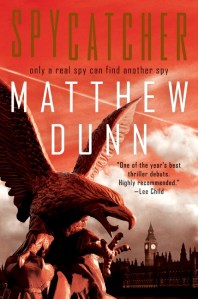
 

Review: Spycatcher, Matthew Dunn

Fan of John Le Carre? You’ll love Matthew Dunn’s Spycatcher. Written by a former MI6 field officer, Spycatcher takes us right into the mind and heart of master spy Will Cochrane. Cochrane is a highly skilled operative, tasked by MI6 and the CIA to locate and stop an Iranian terrorist named Meggido from launching a massive international attack.

Dunn’s background in espionage is evident. Spycatcher has an action-packed story, with some of the best fight scenes I’ve ever read. They remind me of the Sherlock Holmes movie with Robert Downey Jr, where a voice-over narration details all the moves Holmes will make and the reasons behind them (like “fake to the eye to distract, then strike to the throat to incapacitate”). When Will takes a guy out, we see exactly how he does it, and we believe in Will as a killing machine. As a fan of action movies and MMA, I loved reading such scenes of realistic, efficient hand-to-hand combat.

I also love the way Dunn describes the operations carried out by Will and his team of CIA agents. In some scenes, they seem almost unbeatable. For example, when Will has to break into a building, he has Julian, a member of his team, giving instructions in his ear. The instructions are split-second precise, with Julian telling Will where to face, when to go and when to stop and hide. They move with clockwork precision, and so even when things go wrong, we just know that such a highly skilled team can come up with a viable Plan B on the fly.

What really makes Spycatcher work, however, is the depth of insight it gives into the personal lives of spies. The CIA team and Will’s MI6 and CIA bosses are all engaging characters, but Will, in particular, is a very lonely man. In one scene, he runs into his sister, who he hasn’t seen in eight years, at a cemetery, and she comments that it’s just like him to visit the dead and not the living. It’s a striking observation; we realize that, in choosing the life of a spy, Will Cochrane has given up the chance to have a family, and even to be with the family he already has. We also get some flashbacks to Will’s childhood and the traumatic events that have made him such an effective spy and efficient killing machine.

So when Will meets Lana, a woman who can help him get Meggido, and whom Will wants to protect because of all she’s suffered in the past, and when Will realizes he isn’t as lonely with her around, I really wanted them to end up together. I don’t usually care much for the romantic subplots in thrillers; I prefer to focus on the action. But in Spycatcher, since Dunn makes such a compelling portrait of Will’s humanity and loneliness, I just wanted Will to find happiness.

In one of my favourite scenes, Will hesitates to kill a man whom he respects for his courage: “For the briefest of moments, he wanted to leave the brave man alive, just turn and walk away. But he knew he could not allow the man to live. He shot him.” So many action movies or thrillers have clear good guys and bad guys, and if a good guy hesitates at killing a bad guy, it’s because they have some kind of history. But Will had never met this man before, so it was just his behaviour in combat that made Will respect him. Will’s hesitation at killing this man, and yet killing him anyway because it was necessary, is such a wonderfully complex, emotional portrait of Will as both vulnerable human and professional spy at the same time. We feel for Will, and can relate to him, even as we admire his skills as a deadly machine.

In the book trailer on the Harper Collins Canada website, Matthew Dunn says he’s been told to write what he knows, and what he knows is espionage. Reading Spycatcher, I can definitely see it. Dunn takes us into the heart of a spy. Will Cochrane’s adventure is thrilling, but it’s his personal life that keeps us hooked, and his personal demons that we really want vanquished.

Review: Dead Man’s Grip, Peter James

Being a fan of British mysteries, I’ve had Peter James on my To Read list for a while. So when Shannon from Harper Collins Canada asked if I was interested in his new Roy Grace mystery, Dead Man’s Grip, I jumped at the chance to check him out. I had imagined Detective Superintendent Roy Grace as a thin man with a handlebar mustache and Peter James’ books as P.D. James type genteel whodunnits. Turns out Roy Grace is a Paul Newman lookalike and Dead Man’s Grip, at least, is more Jo Nesbo than P.D. James. (A quick check on IMDB reveals an actor named Roy Marsden played P.D. James’ detective Adam Dalgleish several times, which must have led to my mistake.)

Dead Man’s Grip is more a police procedural thriller than a mystery. We know who the villain is almost right away; the only question is whether or not Grace can catch him in time. A traffic accident kills the son of a member of the New York mafia. The victim’s mother, heartbroken, offers a reward for information about the identity of the other drivers involved in the accident. Grace points out that the usual wording is “information leading to the arrest and conviction of someone,” and the way this victim’s mother has phrased the offer of reward hints at vigilantism. Sure enough, the other drivers in the accident start dying, in particularly gruesome ways, and Grace fights to keep the surviving driver safe.

Expecting a genteel mystery, I was particularly affected by the gore, and it was just an exciting read throughout. James isn’t quite as explicit as Jo Nesbo or Val McDermid, whose descriptions of torture can get into horrific, excruciating detail. Rather, James relies more on the power of suggestion, which in my case at least, is just as effective. One scene in particular, of a man walking around a smoked salmon factory, absolutely freaked me out. I felt like I was watching one of those horror/suspense movies with the camera zoomed right into the actor’s face, and you know, you just know that something horrible is about to happen but you can’t see any hint of it yet onscreen. Reading that scene, I completely lost my appetite for salmon, and James hadn’t described anything gruesome yet. I love it when an author can build such an atmosphere of tension, and still withhold the source of that tension from the reader.

I also like how James fleshed out the various characters. Both Carly (one of the drivers in the accident) and Fernanda (the accident victim’s mother) are portrayed as very devoted mothers, so it’s interesting to see them up against each other. Even Tooth (killer for hire) is an interesting character, chilling in his methodical approach to murder yet still more human than the Stieg Larsson supervillain who felt no physical pain. Minor things: Carly made a really stupid decision that annoyed me even though I could somehow understand her reasoning. Also, I wish I knew what Tooth’s original master plan had been, and just how much Carly’s actions had changed it.

This is my first Roy Grace novel, and it certainly won’t be my last. Other than the gripping story, Roy Grace is an interesting character as well, with a complicated love life. His wife has been missing for ten years and his girlfriend is having complications with her pregnancy. I immediately wanted to know if we will ever find out what happened to Grace’s wife (my imagination was running wild). Now, I don’t know if her storyline has been explored in previous novels, or if the question of her fate is one that long-time Peter James fans have been dying to have resolved and I just lucked out by beginning with Dead Man’s Grip. Possible good news for long-time fans then: we find out quite a bit about her story in this book.

Even better news for Canadian fans of Peter James: I found out from his website that he’ll be coming to Toronto in September.

*EDIT*

Toronto fans:

Peter James will be doing a Q&A at Ben McNally Books (366 Bay St) on Tuesday, Sept 20th, 6:30 – 8 pm. Details at the Savvy Reader here.

Are you a fan of Harper Collins Canada on Facebook? Check out their Facebook page for details on how to meet Peter James at the HCC office on Sept 21st, 7 pm.