Hunger (Book 2 of Gone series), Michael Grant #50BookPledge

Michael Grant’s Gone series just keeps getting better. In the second installment, Hunger, the kids in the FAYZ have run out of food, some of the normal teens have drawn battle lines against the kids with powers, and the mysterious entity called the Darkness keeps sinking its claws even deeper into Lana and Caine. Sam and his crew have discovered fields with vegetables, but there are giant killer worms guarding their territory (sounds ridiculous, but they’re actually quite horrifying… and gross).

Worse, kids in the FAYZ don’t want to work. “I’m just a kid” becomes a common refrain, understandably frustrating Sam’s team, all of whom are kids themselves. My sister, who introduced me to this series in the first place, commented that she found it hard to believe that only Sam’s friends are stepping up, and the rest are content to whine about their hunger and play video games all day. She understood about the younger kids, but wouldn’t the tweens and teens at least band together and help organize something? My initial reaction had been that this situation seemed very realistic, but my sister raised a good point — is Michael Grant, and are readers like me, underestimating the potential for maturity in young adults?

Then again, it’s not just that it was only Sam’s friends stepping up; it was just that those who did step up naturally became part of Sam’s “government.” One of the characters also said something that struck me as logical: the kids have no incentive to do hard labour, because they know that even if they do nothing, Sam’s team will make sure they’re fed. One of my favourite secondary characters from Gone, Albert, comes up with what I consider a brilliant solution: he sets up a market economy, first a barter system, then eventually establishing a currency using McDonald’s Monopoly money. Astrid’s response to this disappoints me, considering how brilliant she is supposed to be: she tells Sam to shut Albert down, saying they now have the opportunity to establish a class-free society, where money doesn’t exist and therefore no one is richer than anyone else. Would socialism have worked in the FAYZ? Possibly, but only if established from the very beginning, before they ran out of supplies and most kids show no motivation to work “for the greater good.”

What I love most about Hunger is that we see the vulnerability in so many of these characters. Sam’s heading for a breakdown: “I’m not their parent,” he constantly tells Astrid, to which she reminds him, “They’re just kids,” who need parenting. Sam, of course, is a kid himself, and even adults would prefer to focus on the bigger issues like finding food or preparing for Caine’s next attack rather than have to deal with complaints of who pulled whose hair and who called whom stupid. Lana, as the Healer, feels a similar pressure. Kids come to her with everything from bloody noses to loose teeth to skinned knees. She’s like a celebrity hiding from paparazzi; everyone demands her attention, and all she wants is privacy. Astrid’s brilliance reveals its cracks. While Sam is the official leader, Astrid definitely holds the power, and a lot of her decisions (shutting down Albert’s enterprise, curtailing Quinn’s initiative in going fishing) reveal short-sightedness. I can understand why some of the kids in the FAYZ have grown resentful. I especially love the bigger role other characters play: Mary’s eating disorder grows much worse, Albert and Quinn reveal economic savvy, Edilio takes a much stronger leadership role, Brianna, Taylor and Dekka become essential to battle, and even Caine reveals his softer side.

Gone was thrilling and action-packed, with characters you grow to admire. Hunger is even more thrilling, and makes these characters even more real and tangible to us. Fantastic sequel, darker and more introspective than the first, Hunger takes the FAYZ kids from trying to survive a battle to taking the first steps in creating a long-term, sustainable society.
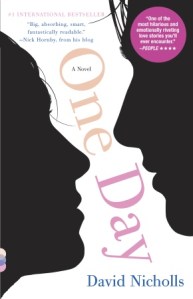
One Day, David Nicholls #50BookPledge

I read One Day on the recommendation of a fellow bookworm who thought it was a good book but hated the ending. My boss at the bookstore loves this book, has recommended it a lot of times, and is looking forward to the movie with Anne Hathaway and Jim Sturgess. So it’s been on my TBR list for a while, and when my bookworm friend lent me her copy, I was excited to read it.

One Day follows the relationship between Emma Morley and Dexter Mayhew over the course of twenty years, depicting snapshots of their lives on the same day (July 15th) each year. They meet in 1988, have sex, and set off to pursue different lives after graduation — Emma as an aspiring writer and Dexter as someone who wants to travel the world and become famous somehow. Their relationship shifts from romance to best friendship, and their lives turn out very different from how they’d imagined it in university. Taking a yearly snapshot is an interesting concept, allowing Nicholls to show gradual character development and long-lasting effects of decisions that characters make. Nicholls is a talented writer, and his characters are complex, interesting people you can imagine being friends with.

That being said, it took me a long time to get into One Day. I found myself bored for the first half of the book. Nothing to do with Nicholls’ writing, and I have to admit, the behaviour of characters and development of Emma and Dexter’s relationship felt realistic. It actually took me a while to figure out why I wasn’t enjoying the book, and I realized that while the yearly snapshot approach is an interesting idea, it made me find the story meandering. I just wanted something to happen already. While I acknowledged the Emma-Dexter chemistry, I found the single day narrative too abrupt — I’d just be getting invested in a plot thread when the day ends, I flip the page and I have to hear about the results through flashback. It didn’t help that I found the young, politically active Emma annoying. Dexter accuses her of being condescending and a know-it-all, and I had to agree. That made me a bit wary about the upcoming movie — I can imagine finding it more annoying on screen.

As Emma and Dexter grow older, however, and become a bit more settled in their respective lives, I found myself becoming more interested in the story. Secondary characters started to become more significant, and Emma and Dexter’s desire to be with each other (not just romantically, but also to connect more deeply as friends) becomes more urgent. That’s what I love most about Emma and Dexter’s relationship: it’s based on a deep friendship; they’re soul mates in a similar (though much less melodramatic) way as Cathy and Heathcliff. It’s a wonderful, touching love story, and Nicholls depicts their connection well.

Like my friend, I hated the ending. Without giving away any spoilers, I just have to say I found it unnecessary. Fortunately, Nicholls is a gifted writer and he handles it much better than I imagine others would have. I also think the one day snapshot format helped him pull off this ending well.

Would I recommend this book? Sure. I can see why so many readers like this book. Despite the movie poster image, One Day is more than just a romance. It’s a well-written look at how two individuals grow up, and, more importantly, grow up together.

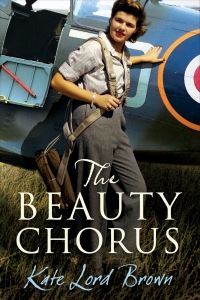
Blog Tour: The Beauty Chorus, Kate Lord Brown #50BookPledge

Kate Lord Brown’s The Beauty Chorus covers a very important topic, in my opinion: the role of the female pilots, “esp. beautiful thrill-seeking debutantes,” of the Air Transport Auxiliary Unit in World War II. They were rather dismissively labelled “The Beauty Chorus” yet served an important, vital role in transporting planes to war-torn areas.  In one scene, a couple of the female ATA pilots are laughing at a Hollywood image of them as glamourous, when the reality is that they usually end up grimy from doing a lot of physical labour.

Beauty Chorus, then, ostensibly seeks to dispel those myths and show just how heroic the reality of these women are, and in some ways, the book succeeds. The italicized chapters, for example, from the perspective of ATA pilot Amy Johnson, who disappeared during a flight and was presumed dead, are touching and give us a taste of the risks these pilots take and the politics they face. The accounts of sabotage and general discrimination against female pilots also ring true, and help portray an important part of that history. And the final few chapters, where the story becomes a pure adventure-in-a-strange-land account, are enjoyable.

Unfortunately, I found Beauty Chorus so full of stock characters and melodramatic dialogue that it seemed more like the Hollywood movie the characters mocked than the reality they mentioned in passing. The main characters are adventurous debutante Evie, naive teenager Megan and young mother Stella, who left her baby with her in-laws. I found Evie mostly a standard “feisty beauty.” She gets into an altercation almost immediately with fighter pilot Beau who had immediately labelled her a spoiled brat, and as anyone who’s read a Harlequin novel can tell, that means other kinds of sparks are about to fly. In the book’s defence, Beau isn’t the stereotypical handsome brooding Alpha male. He is handsome, but scarred, literally, which adds a welcome sense of vulnerability. He is sharp, but not rude, which is good for his character, but also unfortunately makes Evie seem even pricklier.  There is the standard villanous male, who I almost expect to wear a black hat, smirk and twirl a moustache every time he appears. There is also the stereotypical ditzy, ultra-girly romantic rival, who mocks Evie’s job and clothing as being “too masculine.”

Evie has a doting father and an evil stepmother straight from a soap opera, who is after her father’s money and does everything to undermine Evie. They get into some major cat fights throughout the book, with the stepmother using baby talk on the father then demanding behind the father’s back that Evie hand over her mother’s diamonds. At times, I almost expected one of them to slap the other, though, thankfully, they show a bit more restraint than that.

Megan’s family owns land, which Megan and her brother have used to build an airstrip. With the brother dead and Megan off to war, her evil cousins are circling her father, pressuring him to sell them the land so they can use it to make money. This, on top of the Evie’s evil stepmother storyline, and the only good thing I can say is that the evil cousins don’t appear as often as the evil stepmother does.

Stella probably begins as the most interesting character: she’s a mother who has lost her husband and left her baby behind, and quite understandably suffers from depression until she meets a handsome curate who is a good listener… You can probably guess where that goes. And that’s really the main problem – with so many stereotypes and so many cookie cutter situations, a lot of the book becomes predictable.

Details about the ATA pilots being forced beyond their comfort zone are limited to characters laughing about the glamorization of Hollywood, Evie shrieking over a mouse in their cottage and characters mentioning that they have a heavy schedule for the day. Otherwise, there are scenes with Evie driving them into town to shop for their cottage, the women going to dates, and, of course, Evie shrieking invectives at the evil stepmother.

One scene that really irked me, and I’ll try not to give any spoilers away: a woman is about to have sex when she and her date run into another man. She promptly leaves her date, apologizes to the other man, and they have sex, all in the space of a couple of pages. That in itself is pretty skeevy (poor date!), but it could have worked, especially since Brown has established this woman’s naivete. Unfortunately, there wasn’t enough set-up to make me believe in the love between the character and this man. The past few chapters had her gushing about the date, and this other man hadn’t been mentioned at all. So when they suddenly declare deep feelings for each other, I couldn’t believe them. Worse, I felt I could no longer believe any of this character’s emotions in the future, and not in a good way.

There are some moments in the book I loved, mostly because I found they revealed a lot about the character, and in a non-stereotypical way. When Stella (who was still producing milk) was asked to give milk to a starving baby, she balks, and it takes the other woman a while to convince her to make the sacrifice. I thought this was just such a powerful moment, where Stella, against all logic, wants to save her milk only for her baby, even though he is in a completely different country. In another scene, when Evie sees a man beating up a dog with a stick, she takes the stick from the man and beats him up instead. I found that scene hilarious, and thought it really showed Evie’s passion for protecting the helpless.

Finally, I found the last quarter or so of the book, after a certain plot twist, to be a vast improvement. The “bad guy” characters were less prominent, which allowed Evie and the other characters to interact much more naturally, and develop beyond the stereotypes. I only wish this had come earlier, and that the villains, especially, were given more depth.

I wanted to love this book. I think it’s important to tell the stories of groups who may not have gotten as much attention in history about their war efforts, and I appreciated the Author’s Note at the end, which gave me a bit more information on the ATA pilots. Unfortunately, I didn’t find this exciting enough to be a straight-up adventure/romance story nor layered enough to be a penetrating look at the reality behind the glamour.