Review | Sanctus, Simon Toyne

I read Simon Toyne’s Sanctus because of the above trailer. [Note: If you like zero spoilers, ignore the above trailer. It convinced me to read the book, but it also made the first few chapters seem slow, because I already knew what was going to happen.] Promotion for Sanctus focused heavily on its similarities with Dan Brown’s Da Vinci Code. To be honest, while I’m a thriller fan, the deluge of “next Dan Brown” conspiracy thriller books that came after Brown’s success has made me cynical about that type of book.

Still, the trailer did intrigue me enough to check it out. There are definite plot similarities to Da Vinci Code, though the cinematic quality of Toyne’s writing, especially at the beginning of the novel, also reminded me of James Rollins. Unlike Brown and Rollins, however, who both rely heavily on research for their books, Toyne chooses to locate Sanctus in the fictional Citadel, a Vatican-like city-state in Turkey. As well, rather than the Catholic church, it is a fictional religious order of monks that guards the novel’s big secret. This detracts a bit from the impact of the novel, as it then becomes easier to believe the whole thing fiction and therefore Toyne’s revelations didn’t have as much impact on me as Brown’s. However, this decision also frees Toyne to imagine a secret and a conspiracy far beyond the realm of the ordinary.

I enjoyed Sanctus. The novel began a bit slow for me. From the trailer above, I already knew what the monk was going to do. Also, with so many characters in the first few chapters, it felt like a montage of scenes, and I couldn’t find a character to latch on to and care about. Still, once the story gets going, I really enjoyed reading about Inspector Arkadian and Liv Adamsen.

Sanctus is about how one monk’s actions endanger the secrecy surrounding the mysterious Sacrament hidden from the public for centuries by a group of monks. The monk’s sister, Liv, might be an integral part of a prophecy surrounding this Sacrament, and she is hunted by the monks trying to keep the secret and a group of people who want the secret to be revealed.

Toyne writes well, and Sanctus is an enjoyable read. For most of the book, however, it just didn’t grab me as much as I thought it would. I think that’s because it felt so much like The Da Vinci Code, except with the bad guys belonging to a fictional religious group and the clues pertaining to a religious document that doesn’t exist (or at least makes no claim to exist) in the real world. So while I was gasping at Brown’s observations about the Mona Lisa or alternate gospels, I viewed the document in Sanctus with detachment.

It wasn’t enough of a fictional world to completely transport me (as, for example, the world in Lord of the Rings, where I take a prophecy as significant because it feels significant within that world), nor did it have enough hooks in reality to completely grip me (as in the best James Rollins books). I did care enough about the characters to want to keep reading about them, but not enough to make real emotional investment (as I did with Spycatcher). Sanctus is a good book, a well-written, well-paced thriller, but nothing about it really struck me.

At least, that was true until the big reveal. When I found out what the Sacrament was, and why it was significant, I was completely, utterly blown away. I think I was still expecting a Da Vinci type reveal, so I figured that whatever the Sacrament was, it would have the same impact on me as the monks’ sacred document did. Well done, Mr. Toyne. I absolutely did not see that coming. Also, I realized why it was a good thing that Toyne stayed away from the extensively researched worlds of Brown and Rollins.

Sanctus is the first volume of the Ruin trilogy, and I’m curious about where Toyne will take his story for the next instalment. To be honest, I can’t imagine how he’ll take this story to a full trilogy. Then again, as my experience of reading Sanctus showed, Toyne’s imagination can certainly trump mine.

Review | The Sense of an Ending, Julian Barnes

To be honest, I don’t really know what to say about Julian Barnes’ Sense of an Ending, and I mean that in the best way possible. I was chatting about it with @bookgaga on Twitter, and the more we talked about the book, the deeper and more complex I felt the book was. I liked Ending. It’s one of those books I wish I owned rather than just borrowed, because there were just so many passages I wanted to highlight. Reading it at a coffee shop, I alternated between “Hmm…” and “Ooh, so true.”

I read Ending because my co-worker, whose book taste I trust, told me to. “You told me to read Major Pettigrew’s Last Stand,” she said. “I’m returning the favour and telling you to read this book.” We both adore Major Pettigrew (my review here), and Ending is such a wonderfully short book (only 150 pages!) that I figure I might as well. (For the record, I still like Major Pettigrew better, because I got more lost in that story than in this one.) Ending is about Tony Webster, an elderly man who receives a letter from a lawyer that causes him to think about his past. A huge part of that past are Tony’s school friend Adrian, and Tony’s first serious girlfriend Veronica. As the book’s jacket tells us, “[m]emory […] is imperfect,” and Tony is forced to rethink some of the ways he’s viewed the events in his life.

Barnes caught me with the first chapter, but that may be just because I’m a sucker for school stories. I love the schoolboy humour: for example, asked to elaborate on what he meant by there being “unrest” during Henry VIII’s reign, a student replies, “I’d say there was great unrest, sir.” Juvenile, but the narrator uses that same line (“There was unrest. Great unrest.”) to end the book, and that just blew me away. What had begun as a throwaway schoolboy comment had, by the end of the story, become utterly profound. What else, after all, is there to say about life?

I also love the self-conscious reflection of the adult narrator: “Yes, of course we were pretentious — what else is youth for?” I cringe now when I remember how self-righteous and self-important I was at various episodes in school — were we ever really so naive? Barnes’ school scenes remind me of Paul Murray’s Skippy Dies (brilliant book!), but with too much adult self-reflection to enter the teenage psyche as completely as Murray did.

Ending isn’t about a schoolboy, but about a man having to give up the pretensions and illusions he’d had as a boy. From looking forward to having a girlfriend to falling in love with Veronica only to have her break his heart. From dreaming of changing the world only to end up with a rather unremarkable life.

I have to admit, it took me a while to warm up to the post-school part of the book, and that’s mostly because I found Veronica such an unlikable character. She’s cold and manipulative and I just got really annoyed at Tony for being so much in love with her. I kept wanting him to dump her, and, with such a short book, was afraid the book was going to be all about their romance. In my snap judgment of Veronica, I admit I fell into the same trap Tony falls into over and over again, and perhaps my reaction to Veronica is a testament to how skillfully Barnes has used Tony as a narrator. I went from accepting Tony’s view as gospel to realizing he jumps to conclusions so often that his opinions can’t really be trusted.

“History isn’t the lies of the victors,” Tony tells us. “It’s more the memories of the survivors, most of whom are neither victorious nor defeated.” It’s a profound statement, and one that raises so many questions about the nature of history. What role then would these survivors have played in history, and what kind of agenda do they now have in telling us the story? If they were on the sidelines, how much did they actually know about what happened? In the case of Tony’s history, we learn that he constantly has to rewrite his view of the past, as he continues to find out new things. Barnes gets a bit too obvious with comments like “Annie was part of my story, but not of this story.” We get it! Tony  is a narrator controlling the information we get, and I’m sure university English classes will have lots to discuss about lines like that and the role of the narrator. Luckily, however, Barnes also reveals it well through the plot.

We learn, along with Tony, that history, even personal history, isn’t absolute. Just because we learn another facet of someone’s story doesn’t mean we know his or her whole story. So, in the end, when certain discoveries lead Tony to revise his thinking on a couple of major characters, I found his new views yet another absolute and therefore not to be trusted. Yes, certain discoveries cast a more damning or more sympathetic light towards some characters. However, by the end of Ending, I’ve read enough to say, not “Now I understand him/her better,” but “what else have we not been told about him/her?”

Happy birthday, Jess! ~ Review roundup in honour of my sister

My sister Jessica is celebrating her birthday today. She’s introduced me to some of my favourite books and writers ever, including:

  • The Harry Potter series by J.K. Rowling
  • The Rebus series by Ian Rankin
  • The Spenser series by Robert B. Parker
  • The Guido Brunetti series by Donna Leon

… and lots, lots more. So, I figured, what better way to celebrate her birthday on my blog than by writing about some books and genres she loves?

The Hunger Games trilogy, by Suzanne Collins

I don’t have to tell you how awesome this series is, do I? It’s one of the most brilliant YA series I’ve read, possibly second in my mind only to Harry Potter. It took me months to convince Jess to read it, and she’s now an even bigger fan than I am. It just has everything: an inspiring heroine, self-sacrifice, politics, reality TV, family, kick ass action scenes, and yes, a love story.

If you’re one of a handful who hasn’t read the book yet, check out the website here to find out more about it. Better yet, read the books already. Trust me on this one.

Even better, there’s a movie out in 2012.

Love The Hunger Games and looking for your next read? May I suggest Moira Young’s Blood Red Road or Veronica Roth’s Divergent.

And, if you’re a nerd like me, check out The Girl Who Was on Fire, full of essays about the books.

View my review of The Girl Who Was on Fire 

To Kill a Mockingbird, by Harper Lee

One of Jess’ favourite books ever, and I’m sure a lot of you already agree about how awesome this book is.

Harper Lee’s To Kill a Mockingbird still feels as relevant today as it did when it was first published. Despite all the tense race relations Lee depicts in her story, Lee also offers us some of the most inspiring characters in literature. How often do we watch the news and wish we had lawyers or politicians with as much integrity and passion for justice as Atticus Finch? How much do we wish we had the same staunch beliefs in right and wrong that Scout has? In Lee’s tale of a white lawyer defending a black man in a racist town, we simply fall in love with her characters, and cheer them on, whole-heartedly, in their battle, which is a battle for justice, but more importantly, a battle against hate.

The Sigma Force series, by James Rollins

Actually, any book by James Rollins is guaranteed to have two things: insane thrills and science that seems too weird to be true, but is actually based on extensive research. The Sigma Force series, which Jess introduced me to and we both love, has the added bonus of starring a team of kick-ass nerds. Seriously, imagine Sheldon Cooper with a black belt in karate and Iron Man type gadgets.

Reading Rollins is always like watching a good movie: you’re riveted by the action, and freaked out by the knowledge that there’s a kernel of truth in the story. His latest, Devil Colony, isn’t my favourite of his books, but it’s still pretty damn good.

View my review of Devil Colony

For Rollins fans: he’s a very active tweeter, and chats often with fans.

Follow James Rollins on Twitter

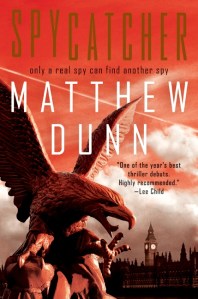
Spycatcher by Matthew Dunn

Jess is a huge fan of spy novels, especially those that feel “close to the ground.” John Le Carre, Alan Furst and Len Deighton, rather than Ian Fleming. Matthew Dunn’s Spycatcher caught my eye as something she’d enjoy. To my delight, I absolutely fell in love with this book myself, and I’m not even much of a spy fiction fan.

Dunn is a former MI6 agent, and like Le Carre, his field experience is almost palpable in his writing. (Unlike Le Carre, Dunn doesn’t use a pseudonym, which I find interesting.) Spycatcher follows Will Cochrane as he tries to stop an Iranian terrorist. It’s a thrilling story, and while Cochrane and his team appear almost superhuman at times in their strategies, Spycatcher works so well because we see Cochrane’s vulnerability, his humanity. We feel his pain at not having seen his sister in eight years, and we long as much as he does for him to be able to settle down with the woman he loves. Incredible book, and I can only hope Dunn writes even more.

View my review of Spycatcher

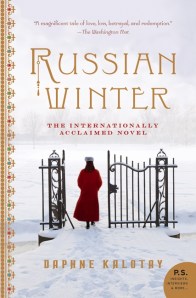
Russian Winter by Daphne Kalotay

Jess loves books about Russia, especially books written bySolzhenitsyn, Dostoevsky and Chekhov. I haven’t blogged about any of their books (I’ve also never read Solzhenitsyn, though Jess assures me he’s really good), so here’s the next best thing: Kalotay’s Russian Winter is about Nina Revskaya, a former ballet dancer now living in Boston and auctioning off her jewelry. A mysterious link between her and a man who appears to own a necklace that belongs to one of her sets leads Nina to remember her past in Russia under Stalin. The present-day scenes were okay, but I just love the scenes in Russia. The descriptions of ballet are just beautiful, and Kalotay makes us feel both the fear of Stalin and the characters’ desire to escape this fear through art.

View my review of Russian Winter