
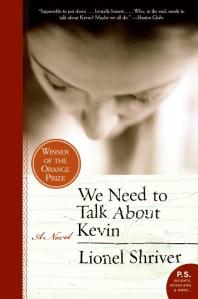
Review | We Need to Talk About Kevin, Lionel Shriver

Lionel Shriver’s We Need to Talk About Kevin is far from the celebratory type of book that I suppose would be more appropriate a way to ring in the New Year, but it’s definitely a must read. I first read it a few years ago, when it was getting a lot of buzz. I didn’t remember a lot of the details, but I do remember thinking it was a very emotionally powerful book.

Confession: I re-read it because of the movie. My sister and I saw the trailer, and my sister was so intrigued by it that we immediately bought a copy of the book. That night, she asked me if she could read it before sleeping: “It’s not too creepy, is it? Because the trailer looked very creepy.” I assured her that I remember it being very emotional, but not quite as horror-movie as the movie trailer suggested. Much later that night, she woke me up: “I thought you said it wasn’t creepy?!” Oops. She devoured it overnight, and the next day was still so disturbed that she wanted to talk about it. I finally had to admit that it’s been years since I’d read it, so I was fuzzy on some of the details. Still, her enthusiasm so intrigued me that I decided to read it again.

My last book of 2011, and my first of 2012, We Need to Talk About Kevin is even more powerful than I remembered. Fair warning: it is creepy. It’s chilling and disturbing, and you won’t want to put the book down. Kevin is about the family of a teenager who kills his classmates and a teacher. But unlike many of the school shooters in the news, many of whom seem to have led tragic lives as social outcasts, Kevin appears more like a psychopath than a troubled victim. From the moment he is born and rejects his mother’s breasts, his mother Eva senses there’s something wrong. Kevin grows up a very creepy boy, scaring away his playgroup and a series of baby sitters. While Eva is increasingly disturbed by what she sees as a power struggle between her and her son, her husband Franklin is wilfully blind to Kevin’s faults, and is determined to maintain a Happy Days family image.
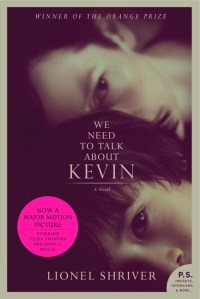
Movie tie-in edition

Kevin, as real-life school shootings do, raises the question of nature vs nurture. Could Eva and Franklin, as Kevin’s parents, have prevented his act? Also, as in real-life, Kevin provides no easy answers. Certainly, Eva admits she is far from blameless — she finds herself unable to form an attachment to her son, even though the mother-son bond is supposed to come naturally. Shriver is a very talented writer, and I love the scenes where she blurs the lines between mother and child, good and evil. For example, Eva once tells Kevin about her distaste for much of the American way of life, particularly how arrogant and materialistic she finds Americans. Kevin, quite rightly, points out that she is just as arrogant and materialistic as other Americans, particularly in the way she thinks herself superior to them. On one hand, it’s a distressing moment — Eva had thought that by being honest with her son, they were finally bonding, only to have her hopes shot down by Kevin. On the other hand, Kevin has a point in saying that the only thing that differentiates Eva from her image of Americans is that she isn’t overweight, and that perhaps he’d rather a mother who was a “cow” and yet not as condescending.

In another, particularly touching scene, Eva watches static on TV and wonders if this is how life is for Kevin. Does he feel as bored in his everyday existence as she does zoned out in front of a defective TV? It’s difficult to feel sympathy for a teenager who cold-bloodedly plans the execution of his classmates, but with that single image of a static-filled TV, I actually did feel for him. The last scene between mother and son in the novel is without a trace of sentimentality, yet I had to pause for a moment just to absorb all it contained.

I love how Shriver uses such subdued, matter of fact writing to deal with such emotional content. The no-nonsense nature of Eva’s narration heightens all the horror and pain and, possibly, even a hint of love, in the story. The title comes from Eva’s plea to Franklin throughout most of the book that they deal with the reality of their son’s issues. However, the title will also definitely apply to the reader. Kevin is an amazing, powerful, chilling book that just blew me away.

I think it also helped that, reading it a second time, I was imagining Tilda Swinton and Ezra Miller as Eva and Kevin. I don’t remember how I imagined the characters to look when I first read it, but bravo to the casting director. Ezra Miller is even more chilling than I think I would’ve imagined Kevin to be, and I can’t wait for the movie. Amazing book, amazing trailer!

Review | Perfect People, Peter James

What if you had the chance to free your unborn child from all genetic imperfections? Sure, you may say all you really want is for your child to be healthy, and it doesn’t matter if he’s the smartest or most good-looking boy in the world. But what if all those options were also available to you, at no additional cost? Would you be able to turn down this chance, and risk having your child grow up unpopular, or unable to realize his dream of becoming a doctor, and know you had your chance to change that? Even if you do decide to keep him as healthy and normal as possible, where do you stop — with the rare genetic disease your first child died of, or remove even the genes for diabetes and cancer and, hey why not, asthma?

There are no easy answers, and Peter James’ Perfect People bombards us with all these difficult questions. This book just blew me away. Wow. I was reading this book at a mall, and I kept gasping or shaking my head every few pages. I started tweeting my reactions, then had to stop myself because I realized that if I kept going, I’d flood my Twitter feed with comments like, “OMG. This chapter made me gasp out loud.” “Oh no! This chapter made me gasp even louder!” “Now what?” “Hmmm… No idea what I’d do…” Exciting reading experience for me, monotonous for my followers.

James takes us right into the lives of John and Naomi Klaesson, who do get that opportunity to design their baby. Their four year old son had died of a rare genetic disorder, so they pool their life savings and go to geneticist Dr Leo Dettore, who can design their next baby’s genetic makeup. I love how James depicts the difficulty of John and Naomi’s dilemma. Naomi insists she just wants as normal a child as possible — if their son is genetically enhanced to have vastly superior intelligence or athletic prowess, will other kids still want to play with him, or will they shun him as a freak? John, a scientist, is afraid that if they turn down genetic enhancements and if designer babies become the norm, then their future son will lose a valuable competitive advantage. I love the combination of parental ambition and desire to nurture. The scenes at the clinic could’ve been very science fiction, but James’ focus on Naomi and John’s fears kept the story feeling very real and immediate.

Naomi and John go home, excited about the soon-to-be-born son they’d requested. Then they go to get an ultrasound and realize Dr Dettore may have made one, very basic mistake with their child. If he got such a simple detail wrong, what else could he have gotten wrong? Worse, even if they do find out other details had been messed up, what will they do about it? Again, James offers no easy answers. The pro-life/pro-choice debate gets even more complicated when this is a baby you’d planned to the very last detail, and now you don’t even know what exactly is growing inside you. A normal, healthy baby, a super child, or an evil baby Frankenstein’s monster? I like that James didn’t have either John or Naomi firmly on one side of the debate. They’re both confused and scared, and end up making mistakes. They’re all too flawed and relatable, and I was completely immersed in their story because even I couldn’t see an easy way out.

Minor spoiler (this is one that James’ own website provides, but if like me, you want zero spoilers, skip to the next paragraph): Naomi ends up giving birth to twins. Super intelligent twins, who at three prefer to surf the Internet than watch a clown, and who might in fact already be more intelligent than their parents. I remember watching I Am Sam, and feeling bad for Dakota Fanning’s character, who seemed more like the parent than the child, and for Sean Penn’s character, who tried as hard as he could but just could not keep up with his daughter. I felt the same way for the Klaesson family in Perfect People, but worse, because while Dakota Fanning and Sean Penn’s characters could look to other adults for guidance, the Klaesson family really had no one to turn to. As parents, how could Naomi and John best provide for such children? Again, never any easy answers, and the story kept me completely engrossed.

To complicate matters even further, Naomi and John are pursued by the Disciples of the Third Millenium, a fanatical religious group that believes designer babies are spawns of the devil. In true Peter James fashion, the author even takes us into the mind of one of the Disciples, who needs to kill the Klaesson family before he can marry the woman he loves. To be honest, this subplot just felt flat to me. Despite the background information on the Disciple’s life and his romantic subplot, a lot of his thoughts and actions read like standard thriller fare, a generic religious fanatic. To be fair, it may have been an accurate portrayal, with the Disciple’s single-mindedness about his group’s mission. Also, it’s certainly realistic that fanatical religious groups would want to destroy designer baby families. Still, with John and Naomi’s story already so mind-blowing, and already raising so many fascinating dilemmas, I almost wish the Disciples of the Third Millenium hadn’t been included at all. Or at the very least, wish they’d been included only as backdrop bad guys, providing external conflict without getting chapters of their own.

Perfect People is such an amazing book. The psychological thrills are almost non-stop, the emotional ups and downs unrelenting, and the ending almost made me cry. I received this ARC from Harper Collins at the fish and chips party to celebrate Peter James’ ITV3 People’s Bestseller Dagger Award (thanks HCC!), so I don’t know if this is available in the final book, but I wish there was an author note with a glimpse of James’ research into real world designer babies. Fascinating topic, definitely, and in Perfect People, James gives this scientific innovation very human faces.

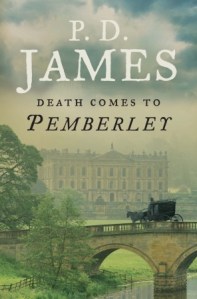
Review | Death Comes to Pemberley, P.D. James

It is a truth universally acknowledged that a quaint English village must be struck by at least one bloody murder. And so it goes in Death Comes to Pemberley, P.D. James’ sequel to Jane Austen’s Pride and Prejudice. Six years after Elizabeth Bennet marries Mr Darcy, Lydia Wickham barges into their home screaming that her husband has been murdered. Murder there certainly has been on Pemberley grounds, and Elizabeth and Mr Darcy are soon embroiled in the court’s investigation of the crime.

To be honest, I was a bit wary of this book. Pride and Prejudice is probably one of the most adapted novels ever. Walk around any Indigo and you’ll find sequels or prequels to the novel in the romance section, the general fiction section, even the mystery section. A quick online search of “Mr Darcy” turns up pages of results. Seriously. I enjoyed Pride and Prejudice, and even battled Austen fatigue with the fun Pride and Prejudice and Zombies, but when I see yet another Pride and Prejudice spin-off in a store, I can’t help but shudder.

That being said, Death Comes to Pemberley is by P.D. James, a master at crime fiction, with knotty psychological mysteries that are classics in the genre. If anything were to get me past my aversion of Austen spin-offs, having P.D. James as the author is certainly it.

I love James’ Author’s Note, where she writes that no doubt Jane Austen would have reacted to Death “by saying that, had [Austen] wished to dwell on such odious subjects [as murder], she would have written this story herself, and done it better.” James walks a fine line between paying homage to a literary classic written by an author James herself admires, and still making it very much a P.D. James novel. Overall, I think she does a great job. The language gets too coy at times — what may have been witty in a romantic social comedy just makes me say “get to the point” in this mystery — but overall a good read.

I love the psychological complexity James brings out in Austen’s characters. She made secondary characters like Charlotte Lucas and Georgiana Darcy much more three dimensional, and gave much more insight into Mr, Wickham and Mr. Darcy. I especially love that James doesn’t have a starry eyed view of the Elizabeth-Mr. Darcy romance, and even has Elizabeth herself feel uncertain:

It still surprised [Elizabeth] that between Darcy’s first insulting proposal and his second successful and penitent request for her love, they had only been together in private for less than half an hour. […] And would she herself have married Darcy had he been a penniless curate or a struggling attorney? It was difficult to envisage Mr. Fitzwilliam Darcy of Pemberley as either, but honestly compelled an answer. Elizabeth knew that she was not formed for the sad contrivances of poverty.

I love that James was willing to take risks with Austen’s characters, and only wish she’d taken it further, and with other characters. I knew then that we were dealing with an older, more mature Elizabeth. The Elizabeth in Pride was intelligent, but she also prided herself on being superior to the frivolity of her mother and sisters. Her realization that she might have married Darcy for money shows her being more self-aware. James’ characters are also more socially conscious, very much aware of the turn of the century bringing in many changes. Georgiana stands up to her brother, arguing that in the new century, women have more of a voice. I love how James infuses her story with this awareness of the historical context — we get the sense of the change coming to Elizabeth’s world, and the characters are made aware of it by the events surrounding the murder.

The mystery itself is pretty good. I like how James ties in events from Pride to the case, like Darcy’s search for Lydia and Wickham, which we only learn about secondhand in Pride. The flashbacks got a bit boring at times; while everything turns out later to have been significant, I much preferred the present-day scenes. As well, while I liked finding out what happened to characters from Pride, I sometimes felt that it was unnecessary for James to include them. Characters like Charlotte Lucas, for example, seemed like they were mentioned just so they could make their cameo. That being said, I’m glad Mary had a satisfying marriage — I always felt she was given short shrift in Pride. Still, other than the Darcy family, I preferred reading about the new characters, because they had much more to do with the mystery.

The one thing I hated about Death is how James handled the ending. The big reveal was too sudden, very deus ex machina. As a reader, I read the reveal, thought back, and realized the significance of such and such a scene, or so and so a clue. So everything fit, but the story didn’t feel like it led up to that reveal. Elizabeth and Darcy had their own suspicions and questions, but there wasn’t an actual investigation, so the lead up just felt disjointed and the actual reveal convenient. I’m fine with Elizabeth and Darcy not turning into Tommy and Tuppence, but I wish Mr Alveston, or a police officer, had more of an active role investigating.

Minor quibble (and minor spoiler alert, skip to the next paragraph if you wish): I also wish Wickham really had been the one murdered. It just felt too much like a marketing ploy to have the murder of a major Pride character on the book jacket, only to have it be someone completely new (or at most a bit character in Pride).

Overall, a good mystery, enjoyable for fans of P.D. James and Jane Austen. James also creates a Gothic atmosphere around Pemberley, and I can almost imagine Catherine Moreland from Austen’s Northanger Abbey enjoying Death in Pemberley.