
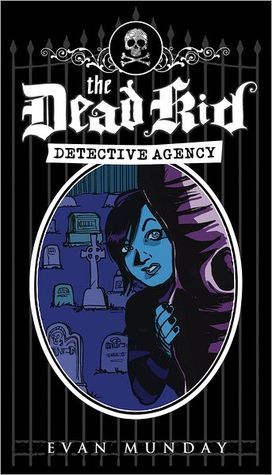
Review | The Dead Kid Detective Agency, Evan Munday

Okay, this book is just awesome. Granted, when the alternative is working on a Sunday, it doesn’t take much to  keep me engrossed. That being said, Evan Munday’s The Dead Kid Detective Agency kept me giggling all afternoon. I kept promising to read “just one more chapter” before getting back to work, then picking the book back up. It was just so much fun to read!

From the book jacket: Thirteen year old October Schwartz is new in town, short on friends, and the child of a clinically depressed science teacher. Naturally, she spends most of her time in the Sticksville Cemetery. While writing her novel Two Knives, One Thousand Demons, of which she admits the title is “the single best thing about the book so far,” October accidentally raises the spirits of five dead teenagers. When October’s French teacher dies in suspicious circumstances, she teams up with the dead kids to form the Dead Kid Detective Agency and solve the case. It’s Nancy Drew with ghosts, and these ghosts happen to love board games and musical theatre — how could I resist?

The mystery is more Scooby Doo than Agatha Christie — there are suspects galore, and the victim has some serious skeletons in his past, but Munday seems more concerned with creating an amusing caper than writing a truly perplexing whodunnit. The big reveal does come as a surprise, but the plot twist that leads to it feels more convenient than “aha”-inducing. That being said Dead Kid works for the same reason Scooby Doo does — it’s wild, it’s an adventure, and you can’t help but turn the page to see what Munday has planned next.

I don’t usually like narrators who provide commentary — I figure, give us the story, and let us make up our own minds. In the case of Dead Kid, however, the narrator’s personality is as much a character as October and the dead kids, and I love his snappy asides and geeky references. From page 6: “But even if her classmates didn’t know, October was sure they could smell the tween on her — the stench of Sour Keys and Saturday morning cartoons.” Not sure if it was the phrase “smell the tween on her” or the stench of Saturday morning cartoons, but with that line, I was hooked.

I love the dead kids, but just as entertaining are October’s live friends Stacey (a boy with a Walkman) and Yumi. In one scene, Stacey tells off a popular girl/bully in such a fitting way that I cheered out loud reading it. The standout, however, in terms of secondary characters, is October’s father. With a book so filled with wisecracks and pop culture references, I expected to be entertained, but I didn’t expect to be touched. Yet the subplot about October and her clinically depressed father is heartwarming. His awkward attempts to connect with his daughter, and October’s desire to learn more about her mother, make you want to just hug them both. Take this passage:

I had always imagined […] all would be revealed on my thirteenth birthday, ten years after the fact. The anniversary was like some kind of mythic event; it would mark a new era of understanding. Mom would have this ultra compelling reason for ditching us, it would be obvious.

October admits this is “like some kind of tragic TV movie,” yet her offhandedness belies deep pain. And when her father “looked like someone had sprinkled broken glass inside his slippers” when October asks about her mother, such that October decides to rephrase her question as a joke, there is just so much going on beneath the humour. I cared for these characters — I wanted to hug them both, and to find out exactly what happened to October’s mother.

A couple of quick bonuses to this book: each of the dead kids has died under mysterious circumstances, so they’ll each then get a book dedicated to their mystery. Next up is the story of Morna MacIsaac, whose body had been found frozen in a snowy alley. Then there is the appendix of pop culture references in Dead Kid. Entries include Darth Vader (“Carries a lightsaber and (spoiler alert) is the dad of that Luke Skywalker kid”), Johnny Depp (“Do you really need to be told who the sexiest man alive is?”), and my personal favourite, Jackie Chan (“if you don’t know who Jackie Chan is, drop this book immediately and go rent Police Story 2 or Project A 2 or something. Forget The Karate Kid and Rush Hour. Go for the Hong Kong stuff. You’ll thank me later.”) This appendix is subtitled “Important Cultural History!” and all I can say is — it is indeed.

Hilarious, geeky pop culture fun and surprisingly touching, Dead Kid Detective Agency was an absolute joy to read. And any writer who says about Jackie Chan that readers should drop his book and watch Chan’s “Hong Kong stuff” makes an immediate fan of me. I finished this book on a Sunday afternoon and already look forward to Book 2.

Review | Magnified World, Grace O’Connell

I received and read the ARC of Grace O’Connell’s Magnified World a few weeks after having read Patrick Ness’ A Monster Calls. World was nowhere near the tearjerker for me as Monster was (thank god — Monster was intense!), but  World is striking in a different way. World is a lovely exploration of grief. When World begins, O’Connell’s narration doesn’t dive into grief so much as brush against it, little glancing touches that depict the intensity of emotion with metaphor and suggestion. The narrative becomes more openly emotional as the novel progresses, and I love how that reflects Maggie’s changing ways to express grief.

Maggie’s mother drowns herself in the Don River with zircon stones from her New Age shop. Maggie tries to cope by removing zircon stones from the shop’s inventory and taking over as shopkeeper. But then the blackouts begin, and they soon become dangerous — Maggie once regains consciousness after having been knocked off a bike she didn’t even realize she’d been riding.

Having dealt with grief, I definitely understand the desire to forget things. I can understand how the pain of losing someone can feel so unbearable you just want to shut off, at least temporarily. However, I can only begin to imagine the horror if your conscious mind really does shut off, and you can’t control when or where it happens. After a loss, touchstones become so much more important — items or places usually associated with the person lost can serve as anchors in a way, reassurances that there still is and will always be something solid to which you can cling.

Some of my favourite parts in the book are when O’Connell shows Maggie trying to cling to these touchstones. For example, Maggie finds herself glaring at customers who are touching the items in the shop because her mother may have touched this or that item last. Irrational, definitely, yet I can definitely empathize with Maggie’s need to preserve even the faintest hint of warmth her mother’s touch may have left behind. I can imagine myself in her shoes, glaring at the strangers who dare to add their own fingerprints to these objects. In other, particularly poignant observation, Maggie realizes that she no longer has to get her mother’s approval on a shop display, and so it can never be perfect. Even if to an outsider’s eye, the display looks absolutely perfect, I can understand how Maggie feels her mother’s approval is a requisite final step — after all, it’s her mother’s shop. I love how O’Connell mentions these minor details — each gets only a few lines in early chapters — that convey so much. I can also appreciate how, given the importance of these semblances of stability, Maggie’s blackouts must have been especially frightening.

Maggie then meets a mysterious customer named Gil, who promises to help her with her blackouts if she talks to him about her mother, for a book he’s writing. Gil’s significance becomes clearer later on when we find out who he is, but even from the beginning, he offers Maggie hope that her life may return to normal. To be honest, Gil creeped me out. I couldn’t understand why Maggie trusted him so easily, and I understood even less why she was sexually attracted to him. A quick re-reading of his first appearance reminded me he was a youngish, attractive man, yet for some reason (maybe his name? his Master Caine-type promise?) I kept imagining him as an elderly grandfather figure. Even without the age factor, however, he’s definitely creepy, showing up at random moments and demanding to know more about Maggie’s mother. That being said, his obsessive tendencies are explained, and we do see his significance.

At the very least, Gil’s demands force Maggie to work out her complex relationship with her mother. She certainly loves her mother, and in a way, relates to her mother much more than to her father, a professor who thought his wife was wasting her intellect at a New Age shop. I love how our perception of Maggie’s mother evolves, as Maggie delves deeper into her memories, and becomes more willing to acknowledge her mother’s flaws. Our perception of Maggie’s entire family changes as well, and from fairly sympathetic yet vague figures, Maggie and her parents are each fleshed out into complex individuals. The tragedy, of course, as Maggie realizes, is that she can no longer continue to get to know her mother. In an especially moving passage, she says

In five minutes I could have asked my mother a dozen questions. I had years and years and I hadn’t asked her. I hadn’t wanted to pry… [I figured] that she would tell me, sometime, everything I needed to know.

Finally, I love how concrete the details of the Toronto setting are. O’Connell uses street names and landmarks a lot, such that reading World sometimes felt like taking a walk/bike ride/drive around the city. I especially love that O’Connell even gives Mississauga a shout-out. Maggie spends some time in Port Credit (in southern Mississauga), and her description, making it sound so different from the city, almost like a quaint little town. Grace O’Connell is already Random House of Canada’s New Face of Fiction; I can imagine Magnified World entering the canon of Toronto literature because it gives such a sense of place.

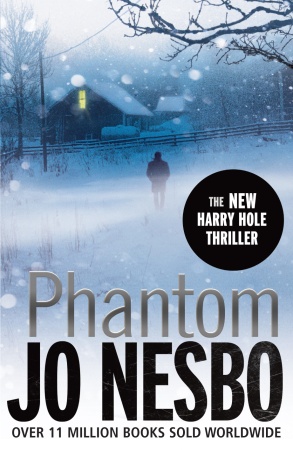
Review | Phantom, Jo Nesbo

Holy crap. WTF Jo Nesbo?! That was all I could think as I finished Phantom, the ninth and latest book in the Harry Hole series (seventh to be translated into English).

Confession: I’ve had an author crush on Jo Nesbo ever since I saw him read at the International Festival of Authors (Most. Intense. Eyes. Ever.) but I’ve never read a Harry Hole novel until PhantomAnd holy hell, what a book to start with!

First, I have to admit, the beginning didn’t grab me. A chapter narrated by a rat? Worse, this rat narrates a few other chapters in the novel. In contrast to the excerpt from The Leopard that gave me nightmares after Nesbo read it at IFOA, this chapter from a rat’s POV just made me go “meh.”

Fortunately, the story picks up right after. Harry Hole returns to Oslo after three years, and we are immediately plunged into a seamy neighbourhood, where Harry notices a drug dealing set up that had been used in the 80s and 90s, but has since been dropped. “Had the police started arresting street dealers again?” Harry thinks, and it’s a wonderful, atmospheric set up for the mystery to follow.

Throughout the novel, we feel how weary Harry has become, how much he wants to give up dealing with criminals and just retire to a peaceful life in a different country. When we first meet him in Phantom, he already has a facial scar, presumably from an earlier novel, a “path left by the nail from his time in the Congo. It stretched from mouth to ear like a badly sewn-up tear.” Nesbo also includes references to the Snowman case later on, and we get the sense that all Harry wants to do is leave Oslo forever and take the rest of his life to heal.

Unfortunately, a 19-year-old junkie has been shot, and convicted for the crime is Oleg, the 18-year-old son of Rakel, the only woman Harry has ever loved. The case is closed, but Harry feels the need to help this boy he considers a son, and the only way Harry knows to help is to be a policeman and find the truth. Who really killed the junkie? As Harry investigates, he is pulled deeper into the world he thought he’d already escaped, with drug cartels and potentially corrupt police officers. He learns that Oleg has been involved in dealing a drug called violin, a more potent version of heroin, and he struggles with the guilt of having left Oleg behind. To top it all off, Oleg refuses to talk, and someone wants Harry dead.

This is Norwegian noir at its finest. The mystery is compelling and convoluted — I kept changing my mind about who I could trust. Nesbo’s Oslo is wonderfully atmospheric — like Ian Rankin’s Edinburgh and Donna Leon’s Venice, Oslo is as much a character as Harry Hole. We become as weary of the deceit, corruption, and especially the desperation-tinged lives of addiction as Harry becomes.

The crux of Phantom lies in Harry Hole himself. I’ve only just met the man, and already I want to give him a hug. Oleg and Rakel have clearly been hurt by Harry’s dedication to such a horrifying career, and Harry’s own pain at his separation from them feels very real. I love this passage, where Harry speaks about a photograph taken years ago of him, Rakel and Oleg:

“When I look at a photograph that’s how I remember it. The way we were in the photo. Even if I know it’s not true. […] But perhaps that’s why we take snaps,” Harry continued. “To provide false evidence to underpin the false claim that we were happy. Because the thought that we weren’t happy at least for some time during our lives is unbearable. Adults order children to smile in the photos, involve them in the lie, so we smile, we feign happiness. But Oleg could never smile unless he meant it, could not lie, he didn’t have the gift. […] I found a photo of the three of us on his locker door in Valle Hovin. And do you know what, Rakel? He was smiling in that photo.”

This is especially poignant when put together with the scene where Harry first sees the photo: he thinks about how he looks like he doesn’t belong in that family, then wonders:

Was that really him? Harry could not remember having such gentle features.

You can’t help but feel for the man, for all he’s survived, and you can’t help but cheer for him to win this case — not just solve the mystery, but patch things up with Rakel and Oleg, and have that family he longs for so badly. That’s why it’s especially painful whenever he thinks he’s solved the case and is all ready to leave Oslo, only to realize that he’s missed something out.

I remember the exact moment I realized who the killer was, and how the novel would end (page 400, if you’re interested). It was an idea that had been flitting about my mind at various points in the novel, but it was only near the end that I realized there was only one solution possible. And yet a part of me still didn’t believe it until the very last chapter. All I can say about this ending is: bravo, Mr. Nesbo, bravo. Also, of course, holy crap, WTF?

Fans of Norwegian noir, Ian Rankin’s John Rebus series, mysteries and thrillers in general, and, most especially, long-time fans of Harry Hole — definitely check this book out. So good.

Oh, and just because… 🙂

Jo Nesbø © Stian Andersen | jonesbo.com