
Wither, Lauren DeStefano

First, kudos to Lizzy Bromley, who designed such a captivating cover. The softness of Rhine’s dress contrasted with the edginess of the geometric shapes wonderfully captures the story’s blend of romance and science fiction.

Wither takes place in the mid- to late 21st century. Humans have discovered a cure for cancer and have created a generation of children (called “first generation” in the book) who are completely free from viruses and other illnesses and who are “practically immortal.” Unfortunately, succeeding generations are genetically cursed with an illness that kills males at age twenty-five and females at age twenty. To keep the human race going, girls are kidnapped and forced into polygamous marriages. Sixteen year old Rhine, the protagonist, is one of them, kidnapped by a scientist, Housemaster Vaughn, to become a wife to his son Linden.

The story reminded me of a mix of Suzanne Collins’ Hunger Games trilogy, Margaret Atwood’s The Handmaid’s Tale and Kazuo Ishiguro’s Never Let Me Go. Focusing mostly on Rhine’s emotions and her relationships to her “sister wives,” the servant Gabriel, and Rhine’s twin brother back home, Wither is nowhere near as political as Hunger Games or Handmaid’s Tale. It does touch on interesting issues – society is divided between those who want to keep looking for a cure and the “pro-naturalists” who believe the human race should just be allowed to die out. The interesting thing about that is that it is those who are searching for a cure – seemingly the more sympathetic cause – who kidnap girls like Rhine and perform experiments on children.

I love Lauren DeStefano’s characters. They are all incredibly complex and, I believe, are the major reason Wither is such a good book. Rhine is a complicated heroine. She vehemently wants to escape her marriage and return home to her brother. However, even as she falls in love with Gabriel, she also develops sympathy, and even affection, for Linden, who she realizes is also as trapped in his lifestyle as she is. Housemaster Vaughn, the primary antagonist, commits horrible acts for a noble purpose — to discover an cure for the illness and therefore save his son. Linden, who has forced three women to marry him, appears mostly a pawn in his father’s plans, and has a tragic love story of his own. Gabriel, who becomes Rhine’s primary ally, also appears resigned to his life with the Vaughn family, and therefore not as motivated to escape as Rhine is. None of the characters are completely sympathetic or completely unlikable, and this makes them all more engaging.

Wither is a teen book, but it definitely has adult appeal as well. Because of their shortened life spans, Rhine and the other teenage characters are remarkably mature. However, because humanity hasn’t adapted to these shortened life spans, in many ways, the teenagers in this book are still very much teenagers, vulnerable, emotional, and lacking the jadedness and experience of adults. The world in Wither forces teenagers to become adults, and DeStefano beautifully depicts the struggle that comes with this.

The ending is a bit anticlimactic, especially compared to the rest of the book, but it does set up the promise for an interesting sequel. I definitely recommend Wither, and I’m definitely keeping an eye out for the rest of the trilogy.
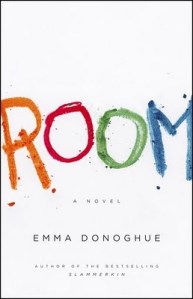
Room, Emma Donoghue

Little late to the party, but I finally got around to reading Emma Donoghue’s Room. Nominated for the Booker, super hyped in Chapters and the media, Room is a novel I approached with caution, afraid all the hype was due to Harper Collins’ incredible marketing and that the book would disappoint me. Long story short, I love the book.

Room tells the story of Jack, a five year old boy who’s grown up his entire life in a small room with his mother, a 27 year old woman abducted by a man Jack calls Old Nick seven years ago. It’s a plot straight from the headlines, and the book could so easily have devolved into a tabloid article or a melodramatic soap opera. What makes Room work is Donoghue’s choice of using a five year old’s perspective. Jack’s lack of understanding about his and his mother’s situation gives us an incredibly restrained narration of highly charged events, and this restraint ultimately heightens our emotional reaction to the story.

We begin with Jack’s account of his fifth birthday, celebrated with candies instead of candles and with his mother’s sketch of him as a gift. We remain entirely within Jack’s point of view, such that, for example, we never find out Ma’s or Old Nick’s real names. However, as adults, we necessarily understand more than Jack does, which then creates an interesting effect in that we get to empathize fully with both Jack and his mother. We can feel Jack’s longing, for example, to have Old Nick acknowledge his presence, while at the same time also understanding why Ma insists that Jack stay hidden in a closet, and therefore separated from Old Nick, whenever Old Nick comes to visit at night. We sympathize with Jack’s anger at not being allowed to eat the lollipop Old Nick brought for him even while we understand Ma’s frustration at Jack’s apparent desire to form a connection, no matter how tenuous, with her captor.

A major turning point in the novel comes when Ma decides to tell Jack about the outside world. Having taught Jack all his life that only things in the Room are real, and everything on TV is make-believe, Ma has difficulty convincing him that things on TV are based on reality outside the Room. Jack goes from asking if all the things Ma describes (stores, trees, hammocks) are floating around in outer space to asking if even Dora, his favourite TV character, is real. In a strange way, these chapters seem almost quotidian. Even in the so-called real, outside world, don’t parents also deal with having to define reality to their children?

Halfway through the novel, Ma decides to attempt an escape. Whether or not they eventually succeed, Ma’s decision to leave Room after having spent the past five years building a daily routine within Room and essentially presenting Room to her son as the entire world strikes Jack as completely inexplicable. As Ma later realizes, while she’s had seven years to think about escaping, Jack has had to completely overturn his mindset in only a few days.

Ultimately, Room is a novel about the intensity of a child’s love for his mother, and about the extent to which a mother would go to protect her child, not just physically, but also to protect him from uncomfortable truths. Through Jack’s eyes, even the most mundane activities can become exciting games, and even the things we most take for granted, like trees and sunlight, can become unfamiliar. Highly recommended.