
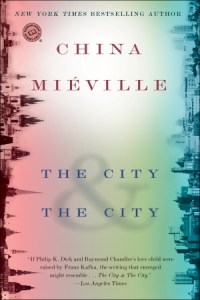
Review: The City & The City, China Mieville

I finished China Mieville’s The City & The City days ago, and to be honest, I’m still trying to wrap my head around it. The novel begins as an apparent classic crime noir: a woman is found murdered in Beszel, and Inspector Tyador Borlu is called in to investigate. Evidence links the woman to neighbouring city Ul Qoma. Thing is, Beszel and Ul Qoma aren’t geographical neighbours as we are used to. Best I can understand, they overlap somehow, and residents of each city train themselves to un-see people and places from the other city, lest they be charged of Breach and taken away. Borlu’s investigation therefore isn’t so much about a murder as it is about the two cities, and the mythical third city that is rumoured to be between them.

The City & The City isn’t a fun thriller to read on the subway or before bed. The murder mystery is certainly interesting, embroiling Borlu in politics, history and legends that may turn out to be true. But it’s far from an easy read, at least for me, and I had to set aside a few hours to sit, read and work things out. My sister and I then spent even more time discussing the relationship between Beszel and Ul Qoma, and trying to figure out the implications of this relationship. The resolution to the mystery itself turns out to be fairly simple — not simplistic, by any means, but certainly nothing as mind-blowing as the political landscape Mieville depicts — and certainly, it’s possible to read this as a straightforward crime novel.

But I think it’s worth quite a bit more thought than that, a bit more of a puzzle than who the murderer is. The more I got into the way Beszel and Ul Qoma work, the more the world in this novel became familiar. My sister suggested that physically/geographically, Beszel and Ul Qoma might actually be the same city, with the distinction between them only psychological, and, more importantly, willed. The further I read, the more that made sense to me, though Mieville certainly opens the nature of these cities up to debate.

City makes you think, in much the same way as Le Guin’s Left Hand of Darkness makes you think. It’s a world absolutely nothing like our own, yet it’s also strangely familiar. I’m not sure if I could say I enjoyed it, but it was definitely worth the read.
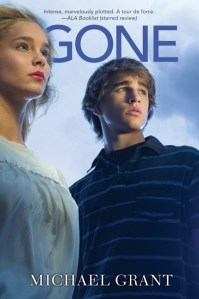
Gone, Michael Grant #50BookPledge

I read Michael Grant’s Gone on my sister’s recommendation, and I’m so glad I did. It’s brilliant and exciting, Lord of the Flies meets X-Men in a contemporary small town setting.

I was hooked by the very first paragraph: “One minute, the teacher was talking about the Civil War. And the next minute he was gone.” I can imagine lots of kids wish their teachers would just disappear, especially during really boring classes, but what if it really happens? What if all the adults in the world disappear? “No ‘poof.’ No flash of light. No explosion.” Just disappear. I actually appreciate how non-climactic the disappearances are, such that the kids the remain at first think they must have imagined  it.

The premise of Gone reminds me of a Star Trek episode where all the adults in an alien planet have died from a disease and the kids have formed a Lost Boys type society, basically being complete brats and driving the Enterprise crew insane. Thankfully, the children in Gone are more mature. Everyone 15 and older has disappeared. Main character Sam is a natural, albeit reluctant, leader. As scared as the other children, the only advice 14-year-old Sam can offer when the adults disappear and younger children look to him for guidance is eat a cookie. There’s almost a Peanuts-type wisdom in that advice, now that I think about it, but mostly it just reflects the children’s helplessness.

The adults disappearing isn’t the first weird thing to happen to Sam however. Something else has happened to him, which I won’t reveal here because part of the fun is finding it out, but basically it makes Sam worry that he has caused the adults’ disappearance. Later on, he finds out that he actually isn’t the only, um, unusual resident of the area, and the unusual nature of certain children may hold the key to what has happened to the adults.

In a world without adults, who’s in charge? As Sam’s best friend Quinn tells him, adults are no longer around to keep the bullies from imposing their rules. How can children who don’t know how to drive and barely know how to cook fend for themselves and care for the really young children? Even more urgent, what happens when they themselves turn fifteen?

Gone has an exciting premise and likable characters. I love seeing Sam’s growth from scared kid to hero, from avoiding the leadership role to embracing it and working to improve their situation. Quinn is an interesting character as well, a free spirited surfer unable to handle the pressure of responsibility, and I look forward to seeing him develop even further in the next book. I love that Astrid is such a strong female character. Nicknamed Astrid the Genius, she spouts random facts when she’s nervous. Her character however is given added nuance because of Little Pete, her autistic younger brother. When the adults disappear, she has no idea where he is, so she sets off to find him, taking Sam and Quinn with her. Mary, who takes responsibility for the day care centre, is forced to become remarkably mature, caring for babies and toddlers all wanting their mothers, and I love how she has her own personal demons to battle as well. Perhaps the most endearing character is Albert, who takes over the local McDonald’s. He takes his role so seriously he actually studies the McDonald’s manual cover to cover.

The bad guys range from bullies to an actual psychopath. Their leader is charming, intelligent and powerful, more than a match for Sam and his friends. I’ve always believed that amazing bad guys help make heroes amazing as well, and Gone has a match up I love reading about. The ending of their ultimate confrontation in this book was a bit frustrating, as my sister warned me, but good news is, there are several more books in this series.

One thing that surprised me is how religious some of the main characters are. It’s not a bad thing, just unusual in contemporary fiction. It’s not preachy in any way, which is good, and the events these kids face certainly merit some appeal to a higher power.

The book answers a lot of the questions it poses, even as it leaves a lot of other questions hanging. Gone is exciting, action-packed young adult fiction. I’ll definitely be checking out the next book in this series.

The Gathering, Kelley Armstrong #50BookPledge

I was fortunate enough to be able to attend the book signing and pre-launch sale of Kelley Armstrong’s The Gathering. I’ve been to quite a few book events, and I have to say, I’ve rarely met anyone so eager to chat with their fans. Kelley must have been exhausted – I was tired and all I did was stand in line! – but when I saw her, she was still as chatty and cheerful as she was when the event began. Love that.

Even better, she answered a ton of fan questions. As almost a brand-new Kelley Armstrong fan (so far, I’ve read Bitten and The Gathering, and still have the rest of her books on my To Be Read list), I was torn between covering my ears to avoid spoilers and realizing I would completely forget these spoilers by the time I get around to reading her other books. Still, one thing she said stayed with me. When asked about writing supernatural characters, she said she doesn’t think about it that way. It’s not about “Ooh, I’m a werewolf, let’s see what cool things I can do!” Rather, it’s about how an ordinary person who happens to be supernatural deals with living in this world. “If you or your friend happens to be a werewolf,” she asked, “how would you live?” How would you shop, eat, work… what would your day-to-day existence be like?

That’s when I realized why I love her books so much. Bitten is about a female werewolf trying to live in Toronto, and The Gathering is about Maya, a seemingly ordinary teenage girl in a tiny (population 200) town in Vancouver Island. [Spoiler alert, though this shouldn’t be a spoiler for anyone familiar with Armstrong’s work: Maya isn’t an ordinary girl. Hint: she has a paw print birthmark.] It’s the ordinariness of the situations in which Elena and Maya find themselves that make them such relatable characters.

I love The Gathering. I love how Maya is such an intelligent, savvy teenage girl. Maya doesn’t have to deal with the dystopian society Katniss faces in The Hunger Games, but Maya strikes me as a very similar character. She’s also strong and smart. I read a lot of books where heroines get caught up in really dumb situations, usually for comic effect, and I don’t usually mind. But Maya is totally not that kind of heroine – she carries pepper spray, and when she encounters a suspicious looking stranger, thinks, “He had a gun. This was the time to run, not fight.” She’s practical rather than emotional, strategic rather than hysterical. I feel old for thinking this, but if I ever have a daughter, I want her to be that capable at taking care of herself.

As with Bitten, The Gathering has its share of hot guys. Unlike Bitten though (Team Jeremy!), I honestly couldn’t choose between best friend Daniel and bad boy Rafe. Both are smart, caring, vulnerable, and equally capable of kicking ass. The story is intriguing: a “reporter” comes to Maya’s town and is interested for some reason in the teenagers, the town has a medical research lab that you just know is up to something shady… Oh, and Maya’s adopted. She’s happy with her adoptive parents, but again, you just know something interesting about her biological parents will be revealed. Unlike Bitten, The Gathering ends on a bit of a cliff hanger, which is somewhat frustrating – I want to know more! Now!

Bright side, I do have quite a few other Kelley Armstrong titles I can read while waiting for the next book.