
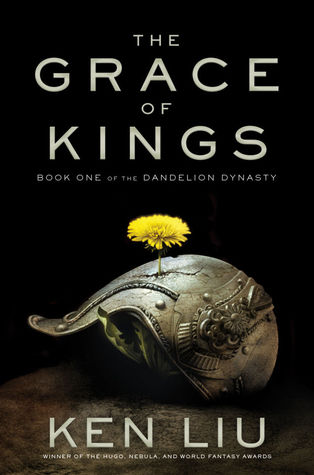
Review | The Grace of Kings, Ken Liu

GraceofKingsSometimes, you just want to completely immerse yourself in a good book. Such is the case with Ken Liu’s The Grace of Kings. A doorstop at over 600 pages, the book was so good that I still wanted to read more after I finished. The story is so captivating that I lugged the book around on the subway to work every day, and devoured the entire tale in only about two weeks.

Liu is a master at world building. He has created a nation united under a single emperor, yet still feeling the tensions beneath its origins as seven separate kingdoms and the bloodiness of the emperor’s path to power. Enter our two heroes: wily bandit Kuni Garu and fierce warrior Mata Zyndu. Mata also happens to be the latest generation of a long family line whose power was deposed by the current regime. Kuni is on the path to power, yet his power lies in his background as a bandit, and his being, at heart, a commoner. Enter as well the gods, several of whom have a stake in the future of this nation, and like the gods in any ancient legend, have no qualms about interfering in human affairs.

Kuni and Mata become fast friends as they wage war against the cruel despot. They are united by a common goal, yet as time passes and circumstances change, both are revealed to have vastly different philosophies about the meaning of justice and how the world should be run.

I absolutely fell in love with this story, and I’m thrilled to see so much influence from Chinese folklore and mythology. So often, when I read these great epic novels — Lord of the Rings, Game of Thrones — the influence is very clearly Western, and the characters usually come off as such. This is the first contemporary novel from a traditional publisher, that I’ve read (or at least can remember) with such scope and depth and such an epic, mythological, legendary feel, that struck me as being influenced by Eastern folklore. As an Asian Canadian, this is definitely important to me. (Another title of note, with a clear influence from Eastern mythology, is Amy McCulloch’s The Oathbreaker’s Shadow, a fantasy adventure YA duology.)

The Grace of Kings is the first book in the Dandelion Dynasty series. It is an entertaining story of intrigue, battles and political plotting. Beyond that, it also raises some interesting philosophical questions about what justice really means and how best to rule such a fragile nation. Above all, it’s a book to lose yourself in, so definitely set aside some time to treat yourself to this tale.

+

Thank you to Simon and Schuster Canada for an advance reading copy of this book in exchange for an honest review.
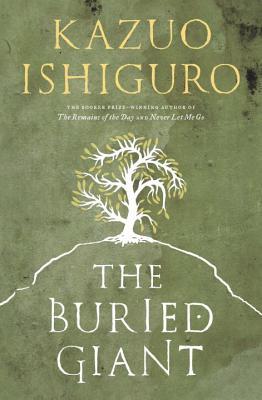
Review | The Buried Giant, Kazuo Ishiguro

22536182“There’s a journey we must go on, and no more delay.” So goes the blurb behind the advance reading copy of Kazuo Ishiguro’s The Buried Giant. It’s a beautiful book, the stylized tree on the cover combined with the text on the back conveying a world of magic within its pages.

And indeed, Ishiguro invites us into an Arthurian style world, where a mist causes forgetfulness, and an elderly couple sets out on a quest to find their son. The language evokes a world of myth, the childlike Middle Earth in Tolkien’s The Hobbit rather than in his later trilogy. The themes are universal — love and forgiveness and the power of memory.

In Giant, amongst the encounters with knights and battles with dragons, amid the backdrop of political turmoil in England, the heart of the story lies in the love between the elderly couple Axl and Beatrice. A fog of forgetfulness has hidden memories of their past together, and at several points the question is raised whether some memories are best left forgotten. This is a particularly poignant question in light of the setting of the story — right at the crux of change, the death knell of the Arthurian age and the beginning of modern Britain. How much of Axl and Beatrice’s Britain will survive in memory, and given the various armed conflicts in their Britain’s history, how much would we ultimately want to remember?

As with any quest, there is a particular point of no return, the crux as it were of the entire adventure. For Axl and Beatrice, this takes the form of a legend about a boatman. According to the legend, couples who truly love each other may be ferried across to an island where they would be together forever. Yet before the trip, the couple must pass a test to prove the depth of their love, and if they fail, they are doomed to wander the island alone for all eternity. It’s a beautiful metaphor for death, and recalls the romantic ideal of love so strong that it lasts beyond death.

There are a lot of beautiful moments in Giant, and the conversations between Axl and Beatrice at times brought me to tears. But something was missing. I can’t quite put my finger on it, and it’s possible that my expectations were just too high (it’s an Ishiguro, after all). But I was expecting to be transported. And with such a mystical framework for the narrative, with such lyrical language and mythological encounters, I was expecting to lose myself in the world that the author has created. Yet I wasn’t. The story felt just a tad too crafted, the language just a tad too designed that it never quite clicked into a natural cadence. I appreciated what the author was trying to do, and I liked his characters and his themes, but I never quite fully connected to the story. This is a shame, because I love Ishiguro’s work, and I really wanted to lose myself in this book. It wasn’t bad, but it could have been so much more.

+

Thank you to Random House Canada for an advance reading copy of this book in exchange for an honest review.

Review | Prince Lestat, Anne Rice

21412673The Vampire Chronicles have always been my favourite among Anne Rice’s books, so I was thrilled when she announced a return to it with Prince Lestat. To be honest, it’s been awhile since I’ve read a Vampire Chronicles book, and while I vaguely remember reading Queen of the Damned (referenced a lot in this book), I remember nothing of the story. So parts of this book did confuse me, but overall, there was just enough backstory provided that I could figure it out.

In Prince Lestat, Rice not only re-introduces us to the Brat Prince, she also takes us deep into the very mythology of her vampires. As such, the book feels much larger than the story of its titular character. The story travels through time and among various points of view, and we learn a lot about how vampires came to be and how fragile their existence as a species really is.

The story is about the vampire world in crisis — a mysterious Voice speaks to select vampires, commanding them to burn seemingly random groups of vampires around the world. It’s vampire genocide, and no one seems to know why it’s happening or how to stop it. The Voice also contacts Lestat, though appears more interested in conversing with him than in commanding him. Lestat himself is his usual dashing, seductive self, though with a lot more pathos now than usual. I love the scenes with Louie and Armand, mostly because I remember them from Interview with a Vampire, and it was sweet to see how much Lestat still cares for Louie.

There are a lot of characters and their flashbacks, and it’s impossible to keep track of all of them, or remember how or if I’d ever known them from a previous book. As a result, I didn’t really care about any individual character, except for Lestat, Louie and Armand. I did become fascinated by the mythology, and by the eventual explanation of what and who the Voice is. I’m not sure how much I liked the resolution, but it did feel right.

I remember reading Interview with a Vampire years ago, and being absolutely spellbound by the language and the story. Anne Rice, at her best, is a master of literary seduction. Prince Lestat falls somewhat short of that mark, but it’s a fascinating story nonetheless.

+

Thank you to Random House Canada for a copy of this book in exchange for an honest review.