Happy birthday, Jess! ~ Review roundup in honour of my sister

My sister Jessica is celebrating her birthday today. She’s introduced me to some of my favourite books and writers ever, including:

  • The Harry Potter series by J.K. Rowling
  • The Rebus series by Ian Rankin
  • The Spenser series by Robert B. Parker
  • The Guido Brunetti series by Donna Leon

… and lots, lots more. So, I figured, what better way to celebrate her birthday on my blog than by writing about some books and genres she loves?

The Hunger Games trilogy, by Suzanne Collins

I don’t have to tell you how awesome this series is, do I? It’s one of the most brilliant YA series I’ve read, possibly second in my mind only to Harry Potter. It took me months to convince Jess to read it, and she’s now an even bigger fan than I am. It just has everything: an inspiring heroine, self-sacrifice, politics, reality TV, family, kick ass action scenes, and yes, a love story.

If you’re one of a handful who hasn’t read the book yet, check out the website here to find out more about it. Better yet, read the books already. Trust me on this one.

Even better, there’s a movie out in 2012.

Love The Hunger Games and looking for your next read? May I suggest Moira Young’s Blood Red Road or Veronica Roth’s Divergent.

And, if you’re a nerd like me, check out The Girl Who Was on Fire, full of essays about the books.

View my review of The Girl Who Was on Fire 

To Kill a Mockingbird, by Harper Lee

One of Jess’ favourite books ever, and I’m sure a lot of you already agree about how awesome this book is.

Harper Lee’s To Kill a Mockingbird still feels as relevant today as it did when it was first published. Despite all the tense race relations Lee depicts in her story, Lee also offers us some of the most inspiring characters in literature. How often do we watch the news and wish we had lawyers or politicians with as much integrity and passion for justice as Atticus Finch? How much do we wish we had the same staunch beliefs in right and wrong that Scout has? In Lee’s tale of a white lawyer defending a black man in a racist town, we simply fall in love with her characters, and cheer them on, whole-heartedly, in their battle, which is a battle for justice, but more importantly, a battle against hate.

The Sigma Force series, by James Rollins

Actually, any book by James Rollins is guaranteed to have two things: insane thrills and science that seems too weird to be true, but is actually based on extensive research. The Sigma Force series, which Jess introduced me to and we both love, has the added bonus of starring a team of kick-ass nerds. Seriously, imagine Sheldon Cooper with a black belt in karate and Iron Man type gadgets.

Reading Rollins is always like watching a good movie: you’re riveted by the action, and freaked out by the knowledge that there’s a kernel of truth in the story. His latest, Devil Colony, isn’t my favourite of his books, but it’s still pretty damn good.

View my review of Devil Colony

For Rollins fans: he’s a very active tweeter, and chats often with fans.

Follow James Rollins on Twitter

Spycatcher by Matthew Dunn
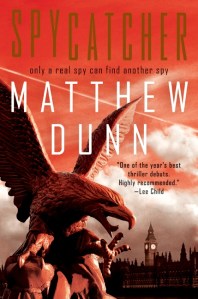
Jess is a huge fan of spy novels, especially those that feel “close to the ground.” John Le Carre, Alan Furst and Len Deighton, rather than Ian Fleming. Matthew Dunn’s Spycatcher caught my eye as something she’d enjoy. To my delight, I absolutely fell in love with this book myself, and I’m not even much of a spy fiction fan.

Dunn is a former MI6 agent, and like Le Carre, his field experience is almost palpable in his writing. (Unlike Le Carre, Dunn doesn’t use a pseudonym, which I find interesting.) Spycatcher follows Will Cochrane as he tries to stop an Iranian terrorist. It’s a thrilling story, and while Cochrane and his team appear almost superhuman at times in their strategies, Spycatcher works so well because we see Cochrane’s vulnerability, his humanity. We feel his pain at not having seen his sister in eight years, and we long as much as he does for him to be able to settle down with the woman he loves. Incredible book, and I can only hope Dunn writes even more.

View my review of Spycatcher

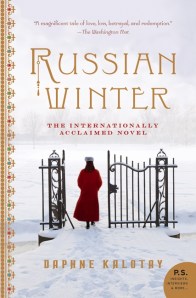
Russian Winter by Daphne Kalotay

Jess loves books about Russia, especially books written bySolzhenitsyn, Dostoevsky and Chekhov. I haven’t blogged about any of their books (I’ve also never read Solzhenitsyn, though Jess assures me he’s really good), so here’s the next best thing: Kalotay’s Russian Winter is about Nina Revskaya, a former ballet dancer now living in Boston and auctioning off her jewelry. A mysterious link between her and a man who appears to own a necklace that belongs to one of her sets leads Nina to remember her past in Russia under Stalin. The present-day scenes were okay, but I just love the scenes in Russia. The descriptions of ballet are just beautiful, and Kalotay makes us feel both the fear of Stalin and the characters’ desire to escape this fear through art.

View my review of Russian Winter

Review: Blood Red Road, Moira Young

I’d heard that Moira Young’s Blood Red Road was very similar to The Hunger Games, so as a Hunger Games fan, I was eager to check it out. There are certainly similarities: Blood Red Road also takes place in a dystopian future, the heroine Saba is an archer like Katniss, and Saba has to compete in a gladiator style Cage Match to the death like Katniss has to survive in the Hunger Games. Overall, however, I don’t think Blood Red Road quite matches up, at the very least in terms of the breadth of social commentary in Hunger Games. While Hunger Games delivers a scathing portrayal of contemporary society’s obsession with consumerism and voyeurism, Blood Red Road reads more like a straightforward action-adventure story, with its social commentary focused on the dangers of drug addiction.

That being said, Blood Red Road is still a very good book. It has a heroine much fiercer than Katniss, UFC-style fight scenes, language that reminded me of the dialogue in The Grapes of Wrath and a landscape and drug culture that reminded me of Dune. Saba’s twin brother Lugh (the “light” to Saba’s “shadow”) is kidnapped and Saba sets off to rescue him. Along the way, she is captured and forced to compete in no-holds-barred cage fighting, where she earns the nickname Angel of Death: when she fights, the “red hot” takes over and she can’t lose. People are addicted to chaal, a drug controlled by a King, and this addiction makes them either suppliant or, after a certain point, filled with bloodlust (hence the need for deathly cage fights). Saba also encounters a group of young female warrior rebels and a handsome young thief called Jack.

Young writes well. This type of writing (filled with intentional misspellings and grammatical errors) usually grates on me, but, as with Patrick Ness’ Chaos Walking trilogy, I thought it worked here. Blood Red Road is a fast-paced, action-packed, exciting read. It’s already been optioned for a motion picture by Ridley Scott, and I can certainly imagine some of the scenes playing out on screen. The secondary characters are well developed and likable. I especially liked Jack, who is charming, funny and sweet. Saba’s younger sister Emmi is usually the kind of character I’d hate in books and movies, the kid who always gets involved in things and so has to be rescued several times. But I really felt for Emmi in this book, and I think it has a lot to do with my major problem with the book: Saba.

I liked Saba as a narrator, but I don’t really like her as a person. I do like that her survival instinct is so strong that she dominates the cage fights. I also like that she is so devoted to her brother, even though it’s clear (Jack even tells her so) that she puts him on too high a pedestal. We do see her vulnerability at times, and also her protective instinct toward Emmi.

Thing is, as one character says, Saba is “prickly.” Beyond that, she can be downright mean, especially to Emmi. A lot of the time, other characters were offering Saba help and friendship and she kept turning them away, preferring to be a lone wolf even when it wasn’t practical. She has to be forced to accept help, and for me, at least, she hadn’t shown enough of her vulnerability to make this anything but annoying.

I was most annoyed by Saba’s relationship with Jack. It followed a standard “I hate you (but secretly I love you)” type love story. But after a while, Saba’s insistence that she really, really hates Jack just felt forced, like the author just wanted to stretch it out just a bit longer. Perhaps it’s because I didn’t really see why Saba was so defensive, unlike in Hunger Games, for example, where I could really understand how Katniss’ society had made her so defensive and afraid to trust anyone.

Overall, however, Blood Red Road is a really good book. Definitely worth checking out for fans of The Hunger Games or Divergent or kick-ass heroines and dystopian fiction in general.

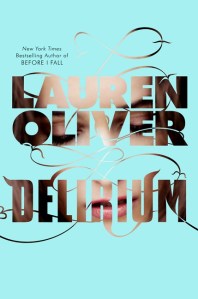
Delirium, Lauren Oliver #50BookPledge

In Lauren Oliver’s Delirium, love has been diagnosed as a disease, and everyone is required to undergo the cure when they turn eighteen. When I first heard the premise, my cynical brain immediately thought it was brilliant. No more Eponine-style romances for me! Thing is, the procedure doesn’t just kill off romantic love. My sister, who also read this book, called it practically a lobotomy, and that’s what it is: the doctors surgically remove every last bit of passion. You will never been heartbroken, but you will also view your friends and children with cold logic (you’ll give your baby milk because he’s hungry and needs food to live, not because you can’t stand to see him cry). You will no longer feel depressed, but you will also never enjoy your hobbies with as much fervour as before. Hana, the best friend of protagonist Lena, tells her early on, “You know you can’t be happy unless you’re unhappy sometimes, right?” And it’s true. Cliches aside, if you remove all violent emotion, you’ll have to remove the good with the bad.

Unlike Hana, however, Lena can’t wait for the procedure. When she was very young, her mother committed suicide because she was too infected by amor deliria nervosa to be cured. All Lena can remember is her mother laughing and dancing with her (then immediately checking to see if anyone had noticed; too much laughter after all is a symptom of delirium) and her mother fiercely telling her, “I love you. Remember. They cannot take it.” Lena is heartbroken by her mother’s death, and looks forward to being cured and freed from all that pain. I love that the heroine begins the novel looking forward to the procedure, and horrified whenever Hana makes negative comments about it. My natural reaction, once I found out the procedure destroyed all passion and not just romantic love, was to wonder how anyone could think that was a good idea. Lena’s desire to forget a completely different kind of pain made sense to me, and showed me how this procedure could be seen as a good thing, even by intelligent, non-brainwashed-drone individuals like Lena.

But Lena falls in love. Only three months before her procedure, she meets a boy named Alex, who has the scars of the cured, but whom Lena saw laughing when something messes up an evaluation interview. I love how she falls in love with him not just because of his good looks (though he is hot), but because of the tremor of laughter in his voice, and the constant look of amusement in his eyes. In a world where serenity is prized and passion is feared, happiness is enticing. Alex too, it turns out, first develops a crush on Lena when he sees her acting silly during a run — as Lena discovers during class picture day, even her ordinary looks are transformed into great beauty when she’s really happy. It’s wonderful seeing this tale from Lena’s perspective — I worry with her when Hana sneaks off to attend an underground party (with real music! Not the government regulated chipper tunes!), I feel for her whenever she remembers her mom, and I get just as giddy as she does whenever she meets up with Alex. She still worries about ending up like her mother, and I love what Alex tells her about the downside of the cure: “That’s when you really lose people, you know. When the pain passes.” I think of when my grandfather died, how my biggest fear is forgetting how he looks, or how he sounds. Pain sucks, but Alex is right; pain also keeps the past alive.

As you can probably tell, I love this book. It’s an emotional ride, which reminds me of how repressing emotions actually ends up making them burst out even more violently. I love how it goes beyond just a romance, and deals with the value of passion in so many things — friendship, family, music, hobbies, and yes, love.

I remember how violently I felt about things when I was younger, and how much more practical I am today. I remember how, when I was young, an older cousin told me never to fall in love, because it hurt too much, and I remember how I, fuelled by Disney movies mostly, vowed never ever to turn away from love, because I’d rather be hurt than block myself from feeling. I remember changing my mind later on, and chalking it up to maturity. Delirium is about a surgical procedure that removes strong emotions, but I wonder, though not as extreme, do we all subject ourselves to a similar procedure in the name of growing up?

This book will make you believe in love again. At the very least, it will make you realize why numbing yourself against pain, while tempting, can never work in the long term. Delirium ends with a bang, which actually reminded me of a Le Carre novel (I can’t say which, as that would totally be a spoiler). It’s a wonderful, exciting book that I hope will touch you like it has touched me.

By the way, if you plan on getting this book (as you should!), just to let you know, I found out on the Harper Collins Canada website that Delirium: The Special Edition will be published July 20, 2011. It’ll have new cover art, a Q&A with author Lauren Oliver and an exclusive excerpt from her next book! Pretty cool, eh? (Thanks to Harper Collins Canada’s Savvy Reader for letting me know details about Delirium: The Special Edition!)