Author Encounter | Jo Walton

Some of you may have already read this blog post or seen my enthusiastic tweets and know how much I adore Jo Walton’s Among Others. Dan Wagstaff from Raincoast Books had called it a “novel for book nerds” — indeed, Among Others is a love letter to books, to libraries and particularly to science fiction. I especially love its ambiguous portrayal of magic — there is always a rational explanation, but that’s just how magic works in the real world. This book blew me away, and I’d been recommending it like crazy to anyone who loves books.

So when Dan tweeted me to let me know Jo Walton would be doing a signing at Bakka Phoenix Books, I immediately entered the event into my calendar. No way was I passing up the opportunity to meet this author!

It was a great experience, meeting Jo Walton. She read from the beginning of Among Others, ending with one of my favourite quotes: “I have books, new books, and I can bear anything as long as there are books.” Then she opened up the floor to questions.

Will there be a sequel to Among Others? She toyed with the idea, but decided against having another book from Mor’s point of view. She explained that Among Others begins after Mor had saved the world — it’s the story of what happens after the adventure that is usually what a book is about. Then, in Among Others, Mor gets to save the world again. “You can only save the world so many times before it gets boring,” Jo said.

The book she is currently working on is about the Congress of Vienna. “Ooooh,” the audience said. “I love you guys!” Jo exclaimed. She is so used to receiving blank stares when she mentions the Congress of Vienna that she sometimes just describes her next book as being about a giant lizard monster. “Same book,” she said.

I asked her about the magic in Among Others — why did she choose to portray magic in this way, neither completely rational nor completely magical? She said it’s because the story is set in the real world, and magic doesn’t exist in the real world. Therefore, she needed “non-falsifiable magic.” She doesn’t like it when books are set in the real world, and actual magic exists but no one notices it — “Do they think I’m stupid?” For her story, she needed to create the kind of magic that could actually exist in the real world.

Then, as she continued to think about it, she realized there was a kind of magic in ordinary objects as well. She gave the example of a favourite household object — a knife, I think? If we have an old knife that we’ve used for cooking for years and has some sentimental value to us, then even if someone gives us a brand new knife, we still usually prefer our old one. “It’s not actually magic,” she said. “But there is a connection.” And that connection in itself is a form of magic. In fact, she found out that the more you observe, the more you really look around, the more you will be aware of the kind of magic that does exist in the real world.

She is also amused at how many reviewers have been reluctant to use the word “fairies.” Instead, they call the fairies in the book elves, or spirits, or if they do use the word fairies, they spell it faeries. “Fairies” is a childish word; even Mor feels awkward using it. But Mor did meet them when she was a child, and trying to pin them down with a more adult term feels awkward. Jo says that the more childish term is actually the most fitting for the fairies in this book. (Immediately, I wondered how I referred to them in my review. A quick check reveals, to my relief, that I did spell the word “fairies”, as the book does. But I do remember feeling awkward typing it.)
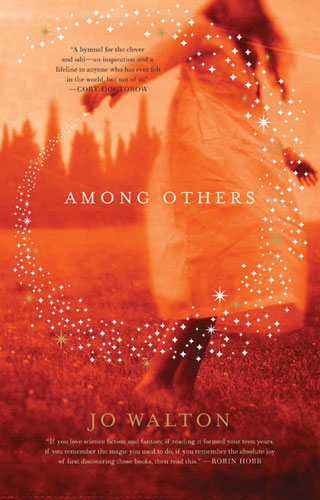
Jo added that, to her surprise, some readers thought there was no magic at all in the book. It had never occurred to her that some readers would think Mor was just delusional. “This book is about magic,” she said. “As you can tell from the swirl on the cover.”
I got to chat with her a bit more when I brought my book up to be signed. I told her that Dan had called Among Others a novel for book nerds, and she laughed and said that was quite accurate. I also asked if she’d actually read all the books she references in Among Others. “Absolutely,” she said. “I wouldn’t talk about a book I hadn’t read, because I wouldn’t know what to say.” She may not have read them at fifteen, like Mor has, but she has read them all. I told her that upon finishing Among Others, I immediately rushed out to get a copy of Samuel Delany’s Triton. “My job is complete!” Jo said. She’d also once read a review of Among Others on a blog where the next review was Ursula Le Guin’s Lathe of Heaven, which, like me with Triton, the blogger had read because of Among Others.
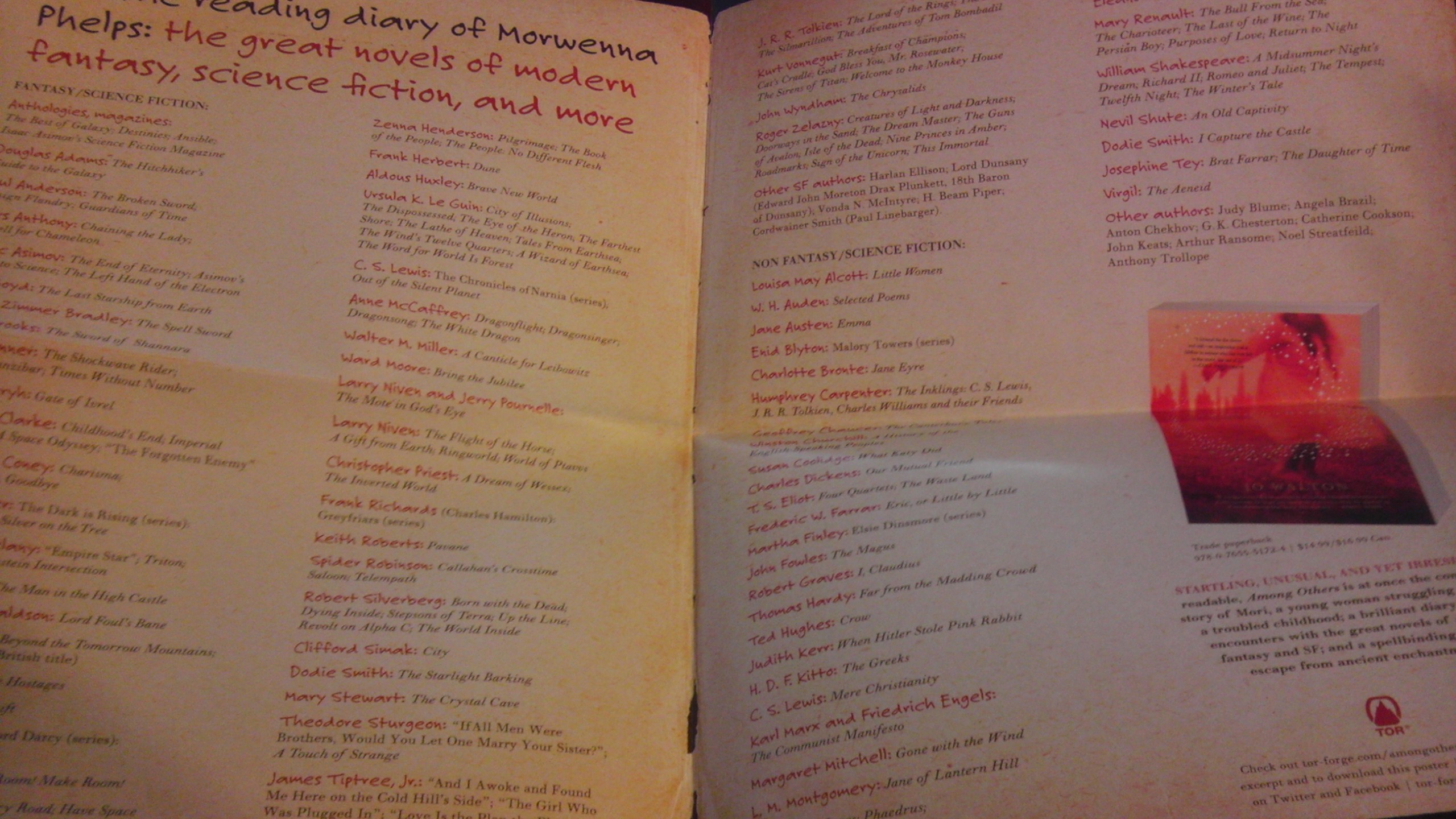
The bonus of having written a book for book nerds: a librarian had actually compiled the Among Others reading list, and, after a few corrections from Jo, the publisher included the list on back of the book’s poster!
Wonderful to have met Jo Walton, and to have actually had the chance to chat with her about such an incredible book! Thank you, Bakka Phoenix, for the event, and thank you, Dan Wagstaff, for telling me about it!

Chatelaine Book Club | Breakfast with Alan Lightman

There aren’t many things that will get me happily bounding out of bed and downtown early morning, but breakfast with an author is definitely one of them. When Laurie Grassi from Chatelaine invited me to breakfast with author Alan Lightman, I was intrigued. Alan Lightman is a theoretical physicist, an astro-physicist to be precise, and he’s written, among other works, the novels Einstein’s Dreams and the recently published Mr g. I found the concept behind Mr g interesting: the novel tells the story of creation from the point of view of God (a.k.a. Mr g). The novel begins: “As I remember, I had just woken from a nap when I decided to create the universe.” That opening hooked me; I wanted to meet this author.

It was great meeting Laurie, with whom I’ve chatted on Twitter (follow her at @ChatelaineBooks), and I was very impressed by how she knew everyone’s names. Every time someone entered the room, she’d introduce her to everyone else, sometimes even citing our Twitter handles and blog names. I was also impressed by the breakfast. We had coffee and tea in beautiful mugs, and trays of fruit, chocolate croissants and other breads and pastries. Seriously, an entire table was filled with food.

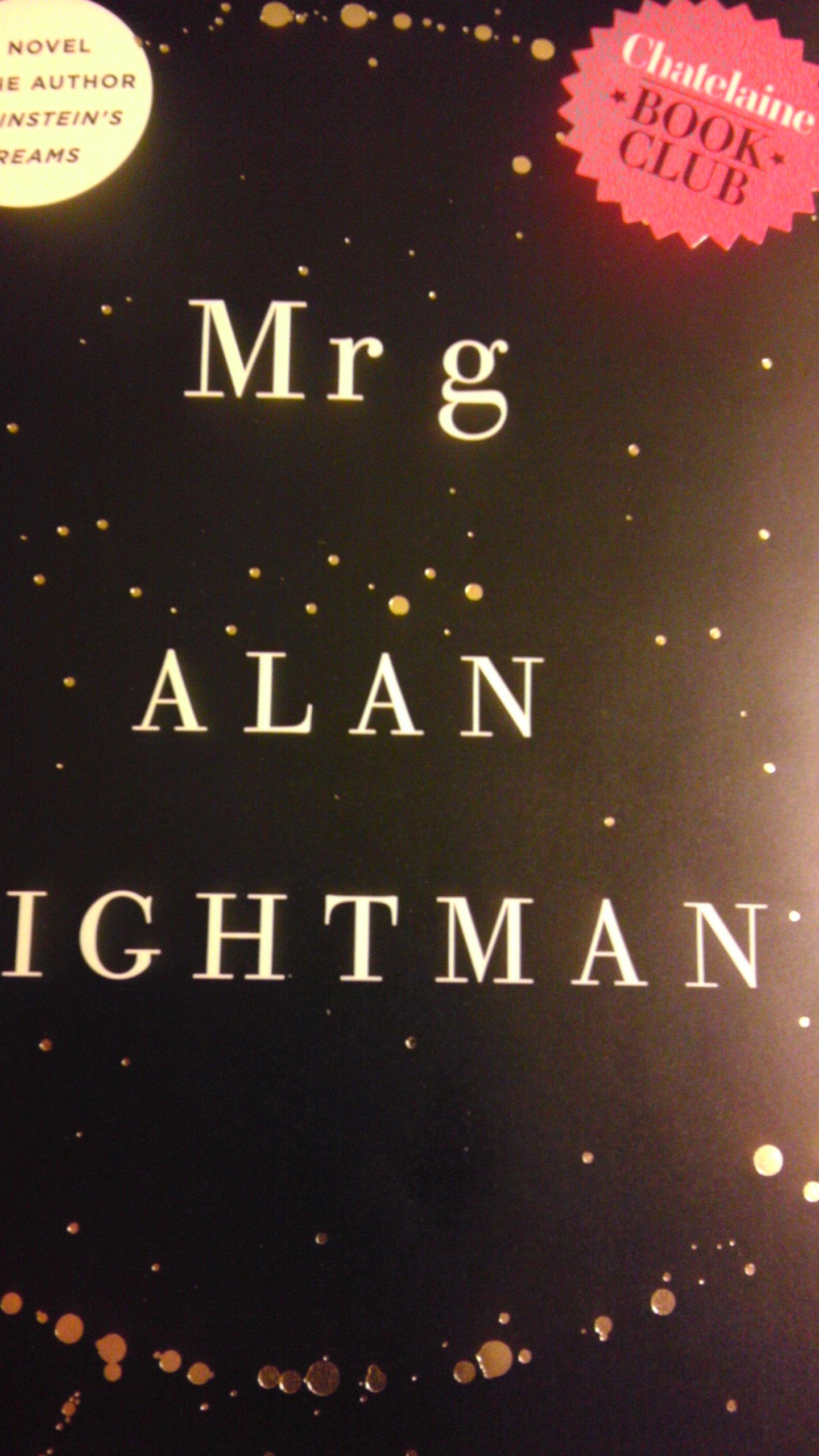
Chatelaine was also kind enough to provide each of us with a copy of Mr g. I absolutely love the cover! The original cover, above, is already beautiful, but our copies have the bright pink Chatelaine Book Club label on it, which I think makes the book even more eye-catching. (I took this image with my phone and the lighting is off; it’s much sharper in real life.)

Alan Lightman is charming. Not only is he a physicist, professor and novelist, but he also runs an organization that provides housing for women in Cambodia. He looked around the mostly female room (all female, actually, with the exception of Alan himself and book club member Josh) and admitted he was used to being surrounded by females. He then laughed sheepishly and added that it wasn’t how it sounded; he meant just because of his work with Cambodian women.

Alan read an excerpt from Mr g, then we were all invited to ask questions and discuss the book with him. Mr g wakes up from a nap and decides to create the universe. His aunt begs him not to: “You could mess things up,” but Mr g had made up his mind and thereby, without really meaning to, created Time. The aunt and uncle characters provide comic relief, but there’s also something sad in their sudden realization of the passage of time. “It was nicer when everything happened at once,” the aunt complains. “I can’t stand to think about the future.” Eternity isn’t a long time until you’re aware of time’s passage. The chapter ends with the aunt’s sudden development of vanity and need to fix her hair for the first time. I wondered if it was an echo of the Genesis myth, where eating the fruit of knowledge made Adam and Eve self-conscious and led to the fall of man.

Someone asked Alan if he was afraid of offending people by writing such a novel from God’s point of view. He responded that even with the humour and the casual nature of Mr g’s actions, he has always endeavoured to maintain the character’s dignity. We did find out, however, that someone did find the content offensive, and so wrote a catalogue description that gave the impression that Mr g was a supernatural being, but not God, and that the universe in Mr g was not our universe but in some other dimension. Fortunately, the description was corrected in time.

I was fascinated by how much of Alan’s work as a physicist influences his novel writing. He spoke to us about string theory multiverses. I’ll do my best to repeat his explanation here, and if it doesn’t make sense, or if I got anything wrong, that’s definitely all me. Alan explained it really well, and at the breakfast, I actually understood what he was talking about. Basically, physicists have a theory that there are countless dimensions, different universes, all of which are governed by different laws. This frustrates physicists because it means they cannot apply a single formula to explain everything in existence. As well, no other universe except ours can support life. Laurie asked him to clarify if he meant life as we know it, or all forms of life. Alan replied that no form of life at all can exist outside this universe. His point is that all the elements that came together to form this universe did so by accident. The absence of a single formula to explain everything means there is no grand design or grand scheme; we exist because of accident. I think that concept is very much encapsulated in the opening sentence of Mr g: the universe is created by God on a whim after a nap, literally without rhyme or reason.

I just started reading Mr g, and I am fascinated by Alan’s language. Even in the first few chapters, we move from the humorous quip of the opening sentence to some very scientific language describing the universe as “a tiny ellipsoid […] and it was a mathematical and tautological impossibility for anything within to emerge without.” Then I am surprised by phrases that are just beautiful, even poetic: “Practically everything slept in an infinite torpor of potentiality.” I love that phrase: “infinite torpor of potentiality.” Beautiful.

Thank you to Chatelaine Book Club for the opportunity to meet Alan Lightman. I had a great time, and I enjoyed meeting so many fellow book lovers. Chatelaine even gave each of us a swag bag. I had to laugh when Josh proudly showed me that he was able to fit the bag into his backpack: “I’ll carry pink for a girl, but not for myself.” I also found the cover of the Chatelaine issue timely. “Declutter!” I read, as I glanced around my very cluttered home. I also love that Chatelaine chose Mr g for its book club. When I think of book club picks for women’s magazines, and I admit I obviously need to change my preconceived notions on this, a book with a scientific slant about the creation of the universe wouldn’t have come to mind. I found Mr g an unexpected, interesting choice, and I can’t wait to find out what they choose next.

Anne Rice at the Toronto Library Appel Salon

Anne Rice was such a major figure in my teenage years that I could hardly believe I would get to see her in person. I loved her Vampire books, with their tortured, Old World, non-sparkly anti-heroes. I remember once being home sick from school once and just spending the day reading Interview with the Vampire. Seriously, forget the Cullens — if you want to fall in love with a vampire, Lestat and Louis are so much more seductive. I stopped reading Rice when she started writing books about Jesus, just because those didn’t interest me, and, like many of her fans, I was thrilled to find out she’d returned to the supernatural with Wolf Gift.

As I expected, tickets to the Appel Salon event were sold out almost immediately. I planned to show up an hour early to get a good seat, but saw on Twitter that a line was already forming three hours before the event! Crazy, eh? Yet that’s the kind of devotion Anne Rice inspires in her fans. Standing in line to get my books signed after the interview, I looked around to see what books others brought. While almost everyone in line had the shiny gold and white Wolf Gift (sold just for us, one day before it hit bookstores!) and one man had a leather-bound edition still in its shrink wrap, many people had somewhat battered, dog-eared copies with yellowing pages. I love that! I saw a book with a cancelled library stamp, and I could only imagine the reader discovering that title at a library’s used book sale. I saw books with creased spines, bent covers, pages that opened naturally to a middle chapter. I also saw books that still looked new, of course, but it was those obviously much-loved copies that caught my eye. How many times have these stories been read? Where have they been read, and how have they touched each person’s life? One woman I met in line told me she had all the available editions of Interview with the Vampire. The story means that much to her. I love that. I love seeing so many people who love Anne Rice’s writing as much, or even more, than I do.

I also loved meeting up with fellow bloggers Jen and Jenn at the event! And Jen – thanks for the cookies! I was enjoying them too much to take a photo, but Random House tweeter Lindsey did!

I was very impressed by Rice’s interview. She is so articulate and intelligent, which I expected from her writing. I didn’t expect, however, how soft-spoken, almost serene, she is. Asked the inevitable Twilight question, she couldn’t barely stop laughing long enough to give her response: Lestat and Louis would be envious of vampires who could walk in sunlight; they’d love to be able to do that. They’d say, “If you can sparkle, go to it!” She admits she never thought of putting her vampires in high school, but hey, sure they’d want to go back to high school, for twenty minutes, maybe. (Yeah, that’s actually more realistic than wanting to spend a century in high school, right?) She also admits Meyer is a genius, because Meyer figured out what her audience wanted — the idea that the guy sitting beside you in biology is really a vampire! Again, Rice raises an interesting point. I was attracted to Louis and Lestat because I love the idea that there are gentlemen with Old World manners still around, who could look good in a top hat and lace collar and who could whisk me away from the ordinariness of homework and traffic jams. So, facetious though Rice may have been, why not have a classmate in a boring biology class have a fascinating secret?

I was also impressed by the depth of reflection she had on her faith. She very famously returned to Christianity only to break from it again, and, on her Facebook page years ago, she announced her decision to leave the Church brilliantly, in my opinion:

I quit being a Christian. I’m out. In the name of Christ, I refuse to be anti-gay. I refuse to be anti-feminist. I refuse to be anti-artificial birth control. I refuse to be anti-Democrat. I refuse to be anti-secular humanism. I refuse to be anti-science. I refuse to be anti-life. In the name of Christ, I quit Christianity and being Christian. Amen.

Her decision had much more of an impact than she realized. She received an email from someone who worked for a church, and that person told Rice that due to her job in the church, she couldn’t say what Rice said, but she was grateful to Rice for saying it. Rice also said that a priest gave her the key to his church’s rectory, along with an open invitation to come and worship the Blessed Sacrament any time she wanted. I found that especially moving, because even though Rice quit the institution of the church, she is still clearly very spiritual. In fact, the epigraph to Wolf Gift is something Rice wrote herself, and she says it’s her personal prayer. I think it’s just lovely:

Say what you will to the force that governs the universe. Perhaps we’ll call it into being, and it will yet love us as we love it.

If you missed the event, the Toronto Library videotaped the whole interview:

Other bloggers’ posts on this event:

Rayments Readings Rants and Ramblings
Reeder Reads