Review | The Chronicles of Harris Burdick, Chris Van Allsburg et al

“The story of Harris Burdick is a story everybody knows,” Lemony Snicket writes in his introduction to The Chronicles of Harris Burdick, “though there is hardly anything to be known about him.” Over fifty years ago, a man named Harris Burdick appeared at the office of children’s book publisher Peter Wenders. Burdick brought with him fourteen illustrations with captions and left, promising to return with the full stories the next day. No one ever saw Burdick again.

Truth be told, I wasn’t familiar with the legend of Harris Burdick, and immediately Googled him — surely, there must have been some clue about what happened to him? Turns out, he is a creation from the mind of children’s book author and illustrator Chris van Allsburg (also the genius behind the classic The Polar Express). I was somewhat disappointed at this discovery, but I was also in awe of van Allsburg’s imagination. What a marvellous idea! To learn more about Harris Burdick and see some fantastic stories inspired by him, go to www.whoisharrisburdick.com. There’s also a teacher’s guide at www.mysteriesofharrisburdick.com.

What is real is the amazing rush of imagination Burdick’s captioned illustrations inspire. In his 1984 introduction to the original Mysteries of Harris Burdick, van Allsburg writes, “I told Peter Wenders how difficult it was to look at the drawings and their captions without imagining a story.” Indeed, an idyllic image of children by a lake comes with the intriguing, horrific caption “He threw with all his might, but the third stone came skipping back.” An image of a harp in the woods has the caption “So it’s true, he thought, it’s really true,” which holds the promise of wonder and magic. The seemingly ordinary thriller-type caption “His heart was pounding. He was sure he had seen the doorknob turn” raises all sorts of questions with the accompanying illustration of a room with a door barely two steps high. I would love to take these illustrations to a third grade class and see the kind of stories eight year olds can come up with. I can imagine readers and writers of all ages delighting in the imaginative experience of creating the lost stories of Harris Burdick.

In Chronicles, that task falls to several of the best, most imaginative authors of our time. Included are stories by Stephen King, Lois Lowry, Gregory Maguire, Sherman Alexie, Kate DiCamillo, Cory Doctorow, and the creative genius who began all this in the first place, Chris van Allsburg. Seriously, this line-up alone was enough to make me want this book, even before learning the legend of Harris Burdick.

The book lives up to its promise. Put such talented writers together, provide them such inspiration and let their imaginations fly, and you end up with a wide range of really good stories. I enjoyed reading these stories, and I love how I enjoyed each story for a very different reason. Stories range from sweet to spooky and the subject matter from mundane to extraordinary.

Some stories in the collection did stand out for me, and for very different reasons. Sherman Alexie’s “A Strange Day in July” is one of my favourites. Alexie took the Enid Blyton-esque image of children by a lake and went the Neil Gaiman/Stephen King route, crafting a remarkably chilling tale about a pair of strange (to my mind, almost psychotic) children. As a major bookworm, I really enjoyed Walter Dean Myers’ “Mr. Linden’s Library,” about a book that kept writing itself as you read. It’s more sinister than you would imagine. Jon Scieszka’s “Under the Rug” is an amusing horror story that for some reason reminds me of Roald Dahl, about a grandmother who spouts cliche’d wisdom and a grandchild whose laziness creates a Dust Monster. Scieszka’s ending was unexpected, yet it totally fit, and I love how he poked fun at the grandmother’s bite-sized pieces of advice. Linda Sue Park’s “The Harp” is a traditional fairy tale, but its ending is very touching. I love the scientific angle to Chris van Allsburg’s “Oscar and Alphonse” and the Twilight Zone feel of M.T. Anderson’s “Just Desert.”

Chronicles ends with a blast, literally, with another of my favourites, Stephen King’s “The House of Maple Street.” I love how King weaves unexplained supernatural elements into a story about domestic abuse and child empowerment. The stepfather in this story is a total jerk, I felt for the mother, and I was cheering on the kids the entire time. Though it’s the supernatural elements that resolve the conflict in this story, it’s the true-to-life elements that stuck with me.

Chronicles of Harris Burdick is an absolute treat. It’s a wonderful storybook, and I love reading all the stories these authors came up with. But it’s also a marvellous nudge on the imagination. Van Allsburg is right — it is difficult to see these images, especially with their captions, and not have the imagination spark with all the possibility of storytelling. Personally, I’d be fascinated to see the stories other authors would make from these images, particularly J.K. Rowling, Suzanne Collins and Arthur Slade. In the meantime, I think Lemony Snicket’s introduction sums up the experience of Harris Burdick perfectly: “As you reread the stories, stare at the images, and ponder the mysteries of Harris Burdick, you will find yourself in a mystery that joins so many authors and readers together in breathless wonder.” Breathless wonder, indeed.

Review | Cain, Jose Saramago (Margaret Jull Costa, trans)

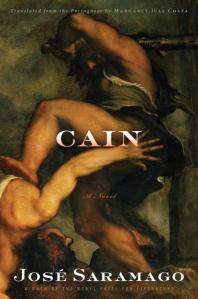
Jose Saramago’s Cain just blew me away. The cover grabbed me at once: Titian’s (Tiziano Vecellio) Cain and Abel. The original painting showed Abel’s murder from below; Cain is caught in the act against the backdrop of a dark, roiling sky. We feel Abel’s fear; Cain appears a monster. In contrast, the book cover focuses on the two figures, with Abel barely in the frame. Rather than a portrait of a larger than life monster, this image is a dynamic depiction of rage. We feel Cain’s fury, we see the precariousness of his pose and can anticipate the downward strike of his stick. It’s a beautiful, powerful, savage image, and it’s given resonance by Cain’s confession in the book: “I killed abel because I couldn’t kill you [god].” This fury then is directed not at a younger brother, but at god, and we feel that throughout the book.

Cain relates the Old Testament from an all too relatable perspective. Condemned to wander the world forever, Cain witnesses Abraham’s attempted sacrifice of Isaac, the destruction of the Tower of Babel, Moses and the golden calf, Sodom and Gomorrah, the trials of Job and Noah’s Ark. At each incident, Cain is bewildered, frustrated and, progressively, furious at the callous, unjust, ever cruel actions of god. About Job, Cain tells an angel

…job, for all his wealth, is also a good and upright man […] he has committed no crime, and yet, for no reason, he is about to be punished […] I don’t think [god is just]. […] if the lord doesn’t trust the people who believe in him, I really don’t see why those people should trust in the lord. […] now [god’s] going to make job suffer because of a bet and no one will hold him to account.

Cain’s objections are reasonable and definitely relatable. The final observation, that no one holds god to account, is troubling, and definitely with a point. I grew up Catholic, and have always had drilled into me the idea that things happen according to God’s plan, which we must trust even though we do not understand. This belief can certainly provide comfort and in lots of ways, things in life do eventually work out. However, when a loved one is suffering from illness or some other personal crisis and begs you to tell him or her why such a horrible thing is happening, the idea that it’s all according to a divine plan rings hollow. Sometimes, life just really sucks; fate seems unfair and like Cain, I can see no logic in it. In Cain, god probably does have a plan, or so the angels claim, but it’s capricious at best and at worst possibly even diabolical.

Cain, however, does hold god to account, and acts as humanity’s advocate in his debate with god. Take for example the story of Abraham’s bargain with god to spare Sodom and Gomorrah if Abraham can find a certain number of innocents. I learned this story as a lesson in God’s mercy and love for humans, such that he’s willing to change his plans for our benefit. But, the story goes, it turns out there were no innocents so Sodom and Gomorrah were destroyed anyway. Here, Cain asks, even if we assume that the residents were sinful, surely the children in those cities were innocent. Why then were they killed as well? In this and other incidents, the people Cain encounters explain that god’s plans are inscrutable, and the platitude grows as thin for us as it does for Cain.

What I love most about Cain is that Saramago keeps it from being pure commentary or manifesto by keeping Cain very much flawed. God may be cruel and Cain’s arguments may make sense, but Cain is, in many ways, also capricious. Cain’s killing of Abel is deeply symbolic and significant, but Cain’s refusal to accept full responsibility is immature. His motive, that god ignored his offering while favouring Abel’s, seems childish in that “mom always liked you better” kind of way. Cain ends up destroying innocent lives just as he accuses god of doing, though unlike god, his motives are clear: revenge on god. I love the moral ambiguity this creates. In his battle against god, how much does Cain actually end up becoming like him? If Cain is humanity’s advocate in this tale, how much are we like him, in our capacity to be just as cruel and capricious as we accuse god to be? Conversely, how much of god’s “mysterious ways” are actually just as screwed up as Cain’s?

Saramago ends his tale with “one thing we know for certain is that they […] are arguing still.” Saramago offers no easy answers or neat resolutions. Rather, he raises many, troubling questions. He also creates in Cain what I hope will be the most memorable portrayal of one of Christianity’s most reviled figures. Saramago’s Cain is less like Dan Brown’s symbolic, practically sanctified version of Mary Magdalene and more like the complex, sympathetic, yet still culpable figure of Judas in Jesus Christ Superstar.

The dialogue in Cain is written in long, run on paragraphs without quotation marks. I usually dislike this style, finding it confusing and unnecessary. However, I love it here, where it creates a rich fluidity. Cain’s lines hurtle almost right on top of those spoken by angels or god, making my eyes race down the page, building momentum until Saramago issues a full stop. It’s an exhilarating, emotional experience, and its intensifying rhythm captures the rush of Cain’s anguish, and his fury, perfectly.

Cain is a potent, powerful book, deceptively unassuming in its 159 pages. The cover alone gives it a prime spot in my bookshelf. The intimacy implied in the cover art is reflected in Saramago’s words and Costa’s translation; it draws you in, keeps you close, and refuses to let go.

EDIT:

Turns out Publishers Weekly loves Cain as much as I do! It’s on their list of 100 Best Books of 2011. Read Gabe Habash’s beautifully written review here. I love the way Habash begins his review:

Oh, José, ye, the teller of paragraphs spanning eight pages. Tell me a story, an old, old story, about the man named Cain, who murdered his brother and was condemned by God to wander out his days.

Full list from Publishers Weekly coming out November 7th.

On book covers

My sister sometimes makes fun of me and how much stock I put in book covers. Browsing through a bookshop or flipping through the IFOA booklet, she’d ask me what I thought of one book or the other, and my response usually is, “Ooh, I love that cover!” or “Meh, the cover doesn’t grab me.” My sister would then ask, “No, what do you think of the story?” and I’d go, “Story?”

Now, I don’t usually buy a book simply because of the cover art. Usually, it takes at least an eye-catching cover and a gripping first page to make me buy a book. That being said, in this age of e-books, it’s even more important for print books to be works of art in their printed form, and I appreciate it when publishers make the extra effort to provide that. One book I boughtprimarily for the book design is Chip Kidd’s The Cheese Monkeys. The story, about an art student and his class, is pretty good, but what really makes this book pop is the book design. Beyond the eye catching cover art, the text on the title page, copyright page and table of contents scroll right off the edges of the pages. Harper Collins offers a view of the first few pages here, but it’s an effect you can appreciate only from the physical book. I love it, and I think it’s a great example of the extra wow factor book design can give a print book.

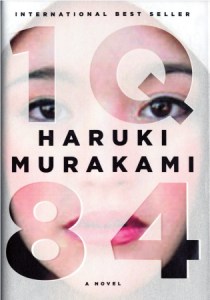
Cheese Monkeys actually made me a Chip Kidd fan, and I am absolutely in love with his latest work — the cover of the single volume edition of Haruki Murakami’s 1Q84. Now this image is beautiful enough, but what the picture doesn’t show is that the book jacket is actually in two layers. An onion skin layer covers the image of the woman, and, my personal favourite part, the portions of the woman’s face within the book title are printed on the onion skin layer and left white on the layer beneath. I can’t remember where I read it, but someone wrote about how the onion skin layer on this cover is defiantly fragile. This seems antithetical to the sturdiness people look for in hardcovers, but it’s also a beautiful testament to the ephemerality of Aomame and Tengo’s love story. I also love that, even with colour e-readers now out, the physical 1Q84 will still have the advantage of design; the e-book version will necessarily merge both cover layers into one image, and it will still be beautiful, just not as beautiful.

I also love the cover of Jose Saramago’s Cain. Featuring a detail from thepainting Cain and Abel by Titian (oil on canvas, 298 x 282 cm, 1542-44), this cover is both beautiful and powerful. It takes the horror and violence of the Titian painting and makes it personal, by focusing on the brothers. You can almost feel Cain’s rage emanating from the cover. Abel’s death is almost secondary; this is an image of action and movement. You can almost feel that weapon being smashed down. Cain just blew me away, overall. A powerful story, in just as powerful a package.


I am a huge fan of the Penguin Essentials series. I love the cover art so much that I bought that edition of The Great Gatsby, even though I already own another edition of that book. I love the playful cover art, and I love that these books are small enough to tuck into your jacket pocket.

One of my recent favourites from Penguin however is the hardcover edition of Madame Bovary, translated by Lydia Davis. I loved the beautiful, subdued cover so much that I chose to buy the hardcover rather than buy the e-book or wait for the paperback. Then I saw the paperback edition recently, and just love it as well. I especially like how both covers are so different, how they set such a different tone for the same novel, and yet, to me at least, are both equally beautiful.

Paperback

Hardcover


When it comes to Agatha Christie books, I usually love buying super old, ratty, used versions. Call me romantic; I love the idea of a fellow Christie fan having enjoyed that book before me. But the Harper Collins re-releases of Christie’s works have such beautiful covers that I admit I’m tempted to start buying brand-new Christies. You can find a comprehensive list with images on this Agatha Christie website, but here are a few of my personal favourites.


Two of my favourite covers from the past year, both from Anansi:

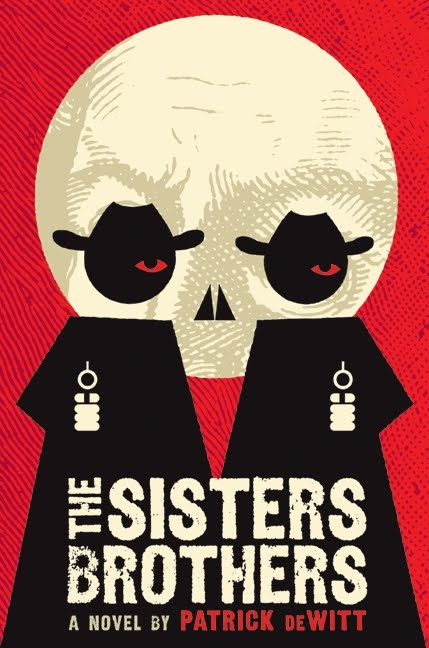
The cover for The Sisters Brothers is just absolutely iconic. Simple, stylized, yet very striking. I love how the Sisters brothers’ heads feature as the skull’s eyeholes. I especially love how the red eyes act as both the eyes of the cowboys (giving them both sinister, one-eyed glares) and the eyes of the skull. You can remove the top and bottom thirds of the cover, and the image is instantly recognizable as The Sisters Brothers, at least for bibliophiles who’ve read so much buzz for this book over the past year. At the very least, I’d say it’s the most striking, most memorable cover among the 2011 Man Booker Prize finalists.

I also love this cover for Stephen Kelman’s Pigeon English. My boss and I were discussing this cover recently, and she told me she just kept discovering more birds than she expected: “I thought that was just a collar!” At first glance, it’s a simple silhouette with striking colours. But a closer inspection reveals a jigsaw-like fit of birds and boy, and I love that this cover forces you to look closely to see all that.


Finally, a couple of gift editions that I just find so beautiful I think they’re well worth the additional cost:

The Giver by Lois Lowry changed my life when I first read it, with its story about thinking for yourself and questioning even things you grew up believing were true. I love my copy for sentimental reasons, yellowed pages and all. But this one, with beautiful illustrations by Bagram Ibatoulline, is just absolutely beautiful. I was literally moved when I first saw it. I love that such a wonderful book has been given such a beautiful edition. And I love turning the pages, reading Lowry’s words, seeing Ibatoulline’s art, and just being drawn back in to the magic of Jonas’ world.

Christopher Moore’s Lamb is a classic, a re-telling of the Gospels by Christ’s childhood friend Biff. It’s hilarious, entertaining and just a great book overall, and this is a case, I think, where the design is just perfect for the text. This gift edition of Lamb looks just like an old, fancy Bible, complete with ornate gold lettering and a ribbon bookmark. The utter seriousness of this design is wonderfully cheeky considering the subject matter, and I love it.


How about you? What’s your favourite book cover art? Have you ever bought a book just because, or at least mostly because, it was so beautiful?