
 I love the concept behind Caroline Preston’s The Scrapbook of Frankie Pratt! The “first-ever scrapbook novel,” the novel takes the form of a scrapbook Frankie keeps from her high school graduation in 1920, through her days at Vassar, her struggle to be a writer in Greenwich Village and in Paris, and finally her return home in 1927. Somewhat similar in form to Griffin and Sabine, Scrapbook contains vintage memorabilia, designed as if they had been glued to the page. Pages include amusement park tickets, graduation invitations, photos cut from fashion magazine, even a magazine ad for Palmolive soap. Unlike in Griffin and Sabine, the memorabilia in Scrapbook are only images on the page, and therefore cannot be removed, but the entire look of the page is almost three dimensional.
Have you ever kept a scrapbook? Back in 2005, right before I moved to Canada, my sister gave me a scrapbook so that I would always have a piece of the Philippines with me. I turned that book into a record of my entire life — as many pictures and memorabilia as I could cram in. My scrapbook ended up looking nowhere near as artistic as Frankie Pratt’s, but it’s definitely one of my most treasured possessions. I flip through it every once in a while, and the book transports me instantly to my past, to people and memories that mean something to me.
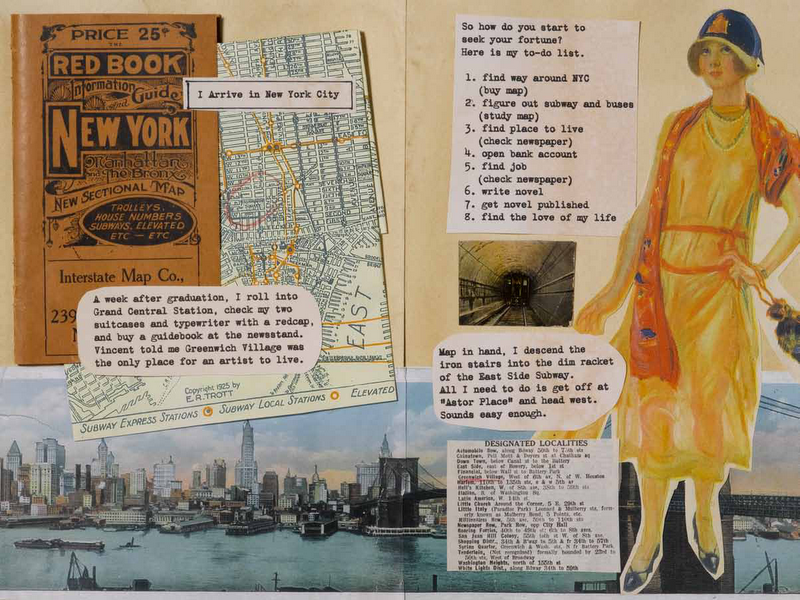 Scrapbook transports us to the 1920s, a fascinating era in history. Frankie, voted the “smartest girl” of her graduating class, dreams of becoming a writer and finding the love of her life. Because of her ambition to be a writer, she gets to meet some of the literary luminaries of her time, such as Edna St. Vincent Millay and James Joyce. Including such significant historical figures, especially when they aren’t the subject of your story, is usually a delicate task, and it sometimes comes off as name-dropping. Preston, however pulls it off and it feels plausible. The scrapbook format also works really well, because giving each writer encounter a page or two of beautifully laid out snapshots, letters and typed lines acknowledges each encounter’s significance without either overwhelming us or trying too hard to be casual about it. Frankie’s scrapbook gives the impression that meeting James Joyce for work is as important to her as a letter she receives from a beau. I also love that Frankie is a reader. I love vintage book covers, and seeing 1920s cover art for This Side of Paradise and To the Lighthouse was just amazing. I especially love the feeling that while, for me, viewing these book covers was a trip to the past, for Frankie, these were contemporary titles, and she would have no way of knowing how significant they’d be over time.
Reading Scrapbook made me want to travel back in time to the 1920s. Well-written novels can certainly transport my imagination to the past, but the beauty of Scrapbook’s unique format is that it puts me as a reader into an interesting dual position. On one hand, I feel like a 21st century woman who happened upon an old scrapbook in an attic or a garage sale, and am viewing the significant moments in the life of someone from the past. On the other hand, I am also Frankie Pratt, viewing these things for the first time and being so excited by Beau Brummel with Mary Astor and John Barrymore that I simply must include the theatre program in my scrapbook. When I think of James Joyce’s Ulysses, I picture a heavy tome of classic literature that, because of its narrative style, is going to be a difficult read. In contrast, Frankie knows Ulysses as “the notorious banned novel!” Ulysses is the controversial novel that everyone talks about, but that is practically impossible to find. She reads it not because she wants to tackle a classic, but because it has for her the thrill of the illicit. The vintage memorabilia in the pages creates an atmosphere of magic, of passion and possibility, and I at least wished I could have been there with Frankie, experiencing all these adventures with her.
 Scrapbook is also such a romantic novel! The question of whom Frankie will end up with isn’t too difficult to guess, but the relationships she forms are all so fascinating. Again, the scrapbook format enhances the romance. Images of dapper men in suits, of love letters, movie tickets and telegrams all work together to create a lush, evocative world, where a gentleman can come knocking at your door or a rogue can invite you for a spin in his brand new automobile. The scrapbook format also softens the edges of emotion. When a man breaks Frankie’s heart, we know this because of a couple of photographs and a few typed lines, over a two-page spread. Frankie has a great sense of humour, and so another painful experience is countered by a lighthearted image from a magazine ad. It is almost too easy to miss the pain behind these images, and the book forces us to stop at moments and discern all the layers of emotions revealed by Frankie’s choice of memorabilia.
I can keep going on about all the things that fascinated me in this novel, but Scrapbook is definitely better seen in person than read about. The book trailer is a bit too long, in my opinion, but it does give you an idea of how the pages in the novel look:
Scrapbook of Frankie Pratt is a beautiful, beautiful book. Frankie is a charming, intelligent, utterly delightful woman, and her personality shines through on every page. I just fell in love with this book, and I hope you will too.


 Literary Treats