
The Paris Wife, Paula McLain

I love Ernest Hemingway. His ability to write such evocative stories with the bare minimum of words amazes me. His dialogue is crisp, witty and a lot of fun to read. So when I saw The Paris Wife, a book that depicts the relationship between Hemingway and his first wife, Hadley Richardson, I was both intrigued and wary.

I know it’s not fair to compare McLain’s writing to Hemingway’s, especially since her narrator isn’t Ernest himself, but Hadley, who would understandably have a very different speaking voice. Still, I couldn’t help feeling disappointed at the dialogue. Ernest’s lines show none of the personality that shines through in his novels. Rather, it felt like reading a fairly forgettable romance novel. Take for example the following exchange:

“Do you want some wine?” He reached into his nest and pulled out a corked bottle and a teacup.
“What else have you got hidden in there?”
“Come in and find out.” His voice was light and teasing.

It’s not completely stilted in itself, but after reading so many similar conversations in the book, it finally just felt too artificial to make me care about their relationship.

The good news is that I found myself liking the story more after Ernest and Hadley’s relationship sours. When the story focuses in tight to Hadley and Ernest is in the background, the scenes seemed to flow more naturally. Maybe it’s because I couldn’t separate Ernest Hemingway the character from Ernest Hemingway the historical figure, whereas with Ernest out of the picture, I could feel like I was reading about a completely fictional woman with marriage problems and therefore allowed myself to be drawn in more.

The Guardians, Andrew Pyper

The Guardians is an exciting, creepy small town horror story that, literally, kept me up all night. For some reason, I decided to read it late at night. I planned to read a few chapters, go to sleep and pick it up again the next evening. I ended up reading probably half the book that night, because I just kept wanting to find out what happened next. It was also past midnight, with the only sound being the wind outside my window, and part of me also really wanted to stop reading, because I didn’t want to get nightmares. The minute I got to a pause in the action, I put the book down before I could get hooked on the next chapter. It’s an absolutely engrossing read, and while it may keep you awake at night, I think reading it late at night is probably the best way to enjoy it. Bonus if you also have an empty house just outside your window.

The Guardians is about a group of boys who grew up together in a small town with an empty house locals believe to be haunted. Something happens in that house, a terrible secret the boys vow to keep. They grow up, and all move away, except for one who appoints himself “guardian” of the house, keeping his neighbours away until he eventually commits suicide. This suicide leads to the group of childhood friends going back to the small town, and delving into memories of their childhood and investigating the story behind the house. Andrew Pyper intersperses the narrative with flashbacks into their childhood, so that we learn about their childhood secret as we’re watching them deal with the house as adults. This of course makes the story much more engaging, with me eagerly following both narrative threads to find out how they end.

There are times when, as a reader, I felt manipulated. For example, the narrator Trevor has Parkinson’s disease, which felt unnecessarily dramatic, like an element introduced just to ratchet up the tension. Or a chapter would end in a cliff hanger, and I know that I’d have to get through either a flashback or a present-day scene first before finding out how the cliff hanger is resolved. Ordinarily, feeling manipulated would keep me from being completely involved in the story. Thing is, and kudos to Pyper for this, The Guardians is just so engrossing, I didn’t care that I was being manipulated. It’s like being on a roller coaster – you know they put the big loops in to scare you, but they do make the ride so much more thrilling. Plus, every element in the story is eventually revealed to be essential. Even Trevor’s Parkinson’s plays a part in a climactic scene.

What ultimately makes The Guardians work, I think, is that Pyper draws on elements that are familiar to all of us. We all had a creepy house in our neighbourhood – or at least encountered one sometime in our childhood. We all have a group of childhood friends who share a secret with us that perhaps our current friends know nothing about, and yet that still colour our lives. The flashback scenes especially capture the flavour of childhood – the dialogue, the descriptions all take me back to a time when I still believed in haunted houses. Reading Guardians, I was transported back to childhood, to ghost stories I heard back then, and to the thrill I’d thought I’d outgrown.

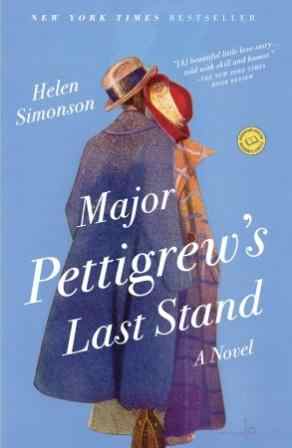
Major Pettigrew’s Last Stand, Helen Simonson

One of the best love stories I’ve read in the past few years, Major Pettigrew’s Last Stand depicts the relationship between the staid, stiff-upper-lip English gentleman Major Ernest Pettigrew (retired) and the warm, friendly Pakistani shopkeeper Mrs. Jasmina Ali. I love the subtle, almost repressed, romance between the butler and the maid in Kazuo Ishiguro’s Remains of the Day, and Major Pettigrew features a similar romance: a multi-cultural Remains of the Day in a small English village.

In the village of Edgecombe St. Mary, the blossoming romance between Major Pettigrew and Mrs. Ali is not controversial at all, mostly because none of the villagers even perceive it as possible. Though Major Pettigrew was born in India and Mrs. Ali was raised in England, the villagers insist on maintaining their image of him as the quintessential Englishman and her as absolutely foreign. In an especially telling – and hilarious – scene, the villagers decide to throw a Mughal-themed party, and ask Mrs. Ali about Indian history, completely ignoring Major Pettigrew’s interjections about all the historical inaccuracies in their party plans.

Helen Simonson’s language is wonderfully subtle. The attraction between Major Pettigrew and Mrs. Ali is beautifully suppressed, with the tiniest steps made significant yet handled very delicately. Take for example a scene near the beginning of the novel, where Major Pettigrew considers dropping by Mrs. Ali’s shop: “He… decided that he might benefit from a short walk through the village. He might stop in at the village shop to purchase some tea. It would, he thought, be generous of him to make a visit and give the busy Mrs. Ali a chance to make her excuses for not coming to see him.” So much emotion is kept between the lines, and that just makes it even more potent.

While Major Pettigrew and Mrs. Ali are physically attracted to each other, their connection is rooted firmly in friendship, particularly in a shared love of literature and conversation. Because both characters are past middle age, they both also have to contend with family issues, with being thought of as irrelevant. Major Pettigrew’s “last stand” refers to a gun that belonged to his father, which Major Pettigrew wants to keep but which his son wants to sell to advance his own career. These just add texture to their growing relationship, and Simonson interweaves the various subplots masterfully.

Major Pettigrew is Helen Simonson’s first novel, and I definitely look forward to reading more of her. Major Pettigrew is a beautifully written, subtle love story, which also deals with issues of culture, family and the very human need to find someone to grow old with.