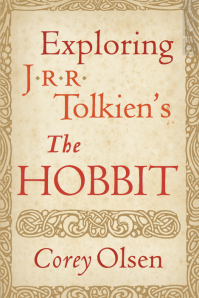
Review | Exploring J.R.R. Tolkien’s The Hobbit, Corey Olsen

exploring the hobbitI am an absolute nerd. The reason I fell in love with The Hobbit in the first place is an English class on Children’s Literature I took in university. I’d tried to read The Hobbit and the Lord of the Rings trilogy several times (my mom bought me the book box set when the LOTR movies were released), but could never get into them. Then I took the class in university and, for some reason, parsing each chapter of The Hobbit made me appreciate the story in a way I never had before. The songs that so irritated me when I was younger were revealed as powerful, telling entire histories within a deceptively simple rhymes. I learned about the similarities between hobbits and children, and that part of The Hobbit‘s appeal to young readers is the idea of a small person being capable of gigantic heroism. In that class, Tolkien’s magic finally swept me up, and led me to continue reading till Return of the King. I am late to Tolkien fandom, but I now consider the series among my favourite books of all time.

So you can imagine my reaction to Corey Olsen’s Exploring J.R.R. Tolkien’s The Hobbit. Here is an opportunity to learn from another professor, learn another perspective on this book! Olsen is well-versed in Tolkien’s body of work, and it shows — while he focuses on The Hobbit as a separate book, he also mentions various points where bits of The Hobbit are connected to Tolkien’s other books. Tolkien’s work invites a wide variety of ways to nerd out — people have studied the languages of Middle Earth, and others have studied the geography. There are even Middle Earth inspired cookbooks for culinary nerds.

Olsen’s book is a feast for literary nerds. Did you know, for example, that the version of The Hobbit we read today is not how the story was originally published? The legendary Ring that Bilbo finds in Gollum’s cave was originally just a ring of invisibility, and Gollum was originally an ancient creature who had every intention of playing the riddle game fairly and giving Bilbo the ring as a prize. Then, when Tolkien started writing Lord of the Rings, he decided to turn Bilbo’s ring of invisibility into the Ring of Power that sets off the events in the trilogy. This change meant that he had to rewrite Gollum’s character and change his motivations considerably. The story of The Hobbit itself still remained mostly intact, but Olsen points out a few tweaks that Tolkien made to the revised edition, and suggests how these revisions made the book fit more seamlessly into the entire saga.

Olsen also delves into a close reading of each chapter, pointing out significant moments in Bilbo’s character development, and analyzing the riddles and songs in the book. I love the chapter on “Riddles in the Dark,” where Olsen details how the Bilbo and Gollum’s riddles reveal not just their respective characters, but also, collectively, chart an escalating argument between light and dark, happiness and despair, life and death. I especially love how Olsen uses the songs of dwarves, elves and goblins (orcs, as they are known in Lord of the Rings) to reveal the character traits of each race.

I had a great time indulging my inner nerd with this book.  I’m not much of a Tolkien nerd, in that other than Mordor and Hobbiton, I would be hard-pressed to name any other place in Middle Earth, much less point them out on a map. So if you are a Tolkien nerd, if you know the various languages spoken in Middle Earth, for example, I don’t know if this book will tell you much that you don’t already know. But if you love reading The Hobbit over and over, and you actually enjoyed nerding out in English literature classes, I highly recommend this book. My copy is underlined, dog-eared, and full of marginal notations. It’s utterly fascinating, and above all, made me want to read The Hobbit yet again. Anyone up for an adventure?

the-hobbit-banner

+

Thank you to Thomas Allen Ltd for an advance reading copy of this book in exchange for an honest review.
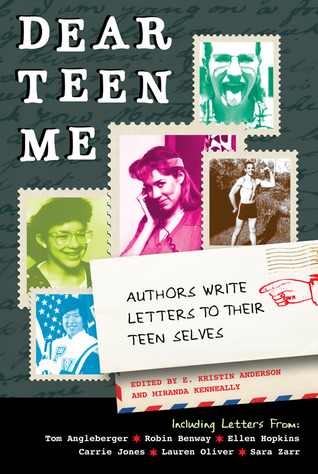
Review | Dear Teen Me, edited by E. Kristin Anderson and Miranda Kenneally

If you had the chance to write a letter to your teen self, what would you say? In Dear Teen Me, YA authors do just that. This book covers topics such as bullying, eating disorders, absentee parents, and teenage crushes. At least a couple of authors mentioned the adage that what doesn’t kill you make you stronger — in the case of Mari Mancusi, she tells her teen self, “What total BS!” Her letter is about being bullied, and her point is that life is hard enough without having to deal with the idea that being bullied can be beneficial. She’s angry at the boy who bullied her and, quite rightly, she’s angry at adults who, well-intentioned though they may be, brush away her feelings with platitudes.

Remember when you were a teen, and adults told you they knew just what you were going through because they’ve been through it themselves? Even then, you know they didn’t, really. You knew they were just trying to help, but even though they may have also gone through a breakup, a flunked test, a mean classmate, whatever, they could never understand exactly what you were feeling. However, what if that adult was you, years in the future?

Dear Teen Me is refreshingly free of the smug, platitudinal knowingness I remember seeing in adults when I was a teen. Or perhaps it’s just because in this case, knowing it all is okay. Somehow it’s easier to accept assertions like “it’ll get better” from someone who knows first hand that your life really does get better. Don’t worry about that boy turning you down; years later you really will find someone else, and you’ll be happily married to him.

Even more powerful are the letters that admit that, guess what, it does get worse. You will get a debilitating nerve disorder. The absentee father you’re jumping through hoops to impress will never notice you. That boyfriend who convinces you to have sex with him will still break up with you. These letters are mostly gentle when imparting harsh truths, because the letter writers know exactly how much it will hurt. Even better though is the message at the end of these letters — it may take years, possibly even decades, but you will survive, you will even thrive.

Reading the book, I kept hearing Kelly Clarkson’s “Stronger” running through my head, to the point that I watched it on YouTube just to get rid of the ear worm. Certainly, the authors writing to their teen selves have become stronger and wiser. Some authors observe their teen selves making mistakes and wryly comment that their teen selves aren’t fooling anyone with their attempts to be cool. Other authors observe more serious mistakes and tell their teen selves to stop — it’s not worth it. One author even told her teen self to go ahead and commit those mistakes, because they’ve shaped who she became. Through it all, however, the primary message seems not so much to be “Do this,” or even “It gets better,” but rather: I understand.

YA authors wrote the letters in this book, and I can imagine the impact this book will have in revealing that these authors grew up just as dorky and out-of-place, perhaps going through similar experiences, as their readers are. I have to admit I haven’t read most of the authors in this anthology, so I felt the impact of these letters, not as a reader discovering a human side to someone I admire, but rather as a lifelong dork reading about other lifelong dorks. There were some things in these letters I would have wanted to tell my teen self, and I’m sure other readers will also find aspects to relate to.

What would you tell your teen self? I’m not quite sure myself, but this book has certainly got me thinking. I probably will write a letter to teen me — I’ve been composing it on and off as I was reading this book. Then I’ll stick it in some journal or other, and ten years from now, write another letter to teen me. I wonder how different it’ll be.

Now to end with some Kelly Clarkson:


Review | River Dragon Sky, Justin Nicholes

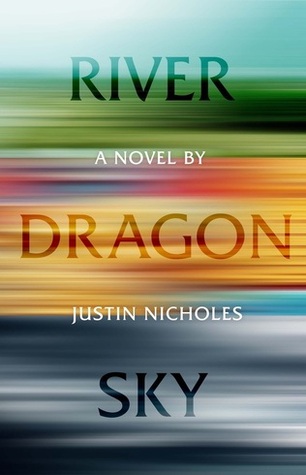
I’m a sucker for good cover art, and the cover of Justin Nicholes’ River Dragon Sky caught my attention immediately. Kudos to Justin Kowalczuk for the beautiful cover image.

In a debate over the importance of guanxi (connections, or, more specifically defined by the professor, nepotism), university student Zhuan He argues that the importance of guanxi shouldn’t even be in question — we all use it. “It is part of the human being,” she says. “You have to cut out his heart if you want to cut out guanxi.” She adds that if you ask Americans what they like about China, “they will say the Chinese are cooperative where the Americans quibble. It’s in all the textbooks.” [64% of eARC]

I include these quotes because they seem to me indicative of the general thrust of this novel. River Dragon Sky explores the connections between five characters — Zhuan He, her boyfriend Feng, Russian professor Kal (also Zhuan He’s lover), American missionary David (also Feng’s professor), and the seer Junping (who believes Zhuan He is his long-lost daughter Xiling). Their lives intersect in a web of connections — Kal for example frames David as Zhuan He’s lover, so Feng becomes insanely jealous of the wrong man; Feng becomes an obsessive stalker, yet Junping as well watches Zhuan He closely; the university is concerned over arson cases when we know fairly early on the arsonist’s identity; and so on.

Adding to the complexity of the story are shifts in time and perspective — we learn about Junping’s courtship of Xiling’s mother, as well as Kal’s history of trouble at school. Nicholes also adds cross-cultural complexity — Zhuan He, for example, knows that her classmates view her relationship with Kal as a bid to leave China, and as she says in her debate speech, “If you do [marry your coach], maybe you marry him because he can enable you to do something. Can you go abroad to study, to practice English, without guanxi?” [64%] It’s quite a lot for a novel to cover, and in the hands of, say, David Mitchell or Haruki Murakami, this tale could have been amazing. Unfortunately, in Nicholes’ hands, the story just feels disjointed, convoluted and erratic. There are a few moments of beautiful insight, and chapters that drew me in to the story, yet for the most part, I found myself either confused or detached.

A lot of it, I think, had to do with language. In attempting to create an atmosphere of great import, Nicholes veers too much into abstraction and waits too long before giving the reader something concrete to grasp. Take for example the following passage:

The memory that Junping had teased from the American was from a long time before. He sucked in a break while thinking it over. His stomach burned.

In other life, Junping had lifted a newborn’s hand to his face and pressed his lips into its palm. The smell had been sour. The child had been cradled in blankets beside a woman.

Junping stumbled back against the wall. He brought his hands up to his face because he couldn’t believe what was happening. Another ghost approached him (they had visited, shifting shapes, before), another omen come to unsettle him, to prevent him from glimpsing, when that walking stick lay in his deathbed in place of his body (the sign that he’d achieved immortality), the all-subsuming Tao.

It was a girl. She was reading the hexagrams he had drawn into the paper. He couldn’t believe it. He couldn’t believe who this was. But it was true, and it all made sense.

But why? After all these years? [5%]

The narration is probably supposed to be dramatic, building up to the big reveal about who the girl was. Unfortunately, the dramatic impact is undercut by the lack of clarity. The sentence about the ghost is a prime example of what I mean about abstraction. Nicholes injects some spirituality and horror into the narrative, but uses an overly convoluted sentence with bracketed clauses that distract more than elucidate. As well, at this point, we have no idea why Junping is so affected, or why he’s thinking of ghosts and the Tao.

It’s frustrating for a reader, and even within this passage, we still have so many unanswered questions. Who is this newborn and this woman? How can we tell when the flashback begins and ends? Where did these hexagrams come from? Who is this girl, why did she have such an effect on Junping, and what does all this have to do with the baby?

The language also gets oddly formal, or at times rather awkward, making me wonder if this is a translation (it’s not). Take for example “before he had molted the identity of Yang Dong” [5%], “Kal had revolted against his dad” [27%], and “he’d absconded with Darlene” [27%].

I don’t usually mind difficult books, but in this case, the language wasn’t compelling enough to put me under its spell, and the payoff (various revelations and insights throughout) didn’t feel significant enough to merit the self-important tone. It’s not a bad book. I did enjoy the kung fu scenes and the relationship between Zhuan He and Kal. I also found Feng’s stalker tendencies creepy and David’s attempts to stay out of the love triangle drama somewhat amusing. Overall, however, I think much could have been streamlined and clarified.

+

Thank you to Signal 8 Press for an eARC of this book in exchange for an honest review.