
Review | S.E.C.R.E.T., L. Marie Adeline (Preview Sample)

Given the fervor for the erotic genre, was it possible to write a book that was first and foremost a smart and engaging novel and, second, erotically charged? And if someone wrote that in the current publishing climate, would readers respond?

[Letter from Doubleday Canada that came with the sneak preview uncorrected proof]
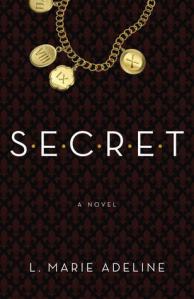
16099174Admittedly, my experience with erotic fiction is very limited. I suppose I’ve always viewed erotic fiction with Anne Rice’s frame of mind. In the introduction to The Claiming of Sleeping Beauty, she writes that she wastes no time in getting to the sexual content: “every page is meant to give you pleasure.” The classic Story of O establishes the mood of sexual desire from the very first page. So when I read the promotional letter about S.E.C.R.E.T., my initial reaction was to wonder, perhaps naively, how an author who set about making the eroticism second priority could differentiate her book from a racy Harlequin romance.

“No judgments. No limits. No shame.” What if you could have your every sexual fantasy fulfilled, in a safe, supportive environment where the men are hot and you are in total control? For shy, awkward waitress Cassie Robichaud, the idea is too wild to even contemplate — and yet too tempting to pass up. The premise of S.E.C.R.E.T. sounds very erotically charged, but the book itself lives up to its promise to put the story first. The story opens with Cassie observing the people at the cafe where she works, and reflecting on her fourteen year marriage to an angry drunk:

Waitresses are adept at reading body language. So are wives who’ve lived under the same roof as an angry drunk. […] And yet whenever I tried to turn that skill on myself, to anticipate my own needs, I couldn’t. [p. 1]

When it comes to sex, Cassie hasn’t had any in five years. She calls her vagina “down there” because it seemed the only appropriate term when by yourself — to the author’s credit, this hesitation on Cassie’s part arouses sympathy rather than irritation. This is a woman who calls a red dress “brave” and is so shocked at reading about a woman having two men at the same time that she immediately slams the book shut. So when S.E.C.R.E.T., a society of women who help other women achieve sexual fulfillment, reaches out to Cassie, you can’t help but cheer her on. As one of the members of S.E.C.R.E.T. says, “We definitely found the right candidate in you. You can’t even say the word [fantasies]!” [p. 70]

As far as the erotica goes, S.E.C.R.E.T. is beyond vanilla, and fittingly so. The sampler I got included only the first fantasy (Cassie will have a total of nine fulfilled), and featured “a lanky, good-looking man” with “puppy-dog brown eyes.” Despite an intro straight out of a porn movie, the fantasy scene is ultimately rather sweet.

I covered my face with my hands.

“I can’t believe this is happening.”

“It is. This is all for you.”

[…] The contact felt amazing. His hands on my thirsty skin. How long had it been since I’d been touched, let alone like this? I couldn’t even remember. [p. 74]

It’s the ultimate fantasy, isn’t it? The kind, considerate, handsome man who tells you you’re beautiful, who asks you exactly what you want, and who you know will stop at the slightest hint that you want him to. There is no romance in this scene — we don’t even know the man’s name — yet there is much romancing in it. It’s a lovely scene, and Adeline does a masterful job in showing just how much such small gestures mean to Cassie.

There are moments when I wondered if Adeline was poking fun at Fifty Shades, most notably with Five Years. It’s been five years since Cassie has had sex, and she calls her celibacy a “skinny old dog […] Five Years came with me everywhere, tongue lolling out, trotting on its toes.” [p. 3] I seriously hope the author meant that as a jibe against Anastasia Steel’s inner goddess rather than a serious attempt at metaphor, because seriously? Five Years the dog? He’s mentioned again a couple of times later on, and at one point I had to go back to check that Cassie wasn’t referring to an actual dog.

From the 81 page preview, this book definitely shows promise. Cassie still has eight fantasies to go through, and I believe they’ll just get more and more erotically charged as she becomes more open to her sexuality. There’s a hint of potential romance for Cassie with another character, but from the preview, the focus is clearly on her and her alone. She’s a sympathetic figure, and I look forward to seeing her regain her confidence and sense of identity through S.E.C.R.E.T.

+

NOTE: I received the sneak preview for this book before the holidays, and had originally scheduled the review for the release date in February. I just received the final book in the mail today, and am delighted at the opportunity to find out more about Cassie’s story. So I’ve decided to bump up this post a couple of weeks, and let you all in on the S.E.C.R.E.T. a bit early as well!

Interested in finding out more? The preview I just reviewed (Step I of S.E.C.R.E.T. / first fantasy fulfillment) is now available online at the book’s website! Check it out here. And if you want to keep reading Cassie’s experience with Step II (second fantasy fulfillment), check it out here.

Stay tuned for my review of the full book in February!

+

Thank you to Random House Canada for the uncorrected proof preview of this book in exchange for an honest review.

Review | Mr. Penumbra’s 24-Hour Bookstore, Robin Sloan

9780374214913Mr. Penumbra’s 24-Hour Bookstore is my book soulmate. Seriously, if ever a book were to combine all the elements that would make me fall in love with it, this is it.

The title alone is enough to hook me, and, I suspect, any fellow book lover. The idea of a bookstore open 24 hours sounds like heaven. And no, online retailers don’t count — sure you can download an ebook or order a print book at any time, but there’s a magic to actually being in a bricks and mortar place. And Mr. Penumbra’s store in particular has the musty, old book charm that makes me want to spend hours in it.

Even better, Penumbra’s store is an indie! Bookseller protagonist Clay is used to customers asking for book recommendations, then leaving to buy it on their e-reader. As a bookseller at an indie myself, I could relate, and the scene where author Robin Sloan creates a clever reversal of this scenario made me as baffled and overjoyed as it did Clay.

I’m an avid mystery reader, and Sloan teases his reader with a creepy, utterly compelling one: What books are in the dark stacks Clay is forbidden to read? Who are the customers who come in the dead of the night to return a book to those stacks and pick up a new one? I was definitely hooked. Where would the author take this?

To his credit, Sloan completely blindsided me. When I think of a book about an indie 24-hour bookstore, with mysterious leather-bound tomes taken out in the dead of the night, I have a certain type of storyline in mind, and I bet you do too. So it took me completely by surprise when Sloan introduced a digital element — 3D mapping, Google search capabilities, computer wizardry — and somehow managed to make it all work with the mysterious, musty atmosphere of the old-fashioned bookstore. I admit, as a total book and mystery geek who also happens to be a tech geek, all I could think was, this book was tailor made for me.

Too often, the divide between the physical and the digital, the old school and the new, is posited as a one or the other type deal. You’re either a print book person or an ebook person, someone who appreciates the handwritten card or someone who loves the 3D IMAX 42fps type movie. Obviously, reality is rarely so clearcut, but in books at least, I usually find either nostalgia for the way things were or all out Cory Doctorow-style techno-geekery. To have both so seamlessly in one book just blew me away.

To be honest, the reason behind the mysterious customers disappointed me at first. On one hand, it would’ve been really difficult for any author to come up with an explanation impressive enough to live up to amazing build up, but then again, it also made me feel like Sloan settled for safe, overdone Dan Brown territory. Not a spoiler — Mr. Penumbra has nothing to do with Mary Magdalene, but the customers are using the books to search for something, and the object of their search disappointed me. Sloan reverts to a classic trope, and after having build such an exciting, esoteric world, the familiar was a letdown.

But then, again Sloan surprises me. And again, it’s with his masterful integration of the digital with the physical. The object of the customers’ search may be overdone (in my view, at least), but the combination of ways in which Sloan makes his various characters conduct this search is highly original. The final answer is highly original as well, and quite frankly, brilliant. Bravo, Mr. Sloan — you’ve blown me away.

I am in love with this story. I love that it manages to bring together so many things I love, including science fiction and fantasy, an absolutely awesome romance, even typography and design! My copy is filled with underlined text, marginal notations, and at the very end:

Posted on Instagram 26 Sept 2012

Sometimes, words aren’t enough.

+

Thank you to Harper Collins Canada for an advanced reading copy of this book in exchange for an honest review.

[Note: If you live in the US, your edition of Penumbra has a glow-in-the-dark cover!]

Review | Son (The Giver #4), Lois Lowry

lowry23cutI can’t even begin to explain how much this book means to me. Lois Lowry’s The Giver changed my life when I was 14 (see story here), and reading Son feels like coming full circle. One of the reasons The Giver resonated so much with me is that I read it when I was fairly close to the age of its protagonist Jonas. So you can imagine the chill I got when, reading Son at 29, I realized that I must again be fairly close to the age of Jonas in this story. I’ve grown up with these books, and reaching the end of this series feels, in many ways, like ending a chapter in my own life. Son is a far more adult, far more sombre book than The Giver, or perhaps I have just grown up. [Minor warning: there will be spoilers about The Giver in this review.]

Son brought me to tears. From the very first line: “The young girl cringed when they buckled the eyeless leather mask around the upper half of her face and blinded her,” Son transported me right back into Lowry’s world, but a much darker, more frightening one than what I remember from The Giver. The “young girl” is Claire, fourteen years old, assigned to be a Birthmother. I can’t imagine being a mother at fourteen; worse, I don’t even want to imagine being twelve and being told that the only thing I have left to do in life is create a set number of babies, then retire.

Despite its title, Son is really about a mother, Claire. Her son is Gabe, the baby in The Giver who wasn’t performing at par with his age group and so had to be “released” (killed). At the end of The Giver, however, Jonas takes Gabe with him when he leaves town. Here’s the thing: as Gabe’s Birthmother, Claire isn’t supposed to see him again after birth — she wasn’t allowed to hold him, or even know his gender. Instead, she’s supposed to take pills to numb the pain of loss.

I’m not a mother, and I can’t even begin to imagine how that would feel. I have, however, lost my own mother recently, and that may be partly why Claire’s story resonated so strongly with me. I almost cried, and I also wanted to cheer, at the Claire’s resolution not to take the pills: “She would rather die, Claire realized, before she would give up the love she felt for her son” [page 116]. When Jonas takes Gabe away with him, Claire follows, and her quest, even though it’s just to a simple fishing village, felt powerful. Lowry’s way with words is nothing short of magic, making Claire’s journey feel as epic as a Tolkien narrative. Take for example the following conversation:

“It will be a long time,” he told her, “to make you ready.”

“I know.”

“Not days or weeks,” he said.

“I know.”

“Mayhap it will take years,” he told her. “For me, it was years.”

“Years?”

He nodded.

“How do I start?” Claire asked. [p. 209]

The language is that of fairy tales and legends. Lowry takes something as ordinary as the love of a mother for her son, and reveals just how extraordinary it really is.

In her speech at Book Expo America 2012 about Son, Lowry says that she wrote The Giver as a response to a question from her own son, a soldier who died in battle, who’d asked her why evil exists in the world. She had no answer. But evil does exist in Son, and while Claire faces evil, it will ultimately be up to her son Gabe to defeat it.

Evil, in Son, takes the form of the Taskmaster, who promises to fulfill a wish, but will require payment of your most valuable asset. In some people, payment will take the form of their kindness, in others, youth. And generally, whatever they receive turns out not to be worth what they gave up. The Taskmaster is a classic figure in literature, and with her simple, lovely language, Lowry makes us feel just how much is at stake here.

We do meet Jonas again; he is an adult now, and his new perspective of the world reminds me of just how much I’ve grown myself since I first began these stories. Son feels both epic and personal, and reading it is just an overwhelming experience. We want the Taskmaster to be defeated because, even though we know it’s fiction, even though we know evil will always exist in the real world, Lowry has immersed us so much in her world that whatever the outcome there is, it matters. Call it superstition, call it sentimentality, but I couldn’t help feeling that if only Gabe defeats the Taskmaster, perhaps a bit of the evil in the real world can also be defeated. Unrealistic yes, but Lowry’s words have a way of bringing out the child in her readers, the child that still believes in hope.

Son is probably one of the most powerful books I’ve read all year. The Giver changed my life as a child. Son brought me back to who I was — and in many ways, felt like the end of a chapter in my own life. Has reading Son changed me as an adult? Possibly, but unlike my experience with The Giver, I can’t even begin to tell you how.

Lois Lowry’s amazing, heartbreaking speech at Book Expo America 2012:

Evil does exist, it has always existed, and we will fight it again and again. And in every generation, it is the young who come forward and try to bring an end to it. It’s fiction, of course, the happy ending… [But] young people, young readers believe they can fix the world.

+

Thank you to Thomas Allen Ltd for an advance reading copy of this book in exchange for an honest review.

[All quotes and page numbers from Son in this review are from the Advance Reading Copy.]