
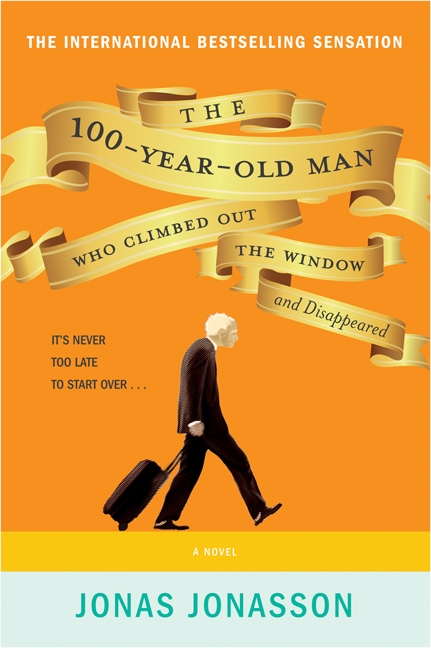
Review | The 100-Year-Old Man who Climbed Out the Window and Disappeared, Jonas Jonasson

9781443419109Jonas Jonasson’s The 100-Year-Old Man who Climbed Out the Window and Disappeared is about… Well, the title says it all, doesn’t it? Allan Karlson escapes the nursing home just before the party for his 100th birthday and, on a whim, steals a suitcase at the bus terminal. Unfortunately for him, the suitcase contains a lot of cash, and this leads to a hilarious, utterly absurd chase that involves a hot dog stand operator, an elephant and a lot of unexpected twists.

We also learn about Allan’s life before the nursing home. This is where the comparisons to Forrest Gump come in — like Forrest, Allan is involved in a wide range of historical events, meeting such historical figures as Mao Tse-Tung (and his wife!), Stalin, Kim Jong Il and several US presidents. Like Forrest, Allan is unaware of the massive influence of these figures on world politics, but unlike Forrest who really is an innocent, Allan is an apolitical explosives expert. He knows how to blow things up, and he doesn’t care how his skills are used. This isn’t meant to imply that he’s a cold-hearted man who sells his skills to the highest bidder, but rather that he mostly just wants to be left alone playing with his explosives, and yet the world just won’t leave him alone. Take for example this episode with an immigration officer:

And the more the immigration officer got out of Allan, the less fascistic the Swede seemed to be. He wasn’t a communist either. Or a national socialist. He was nothing at all, it would seem, other than an expert on explosives. As for the story of how he came to be on first-name terms with General Franco, it was so ridiculous that it had to be true — he could hardly have made it up.

Since he had no better ideas, the senior immigration officer arranged for Allan to be locked up for a couple of months. Unfortunately, the months turned into years, and the immigration boss mostly forgot about Allan, until one day he found himself discussing the case with his brother when they met at the family farm in Connecticut for Thanksgiving. [p. 102]

The novel is hilarious, but as seen in the passage above, Jonasson’s humour is dark, at times satiric, and at others even disturbing. Allan’s life is filled with misadventures and random streaks of good luck, and it’s mostly Allan’s nonchalance at everything that keeps the story humorous rather than tragic. Jonasson’s writing as well has a sharp bite — dramatic incidents are immediately undercut by quick quips and mundane things are inflated to absurdity.

100-Year-Old Man is a fun, quirky read. Some parts dragged, and even though the ARC I received is less than 400 pages long, at times, the book felt longer. Then again, with 100 years to cover, the story is understandably packed with events. Still, I love Jonasson’s humour, and I enjoyed seeing history through Allan’s eyes.

+

Thank you to Harper Collins Canada for an advanced reading copy of this book in exchange for an honest review.

Review | Speaking from Among the Bones, Alan Bradley

coverThe fifth in Alan Bradley’s Flavia de Luce series begins with blood. An image of John the Baptist’s head in Salome’s hand looms over the pulpit at St. Tancred’s in full colour stained glass. The narrator muses on the vicar’s words, that “in Old Testament times, our blood was taught to contain our lives.” [p. 4] One can almost see the darkened church and hear the portentous music.

Suddenly, the narrator’s reflections on the gory image are cut off:

Of course!

Blood!

Why hadn’t I thought of this before?

“Feely,” I said, tugging at her sleeve. “I have to go home.” [p. 4]

Last spring, the news broke that the Flavia series has been optioned for TV movies, and with such an opening, it’s easy to see why. The rapid switch in mood is comedic gold, and you can just see it on screen as the introduction to this week’s adventure with a beloved series character.

Speaking from Among the Bones is classic Flavia fare. A dead body is found inside the tomb of the village saint, and Flavia, who is “almost twelve” in this instalment, is once more on the case. The mystery itself isn’t my favourite among Bradley’s books, though that may just be a personal preference for Christmas, filmmaking and Shakespeare over archaeology, botany, and a long-lost jewel. There were also moments when Flavia’s taste for the grotesque felt a bit much — more grating than endearing. For example:

Dangerous killers on the loose! The words which every amateur sleuth lives in eternal hope of hearing.

[…] “A matter of life and death!” That other great phrase! Perhaps even greater than “dangerous killers on the loose.”

My cup of crime runneth over, I thought. [p. 306]

Such passages remind me of how young Flavia is, and when used too often, can make her seem callous. That being said, Bradley counteracts these reactions with thoughtful passages that reveal how shaken Flavia is by the murders. For example, a careless remark that “Feely will simple die.” leads Flavia to think about the murder victim and how he died. “Nothing simple about that,” she thinks. “Nobody ever simply dies.” [p. 271] It’s a sobering thought, and one that reveals much more than it purports to.

I probably learned the most science from this book, than from the rest of the series. Did you know, for example, that “blood from the arteries has more oxygen and less nitrogen, while blood from the veins is the opposite”? [p. 285] It is to Bradley’s credit that Flavia’s lecturing never feels boring or unnecessary. And then there are the lovely observations that reveal how magical science can be. For example, did you know seeds from hundreds of years ago can still be planted and grown?

“A seed is a remarkable vessel,” he told me. “Our one true time machine. Each of them is capable of bringing the past, alive, into the present. Think of that!” [p. 77]

Flavia’s family is central to this novel as well, with the mystery of the saint tied closely to whether or not Flavia’s father will be able to keep the Buckshaw estate. Flavia’s sister Feely is reaching marriageable age, and I love her developing romance with Dieter, who “has nothing to offer but love.” [p. 65]

Long-time Flavia fans know her insecurities about her mother Harriet, who disappeared when Flavia was a baby. Flavia’s sisters enjoy teasing her about how much Harriet hated her, and how Flavia is barely like Harriet at all. In this book, there’s an absolutely lovely scene in the middle of the book where Flavia’s father speaks to her about her mother. I won’t post an excerpt here, because I want you to experience the full impact of reading the scene for the first time within the context of the novel. It’s a lovely, revealing moment, only a couple of pages long and sandwiched between more action-packed scenes, but it moved me to tears.

Flavia fans will enjoy this novel, but I will recommend new readers to begin with an earlier book in the series. Elements in this story delve deep into the characters and while even new readers may understand what’s going on, I think I Am Half-Sick of Shadows (Book 4) sets up the family dynamic much more comprehensively, and will set up a better appreciation of the events in this book.

A final note: the ending. Oh my god, the ending. A handwritten note from Lindsey at Random House Canada warned, “P.S. Ainsley said the ending was crazy!” And, well, yes it is. Particularly the last line. Talk about a cliff-hanger! Part of me is annoyed at Bradley taking the episodic serial TV format a bit too far, but really, all I want is even more Flavia de Luce. When is Book 6 coming out again?

+

Speaking from Among the Bones will be on-sale January 29.

+

Thank you to Random House Canada for an advanced reading copy of this book in exchange for an honest review.

(Full disclosure: As with all Flavia books, when I received this ARC, I squee’d even before I began reading it. Flavia fans will understand why. 😉 )

Review | Swimming Home, Deborah Levy

978-1-77089-332-0_lNominated for the 2012 Man Booker Prize, Deborah Levy’s Swimming Home sounds like a book I would enjoy. British families on a vacation have their lives disrupted by a disturbed young woman, Kitty Finch, who happens to believe she has a deep, emotional connection to one of the family members, a famous poet. Kitty’s arrival of course brings to light some disturbing fissures in the happy family facade, as well as attracts the fascinated attention of the daughter of the family, who sees Kitty’s effect on her parents.

There’s an undercurrent of menace throughout the slim volume, and as the depths of Kitty’s obsession are revealed, the author just keeps raising the tension levels. The entire story takes place in a week — it’s an intense ride, and while we know how part of it at least is going to turn out, Levy maintains the tension.

It’s a very subtle novel, the narration flitting about between characters and hinting at much more than the actual text portrays. There were moments that really struck me, such as Kitty’s poem, but overall, I found myself unmoved. The subtlety may work for certain types of readers, and I’m sure there are those who’ll see much more in it than I did. However, it didn’t work for me. The emotions and motivations of some characters confused me, and the characters themselves were too obscure for me to care enough to struggle to understand. The final chapter as well, set years in the future, seemed to me unnecessary.

+

Thank you to House of Anansi for an advance reading copy of this book in exchange for an honest review.