
Review | An Echo Through the Snow, Andrea Thalasinos

13122120Last spring seemed to be my season of dog books. I read and reviewed both Puppy Love and A Dog’s Journey, both novels that, like The Art of Racing in the Rainspeak about the bond between a dog owner and their pet. Andrea Thalasinos’ An Echo Through the Snow depicts a different kind of human/dog relationship by exploring the world of competitive dogsled racing.

Rosalie is stuck in dead end jobs and a horrible life until she meets Smokey, an abused guard dog she takes under her protection. Being placed in a position of responsibility over someone else forces Rosalie to mature, and more importantly, leads her to discover a sense of purpose and a job helping a local couple train dogsled teams.

The bond between Rosalie and Smokey is touching, but it’s interesting to see the difference in dynamic with human characters and the dogsled team. Despite the clear affection, the dogs are primarily there to be trained, and to work as a team, rather than to provide companionship to their owners. As such, there is less anthropomorphizing in this book, as well as more focus on the human characters’ stories. I found myself caught up in Rosalie’s story — painfully shy, troubled, and dealing with an abusive husband, Rosalie is a sympathetic figure, one who grows and develops through her experiences with the dogsled team. Apart from an unnecessary (in my opinion) plot twist, this storyline is well done, and one I think Thalasinos should have spent more time developing.

Less successful, in my view, is the parallel storyline, of a Chukchi woman named Jeaantaa, Keeper of the Guardians (Siberian huskies), who lives around the time Stalin’s Red Army is about to invade her land and displace her people. This storyline had promise and a compelling beginning — Jeaantaa is dealing with the death of her childhood sweetheart and so devotes herself to her role as Keeper to her community’s dogs. The future security of these dogs, however, is placed in jeopardy, and she then has to fight to protect them.

A promising beginning, but one that unfortunately failed to maintain the momentum. It may be because of the constant switching between story lines without any sense of real connection, such that it felt like I was reading two separate books put together in a rather slapdash fashion. Or perhaps I just found Rosalie’s storyline more interesting. Jeaantaa’s story just seemed disjointed, and less interesting than I’d hoped. I wish Thalasinos had developed the storyline in more depth and revealed more about the Chukchi people and how the community felt about the impending threat to their way of life. This could have been a rich, evocative historical piece, but as it is now, I just wish Thalasinos had done away with this storyline and focused completely on Rosalie instead.

An Echo Through the Snow is a different kind of dog book, one that keeps the focus wider than the bond between a human and her dog. The Jeaantaa story line could have been more interesting, and the Rosalie story line definitely did not need that plot twist, but overall, an interesting read for dog lovers.

+

Thank you to Raincoast Books for an advance reading copy of this book in exchange for an honest review.
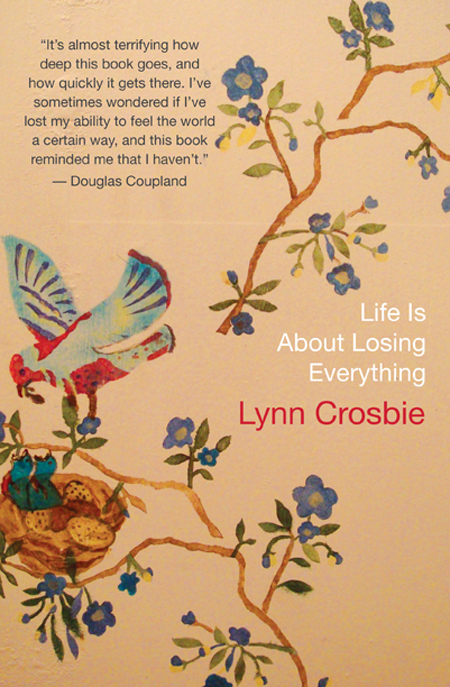
Review | Life Is About Losing Everything, Lynn Crosbie

978-1-77089-003-9_lIn Doug Coupland’s blurb to Lynn Crosbie’s Life is About Losing Everything, he comments that “it’s almost terrifying how deep this book goes, and how quickly it gets there.” The book is certainly intense, a blend of fact and fiction about a time period in the author’s life. I made the mistake of beginning it after a rather bad day, and after the first few chapters, had to stop because it was too depressing. Then again, with a title like that, what did I expect, eh?

To be fair, I think Crosbie’s book will strike a certain kind of reader as utterly beautiful, poignant and heart wrenching. It just didn’t work for me. (That’s not just because of my first, aborted attempt at reading it. I did give it another couple of tries before giving up. Full disclosure: I did not finish the book. I did try, but ultimately I decided to move on.)

The book saunters from vignette to vignette, some chapters in the form of lists, others more straightforward narrative. The story wanders, as if we had a glimpse right into the mind of the author as she thinks first of one memory and then another, and then perhaps doubles back to an earlier event, and so on. It’s not an easy read — the writing is soaked in bitterness and anger. Crosbie’s style is just sharp and biting enough to avoid being whiny, but hell, this novel cuts deep.

There’s a fine line between raw emotion and self-indulgence, and to my mind, this book crossed that line. The randomness of the vignettes, and the slapdash nature in which they were compiled added to the feeling that despite the hodgepodge of episodes, they all began to sound equally bitter. Blogger Buried in Print says that rather than the traditional beginning, middle and end narrative, Life is “all middle.” This maintains just that intensity that Crosbie is clearly going for, and is perhaps the reason other book reviews recommend dipping into Life a bit at a time rather than in one sitting.

Crosbie’s writing is tight and with a definite bite. However, the format of the book just didn’t work for me, and I ended up realizing that I simply didn’t care what other horrible, depressing slice of life was going to be revealed next.

+

Thank you to House of Anansi for an advance reading copy of this book in exchange for an honest review.

Review | Calling Dr. Laura, Nicole Georges

When Nicole Georges visits a psychic for her twenty-third birthday, she finds out that the father she’s always believed to be dead is actually alive. Now, having grown up in a family of secrets and lies, Nicole considers the need to confront her mother about two things: the identity of her father, and the fact that Nicole is gay. The back blurb compares Nicole Georges’ Calling Dr. Laura to Alison Bechdel’s Fun Home, and while Georges lacks Bechdel’s sly humour, she also doesn’t get bogged down by Bechdel’s philosophizing. The result is a straightforward, rather earnest, heartfelt narrative.

Georges highlights the difference between her adult life and her childhood memories through her drawings — her life in her twenties is sketched with realistic detail, while her flashbacks to her childhood are sketched in simple, stylized shapes such as a child might draw. This shift in style highlights the child Nicole’s innocence, and thereby emphasizes the pain such a figure must undergo, watching her mother being abused by various husbands. I especially love Georges’ use of this technique in a scene where the adult Nicole has a particularly devastating piece of information confirmed, and the character shifts back to the child version for two panels, before shifting back to adult mode.

The Dr. Laura in the title actually plays less of a role in the narrative than I expected. Pressured by her girlfriend to confront her mother, Nicole finally calls Dr. Laura Schlessinger for advice. The author has included bits from the actual transcript of their conversation in the memoir, and while the radio personality seemed harsh, it seemed to be the tough love Nicole needed.

Georges does a good job illustrating the atmosphere of stress and deceit in which she grew up. She relates incidents such as stress-related bowel irregularities that lead to an embarrassing situation with a friend, conspiring with her mother to skip school as long as her stepfather never found out, and having to call 911 when her stepfather tried to strangle her mother. As she later points out, even whens he discovered her biological father was still alive, her experience with fathers hasn’t given her much incentive to find him. She struggles not just with the fear of confronting her mother, which comes hand in hand with her coming out to her mother as well, but also with the fear of meeting her biological father. The simplicity of Georges’ narrative enhances the emotional impact of her decisions; she is thoughtful without becoming too introspective. While her tone felt at times too flippant, it’s an understandable way to cope with her fear, and adds realism to her narrative.

Calling Dr. Laura is a touching tale of growing up, of coming out and of trying to make sense of one’s family. The biggest emotional wallop is reserved for the end of the book. Like the rest of the book, it is heartfelt but rendered with understated precision. It’s telling that Nicole feels most free to talk about her concerns over the phone with a radio personality or over email with loved ones. The medium provides a comfortable layer of protection, yet what comes through most strongly is Nicole’s vulnerability. Calling Dr. Laura is a sweet, simple story, surprising in how much it can reveal through so little. Well done.

+

Thank you to Thomas Allen Ltd for an ARC of this book in exchange for an honest review.