
How can I even begin to describe what an emotional wallop this book is? Ever since the success of We Need to Talk About Kevin, other authors have tried their hand at school shooter stories, and stories of teenagers who don’t fit in are a dime a dozen. Matthew Quick’s Forgive Me, Leonard Peacock however stands out — not only does the author succeed in portraying a despair so deep one actually feels what drives Leonard Peacock to take a gun to school, but he also manages to keep Leonard fully, vulnerably, human.
When we think of school shooters, we imagine either complete psychopaths like Kevin, or emotional wrecks who can’t take it anymore. Instead, Quick creates a quiet, troubled young man whose motivations for committing murder-suicide are far more complex than simply his pain at being an outcast. The book works because of its subtlety and humour; its very restraint creates emotional impact.
It is Leonard Peacock’s eighteenth birthday and he will be taking his grandfather’s P-38 WWII Nazi handgun to school so he can kill his best friend and then himself. As the novel begins, the handgun lies beside Leonard’s bowl of oatmeal “like some weird steampunk utensil anachronism.” He takes a photo with his iPhone, “thinking it could be both evidence and modern art.” Then, he tells us,
I laugh my ass off looking at it on the mini screen, because modern art is such bullshit.
I mean, a bowl of oatmeal and a a P-38 set next to it like a spoon — that arrangement photographed can be modern art, right?
Bullshit.
But funny too. [p. 1]
In the space of its first few paragraphs, the book already manages to convey so much. The horror of the handgun is set beside a bowl of oatmeal, possibly one of the most innocuous objects in the world. The incongruence is troubling, and Leonard’s amusement at the image reflects his bleak outlook. His thoughts on the modern art being bullshit hint at a larger disenfranchisement with the world, and even though he laughs, one already begins to wonder at the pain beneath his words.
Before Leonard shoots his best friend, however, he plans to give gifts to four very special people in his life — his Humphrey Bogart-obsessed neighbour Walt, his classmate Baback who is a talented violin player, the Christian homeschooler Lauren whom Leonard has a crush on, and high school teacher on the Holocaust Herr Silverman. Even more than his plan to shoot, it is Leonard’s interactions with these four that form the heart of the book. Each encounter holds the potential for Leonard’s salvation — not in a religious sense, but certainly in an emotional, somewhat spiritual one. Each time Leonard gives a gift, even though he tells us it’s only so they can remember him after his death, we feel his need for connection, and we sense that he’s yearning for something from each of these friends that he may not be able to define, but if received, may make him change his mind.
These scenes therefore become more painful, because we initially see the relationships only through Leonard’s eyes, and it is only when he offers his gifts that we — along with Leonard himself — are treated to the reality of how each of these friends sees him. While some may offer some hope for actual connection, others spurn him, in a way that almost seems cruel until we realize how Leonard’s actions must seem from their point of view. Quick immerses us into Leonard’s psyche, but not so deep that we can’t see the reality of who he is to other people, and while we sympathize with him, we can’t help but sympathize as well with those who maintain their distance.
The major standout in this book is Herr Silverman. Everyone should have an Herr Silverman in their lives. Here is a teacher who goes far beyond the call of duty for his students; here is a man who genuinely cares about other people, and is willing to go out of his way to make sure you are all right. His story made me cry, and as for his scene with Leonard near the end… It moved me. I can’t even express how emotional I got reading that scene, partly I think because I have become so embedded within Leonard’s psyche, but also because I realize how much the world needs more Herr Silvermans in it, and how much everyone should be so lucky as to encounter a Herr Silverman at least once in their own lives. In a book where the protagonist has built such rigid walls of defence, to the point that he can look at a handgun and laugh, Herr Silverman’s presence is a welcome reminder that no matter how bad the world seems, it will never be all bad.
Reading this book is a profoundly moving experience. I rarely say this, but I already wish there was a movie adaptation, with Ezra Miller playing Leonard Peacock, because he’s the only actor in that age group I can think of who has the ability to portray both Leonard’s darkness and vulnerability. I tweeted my wish for a movie, and Matthew Quick himself responded that one is already in the works:
I’m keeping my fingers crossed!
+
Thank you to Hachette Book Group Canada for an advance reading copy of this book in exchange for an honest review.

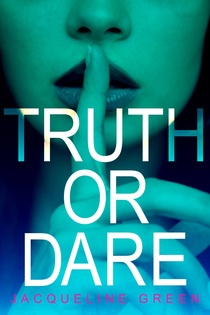 Jacqueline Green’s Truth or Dare takes the concept of I Know What You Did Last Summer and Pretty Little Liars to the small seaside town of Echo Bay. Artsy outcast Sydney Morgan and pretty, popular childhood BFF’s Caitlin Thomas and Tenley Reed receive mysterious dares containing hints to long-kept secrets. As with any self-respecting horror thriller, the attempt to keep these secrets hidden only leads to the need to keep even more secrets, and the girls’ lives quickly spiral into a seemingly never ending loop of jealousy and betrayal.
 Literary Treats