
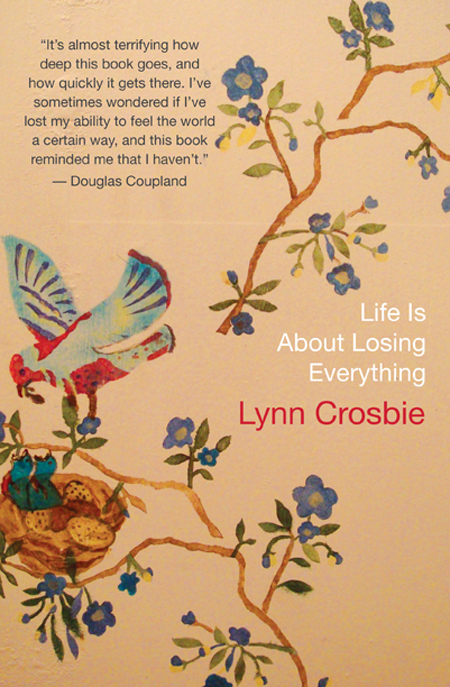
Review | Life Is About Losing Everything, Lynn Crosbie

978-1-77089-003-9_lIn Doug Coupland’s blurb to Lynn Crosbie’s Life is About Losing Everything, he comments that “it’s almost terrifying how deep this book goes, and how quickly it gets there.” The book is certainly intense, a blend of fact and fiction about a time period in the author’s life. I made the mistake of beginning it after a rather bad day, and after the first few chapters, had to stop because it was too depressing. Then again, with a title like that, what did I expect, eh?

To be fair, I think Crosbie’s book will strike a certain kind of reader as utterly beautiful, poignant and heart wrenching. It just didn’t work for me. (That’s not just because of my first, aborted attempt at reading it. I did give it another couple of tries before giving up. Full disclosure: I did not finish the book. I did try, but ultimately I decided to move on.)

The book saunters from vignette to vignette, some chapters in the form of lists, others more straightforward narrative. The story wanders, as if we had a glimpse right into the mind of the author as she thinks first of one memory and then another, and then perhaps doubles back to an earlier event, and so on. It’s not an easy read — the writing is soaked in bitterness and anger. Crosbie’s style is just sharp and biting enough to avoid being whiny, but hell, this novel cuts deep.

There’s a fine line between raw emotion and self-indulgence, and to my mind, this book crossed that line. The randomness of the vignettes, and the slapdash nature in which they were compiled added to the feeling that despite the hodgepodge of episodes, they all began to sound equally bitter. Blogger Buried in Print says that rather than the traditional beginning, middle and end narrative, Life is “all middle.” This maintains just that intensity that Crosbie is clearly going for, and is perhaps the reason other book reviews recommend dipping into Life a bit at a time rather than in one sitting.

Crosbie’s writing is tight and with a definite bite. However, the format of the book just didn’t work for me, and I ended up realizing that I simply didn’t care what other horrible, depressing slice of life was going to be revealed next.

+

Thank you to House of Anansi for an advance reading copy of this book in exchange for an honest review.
Review | Swimming Home, Deborah Levy

978-1-77089-332-0_lNominated for the 2012 Man Booker Prize, Deborah Levy’s Swimming Home sounds like a book I would enjoy. British families on a vacation have their lives disrupted by a disturbed young woman, Kitty Finch, who happens to believe she has a deep, emotional connection to one of the family members, a famous poet. Kitty’s arrival of course brings to light some disturbing fissures in the happy family facade, as well as attracts the fascinated attention of the daughter of the family, who sees Kitty’s effect on her parents.

There’s an undercurrent of menace throughout the slim volume, and as the depths of Kitty’s obsession are revealed, the author just keeps raising the tension levels. The entire story takes place in a week — it’s an intense ride, and while we know how part of it at least is going to turn out, Levy maintains the tension.

It’s a very subtle novel, the narration flitting about between characters and hinting at much more than the actual text portrays. There were moments that really struck me, such as Kitty’s poem, but overall, I found myself unmoved. The subtlety may work for certain types of readers, and I’m sure there are those who’ll see much more in it than I did. However, it didn’t work for me. The emotions and motivations of some characters confused me, and the characters themselves were too obscure for me to care enough to struggle to understand. The final chapter as well, set years in the future, seemed to me unnecessary.

+

Thank you to House of Anansi for an advance reading copy of this book in exchange for an honest review.

Review | Puppy Love, Frauke Scheunemann

What a charming, adorable book! Frauke Scheunemann’s Puppy Love not only has the cutest cover art ever, it also has an utterly adorable (no other word for it!) plot. Fans of Enzo from Garth Stein’s Art of Racing in the Rain or Chance, Shadow and Sassy from Homeward Bound will fall in love with Hercules, or, as he much prefers to be called, Carl-Leopold Von Escherbach. A dachshund who lacks the pedigree for his original, dog breeding family, Hercules is rescued from the animal shelter by Caroline, a violin maker who smells “like a beautiful summer’s day.”

Caroline is a wonderful, sweet human, but, Hercules realizes, she has horrible taste in men. Her boyfriend Thomas is a jerk, and he hates dogs, so Hercules decide to find her a new, more suitable mate. He is aided by Mr. Beck, an old, fat cat and expert in human behaviour.

Puppy Love is charming, and I fell in love with Hercules from the very first chapter. He deals with a bully at the animal shelter thus:

‘I don’t believe,’ I retort with as much dignity as I can muster under these adverse circumstances, ‘that this establishment takes reservations. I was here before you, so I will lie down on this spot. Kindly allow me to do so.’ […] He has surely never encountered such civil resistance. I stretch out contentedly.

It’s the dignity part that got me. I couldn’t help but picture this cuddly little dachshund with his nose in the air like the butler Stevens from Remains of the Day. Go Hercules go!

The novel falters a bit for me in the latter scenes where Hercules and Mr. Beck scheme to find Caroline a man. They are certainly comic, but at times, felt a bit repetitive — how many times can Hercules conceivably pull off the same trick without people, especially Caroline, becoming seriously concerned? That being said, even those moments are charming — they work for the simple reason that you are already in love with Hercules, and with Caroline, and you genuinely care about both finding happiness.

“Natural” is a strange word to use for a book about a dog playing matchmaker, but my favourite parts in the novel do feel natural. They feel real. When Hercules first meets Caroline and loves her scent “like a beautiful summer’s day,” for example, or any of the scenes with Caroline’s business partner, friend and potential love interest Daniel — they feel warm and comfortable.

Caroline’s romantic adventures are interesting to read from Hercules’ point of view. He usually has no clue what Caroline is thinking, and is surprised that his plans haven’t worked out like he thought. Personally, I was totally rooting for one of the men, and felt disappointed by the ending. I was also disappointed with the way Scheunemann ended one of Caroline’s relationships near the end; it just felt too convenient.

That being said, Puppy Love was a lot of fun to read. I’d love a dog like Hercules — seriously, look at that cover. How can you resist those puppy dog eyes? Puppy Love is a warm, wonderful, charming book to enjoy on a lazy weekend or a relaxing day off.