
Review | The Truth About Luck, Iain Reid

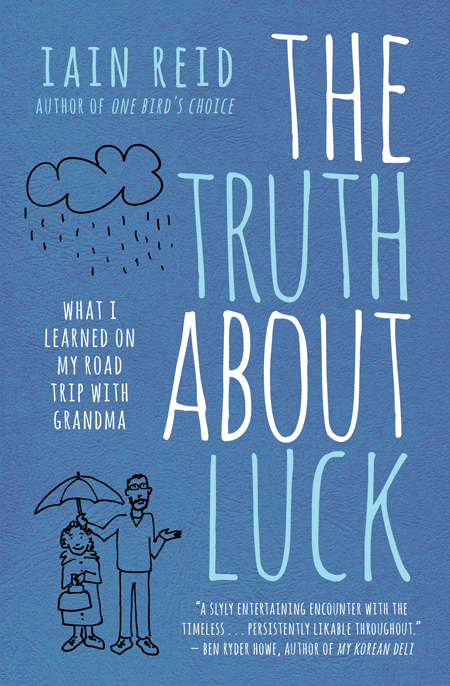
978-1-77089-241-5_lIain Reid has a gift for getting right into his readers’ hearts. In One Bird’s Choice, he made us fall in love with his quirky, hilarious parents, as well as with a certain bird named Lucius. These characters make an appearance The Truth About Luck as well, but Reid’s second memoir shifts the author’s focus to his adorable, utterly loveable 92-year-old grandmother.

The premise of the book is practically guaranteed to make anyone with a grandmother go “Awww…” When Reid’s brother reneges for the first time on a joint birthday gift for Grandma, Reid decides to take his grandmother on a week-long road trip, gifting her with something far sweeter than a quirky portrait: his time. Unfortunately, for reasons that are unclear to me (finances? lack of planning?), the much-anticipated road trip turns instead into a staycation in Kingston. I do wish I understood better why Reid opted for a staycation instead, especially since the original plan had allowed for the possibility of the grandmother paying for the trip. As it is, I felt bad for Grandma, who’d looked forward to a road trip for months, and had possibly even brought her swimsuit. Worse, Reid admits he had no idea how to entertain his grandmother for a week — a cringe-worthy admission, though admittedly, we’ve all been there.

Reid is endearingly self-aware, unflinching in his portrayal of himself and unafraid to make fun of his own quirks. At times, he tries a bit too hard at self-deprecation — people likely aren’t paying as much attention to his treatment of Grandma as he imagines — but this as well is rather sweet, a heightened concern for his grandmother’s well-being. A wonderfully wry passage near the beginning of the book sums up Reid’s self-deprecating humour pretty well:

I called a friend to see if he had any ideas for me, tips on how to inject some carefree mirth into the trip. He reminded me that I wasn’t really the fun or adventurous one in our group. […] When pushed for which one in the group I was, he used the word egghead and asked what the opposite of an adrenaline junkie was. I wonder if I can offer Grandma a sherry first thing tomorrow morning? [p. 60]

Fortunately for Reid, his grandmother is such a sweet, gracious woman that she genuinely seems as excited over a week in Kingston as she originally was over a road trip. Grandma is the heart of this book, and Reid’s prose is a lovely, loving tribute. The staycation offers him the chance to listen to his grandmother’s stories about her past, a rare opportunity with a woman more accustomed to asking about her grandchildren’s lives than speaking about herself. In a coffee shop, as his grandmother speaks about her life during World War II, Reid notices the other customers busy with their books, laptops and mobile phones, and feels the urge to command them all to listen. Grandma’s life is far too interesting to ignore.

My own 89-year-old grandmother, who has always been a feisty, chatty woman, has recently begun exhibiting signs of dementia. She has difficulty remembering events and recognizing people, and is most comfortable speaking in Chinese, her first language and, unfortunately, one I don’t speak myself. Reid’s book makes me think of all the stories I may now never have the chance to hear, and makes me wish I’d paid closer attention all those times my own grandmother spoke about her past. I remember our trip to China, and my grandmother’s attempts to teach me Chinese, and wish I could remember more of what she taught.

This book then, perhaps more than any road trip, may just be the best, most precious gift Reid could have given his grandmother. Not only will he forever be able to remind himself of her stories, but he has also immortalized her past for people who have never even met her. Time and again, his grandmother frets that she is boring him with her stories. Time and again, Reid assures her that he is fascinated. And thanks to Reid’s masterful prose, so are we.

+

Thank you to House of Anansi for a copy of this book in exchange for an honest review.

Review | Carnival, Rawi Hage

I was conceived on the circus trail by a traveller who owned a camel and a mother who swung from the ropes. When my mother, the trapeze artist with the golden hair, tossed me out of her self to the applause of elephants and seals, there was rain outside and the caravans were about to leave. She nursed me through the passages of roads and the follies of clowns and the bitter songs of an old dwarf who prophesied for me a life of wandering among spiders and beasts.

978-0-88784-235-1_lSo begins Rawi Hage’s Carnival. Its narrator is indeed destined to wander among spiders and beasts; however, unlike his mother, Fly’s circus is an urban landscape, where spiders are taxi drivers who sit in their cars waiting for a dispatcher to call and an odd assortment of passengers are daily fare. There are two types of taxi drivers in the Carnival city, and unlike spiders, flies roam the streets, looking for people to flag them down.

The story is carnivalesque — a Baz Luhrmann cacophony of sights, sounds and colourful characters. There’s a lot going on, and not a whole lot holding them together, but it’s a fun ride anyway. Through Fly’s eyes, we see the outsiders of society — a prostitute whose customers refused to pay, a disenfranchised carnival booth worker who ends up arrested, various other taxi drivers dealing with poverty, crime and anger in the face of a taxi inspector’s abuse of power.

I can only imagine the stories real-life taxi drivers can tell about their passengers, and in Hage’s novel, the strangeness and the drama are exaggerated to almost surreal proportions. A lover’s quarrel over money, with the younger man demanding to be let off and the older one demanding that Fly keep driving, ends in a surprisingly sweet moment of tenderness. Hage seems more interested in a British passenger who invites Fly to join him in an underground BDSM club. Other passengers also offer glimpses into secret lives, sex and drama and all. The atmosphere is seedy and sordid, yet, perhaps because of the carnivalesque tone, nothing ever truly shocks.

The final third or so of the novel was a bit of a letdown. It felt like Hage was trying to bring cohesion with a more traditional narrative, involving a series of crimes. Yet in doing so, the story loses the adventure afforded by the earlier sections’ heightened form of reality.

Carnival is over-the-top, in-your-face, and yet very real. I’m not quite sure I quite grasp what the story is about, yet I’m definitely glad I went along for the ride.

Review | People Park, Pasha Malla

9780887842160To celebrate the Silver Jubilee of People Park, the residents hire the illustrationist (as opposed to illusionist) Raven to perform. Unfortunately, Raven’s illustrations turn out to be all too real, and the consequences are much more permanent than the residents predicted.

Pasha Malla’s People Park is a very difficult book to get into, and in fact, I almost gave up halfway through. Malla’s book is ambitious, with a dozen or so narrative threads that never really come together. The various character stories do share the common event of Raven’s illustration — the build up, the actual event, and the fall out — but apart from setting, they seem disjointed. There is a two column character list at the beginning of the book, almost enough characters to populate War and Peace, except none of Malla’s characters are distinct enough to make me care.

To be fair, the story doesn’t seem to be about individual characters, but rather people in so far as they comprise People Park. We see a jumble of characters, arrogantly complacent and eager for Raven’s performance, then turn to panic when the rug is pulled from under them. There is social commentary here, particularly in a scene where Raven quite literally cuts the Mayor down to size and the residents applaud dumbly. The inefficacy of People Park’s political system and law enforcement agency is masterfully portrayed with biting humour. Malla is at his strongest in the political scenes, where we see how much more horrible things are going to get, with the residents absolutely unaware. While Malla resists allegory, there are certainly parallels to the real world, and Malla’s portrayal is harsh, but the harshness feels necessary.

Unfortunately, it’s all just too chaotic. There are too many things being juggled and rather than keep his readers grounded with a single focal point, Malla appears to fling these elements about wildly for his readers to rush around to pick up. The lack of quotation marks definitely didn’t help, particularly when the characters all sound alike. This may be deliberate, a reflection of the chaos already in People Park, whether or not the residents are aware of it. I just found it frustrating. Even when I was able to identify characters, I realized I didn’t really care what happened to them, because they all seemed little more than cogs being moved every which way by Raven’s illustrations. Again, this may be deliberate, but again, it just left me frustrated.

I did almost give it up halfway through, but I’m glad I stuck it out because the second half is better. Or perhaps I was just happy that the residents of People Park finally realize Raven is sinister rather than mere entertainment. To be fair, this may also be a case of myself just not being the right reader for this book. Matthew J. Trafford, for example, in the National Post, found it impressive. Definitely not for me, though.

+

Thank you to House of Anansi for an advance reading copy of this book in exchange for an honest review.